
不同通风管道距离下盲巷内紊流气流结构的研究
Insights into turbulent airflow structures in blind headings under different ventilation duct distances.
作者信息
Semin Mikhail, Faynburg Grigoriy, Tatsiy Aleksei, Levin Lev, Nakariakov Evgeniy
机构信息
Mining Institute of the Ural Branch of the Russian Academy of Sciences, Perm, Russia.
Perm National Research Polytechnic University, Perm, Russia.
出版信息
Sci Rep. 2024 Oct 10;14(1):23768. doi: 10.1038/s41598-024-74671-3.
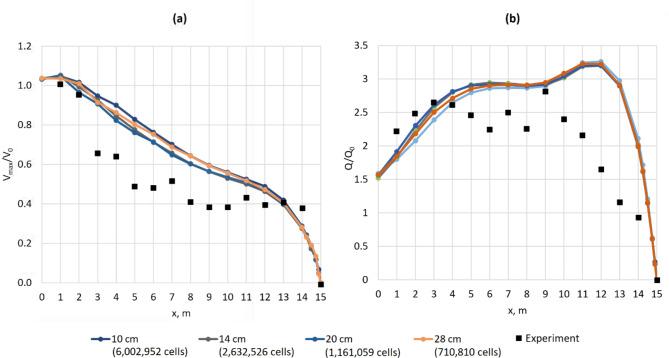
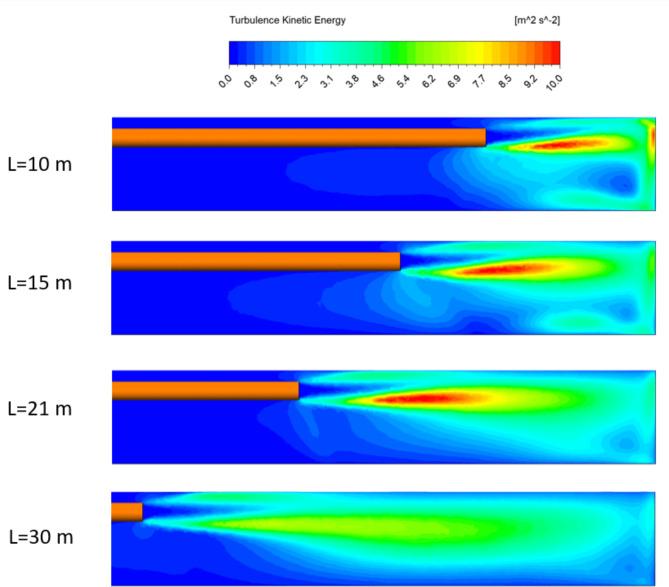
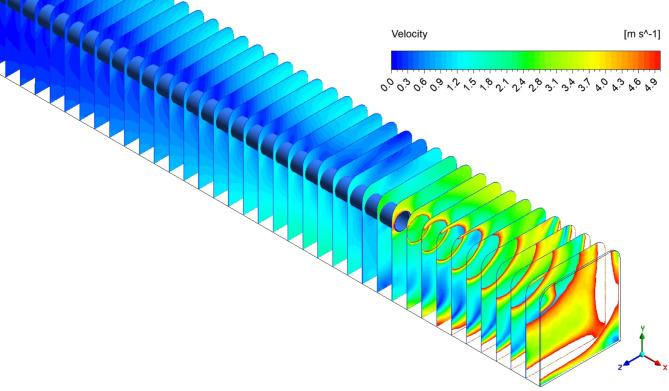
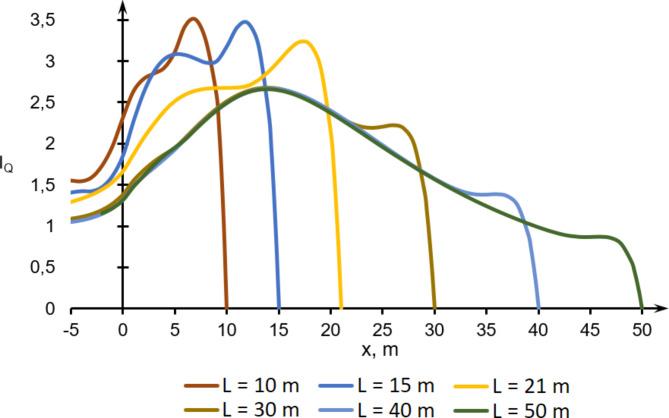
The paper explores the 3D stationary vortex structure of turbulent airflow near the dead-end face of a blind heading, ventilated via a forcing ventilation system. Despite its significance in blind heading ventilation, previous studies primarily focused on temporal dynamics of harmful impurities, overlooking flow structure details crucial for mass transfer processes. Our study delves into the ventilation flow structure across diverse parameters of the auxiliary ventilation system. Alongside standard flow visualization tools, we introduce three dimensionless indicators to comprehensively characterize flow structure, facilitating analysis of its variations with parameter changes and quantitative evaluation of system efficiency. Analysis revealed the formation of a single large-scale vortex within the entire range of considered ventilation system parameters in the heading. This vortex induces a significant increase in air circulation, approximately 2.5-3.5 times greater than airflow emerging from the ventilation duct's end, thus intensifying mass transfer processes within the heading. We found that ventilation efficiency of the dead-end face zone in a blind heading with a 29.2 m² cross-section decreases linearly with increasing distance between the ventilation duct's end and the dead-end face. However, compensating for this distance by increasing duct velocity is feasible, bearing significant implications for mine ventilation safety, particularly in ventilating blind headings with distant ducts from the dead-end face.
本文探讨了通过压入式通风系统通风的盲巷尽头附近紊流气流的三维定常涡结构。尽管其在盲巷通风中具有重要意义,但以往的研究主要集中在有害杂质的时间动态上,而忽略了对传质过程至关重要的流动结构细节。我们的研究深入探讨了辅助通风系统不同参数下的通风流动结构。除了标准的流动可视化工具外,我们还引入了三个无量纲指标来全面表征流动结构,便于分析其随参数变化的情况以及对系统效率进行定量评估。分析表明,在所考虑的巷道通风系统参数范围内,形成了一个单一的大尺度涡。这个涡使空气循环显著增加,比从通风管道末端流出的气流大约大2.5 - 3.5倍,从而加强了巷道内的传质过程。我们发现,对于横截面为29.2平方米的盲巷,其尽头区域的通风效率随着通风管道末端与尽头之间距离的增加而线性降低。然而,通过提高管道风速来补偿这个距离是可行的,这对矿井通风安全具有重要意义,特别是在为通风管道末端与尽头距离较远的盲巷通风时。





 Zotero 插件