Sanabria-Diaz Gretel, Cagol Alessandro, Lu Po-Jui, Barakovic Muhamed, Ocampo-Pineda Mario, Chen Xinjie, Weigel Matthias, Ruberte Esther, Siebenborn Nina de Oliveira S, Galbusera Riccardo, Schädelin Sabine, Benkert Pascal, Kuhle Jens, Kappos Ludwig, Melie-Garcia Lester, Granziera Cristina
Neurology Clinic and Policlinic, Department of Medicine, Clinical Research and Biomedical Engineering, University Hospital Basel and University of Basel, Basel, Switzerland.
Translational Imaging in Neurology (ThINk) Basel, Department of Biomedical Engineering, University Hospital Basel and University of Basel, Basel, Switzerland.
Ann Neurol. 2024 Oct 10;97(1):134-48. doi: 10.1002/ana.27102.
Pathological studies suggest that multiple sclerosis (MS) lesions endure multiple waves of damage and repair; however, the dynamics and characteristics of these processes are poorly understood in patients living with MS.
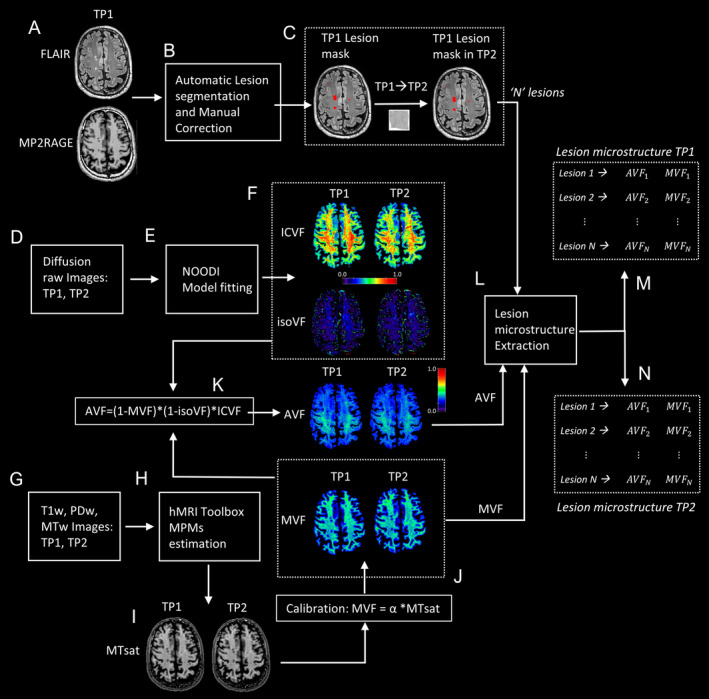
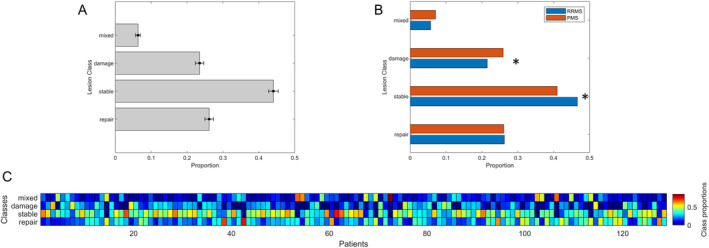
We studied 128 MS patients (75 relapsing-remitting, 53 progressive) and 72 healthy controls who underwent advanced magnetic resonance imaging and clinical examination at baseline and 2 years later. Magnetization transfer saturation and multi-shell diffusion imaging were used to quantify longitudinal changes in myelin and axon volumes within MS lesions. Lesions were grouped into 4 classes (repair, damage, mixed repair damage, and stable). The frequency of each class was correlated to clinical measures, demographic characteristics, and levels of serum neurofilament light chain (sNfL).
Stable lesions were the most frequent (n = 2,276; 44%), followed by lesions with patterns of "repair" (n = 1,352; 26.2%) and damage (n = 1,214; 23.5%). The frequency of "repair" lesion was negatively associated with disability (β = -0.04; p < 0.001) and sNfL (β = -0.16; p < 0.001) at follow-up. The frequency of the "damage" class was higher in progressive than relapsing-remitting patients (p < 0.05) and was related to disability (baseline: β = -0.078; follow-up: β = -0.076; p < 0.001) and age (baseline: β = -0.078; p < 0.001). Stable lesions were more frequent in relapsing-remitting than in progressive patients (p < 0.05), and in younger patients versus older (β = -0.07; p < 0.001) at baseline. Further, "mixed" lesions were most frequent in older patients (β = 0.004; p < 0.001) at baseline.
These findings show that repair and damage processes within MS lesions occur across the entire disease spectrum and that their frequency correlates with patients disability, age, disease duration, and extent of neuroaxonal damage. ANN NEUROL 2024.
病理研究表明,多发性硬化症(MS)病变经历多轮损伤和修复;然而,在MS患者中,这些过程的动态变化和特征仍知之甚少。
我们研究了128例MS患者(75例复发缓解型,53例进展型)和72名健康对照者,他们在基线期和2年后接受了高级磁共振成像和临床检查。利用磁化传递饱和成像和多壳层扩散成像来量化MS病变内髓鞘和轴突体积的纵向变化。病变被分为4类(修复、损伤、混合修复损伤和稳定)。每类病变的频率与临床指标、人口统计学特征以及血清神经丝轻链(sNfL)水平相关。
稳定病变最为常见(n = 2276;44%),其次是具有“修复”模式的病变(n = 1352;26.2%)和损伤病变(n = 1214;23.5%)。随访时,“修复”病变频率与残疾程度(β = -0.04;p < 0.001)和sNfL(β = -0.16;p < 0.001)呈负相关。进展型患者中“损伤”类病变的频率高于复发缓解型患者(p < 0.05),且与残疾程度(基线:β = -0.078;随访:β = -0.076;p < 0.001)和年龄(基线:β = -0.078;p < 0.001)相关。复发缓解型患者中稳定病变比进展型患者更常见(p < 0.05);基线时,年轻患者比老年患者更常见(β = -0.07;p < 0.001);此外基线时,“混合”病变在老年患者中最常见(β = 0.004;p < 0.001)。
这些发现表明,MS病变内修复和损伤过程在整个疾病谱中均会发生,且其频率与患者的残疾程度、年龄、病程以及神经轴突损伤程度相关。《神经病学纪事》2024年。