Demissie Solomon, Mekonen Seblework, Awoke Tadesse, Mengistie Bezatu
Department of Water and Public Health, Ethiopian Institute of Water Resources, Addis Ababa University, Addis Ababa, Ethiopia.
Department of Epidemiology and Biostatistics, College of Medicine and Health Sciences, University of Gondar, Gondar, Ethiopia.
Environ Health Insights. 2024 Oct 9;18:11786302241285391. doi: 10.1177/11786302241285391. eCollection 2024.
Arsenic is a well-known, highly poisonous metalloid that affects human health and ecosystems and is widely distributed in the environment. Nevertheless, data on the spatiotemporal distribution of arsenic in groundwater sources in Ethiopia are scarce.
The principal aim of this study was to assess the extent of arsenic in groundwater sources and analyze the spatiotemporal variations in the central rift valley of Ethiopia.
The study employed a serial cross-sectional study design and census sampling methods. The concentrations of arsenic in the groundwater samples were determined using inductively coupled plasma mass spectrometry (ICP-MS) at the Ethiopian Food and Drug Authority laboratory. Descriptive statistical analyses were performed using IBM SPSS version 29 software. Additionally, ArcGIS software was utilized to map the spatiotemporal distribution of arsenic. Furthermore, Minitab statistical software version 21.4 was employed to assess the correlation between spatiotemporal variations of arsenic concentrations in groundwater sources.
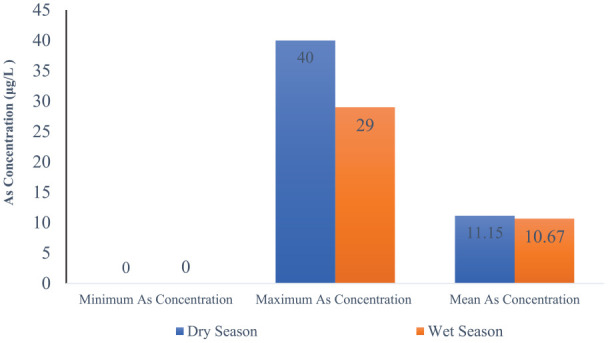
The mean values of arsenic in the groundwater samples were 11.2 µg/L during the dry season and 10.7 µg/L during the rainy season. The study results showed that 18 wells (42.2%) and 22 wells (48.8%) had higher arsenic concentrations (>10 µg/L) during the dry and rainy seasons, respectively. Thus, arsenic levels in 42.2% and 48.8% of the samples exceeded the maximum threshold limit set by WHO, USEPA, and Ethiopian standards (10 µg/L), respectively, during the dry and rainy seasons. Furthermore, our analysis revealed a significant positive correlation between arsenic in groundwater and well depth ( = .75, < .001), indicating a strong association between higher arsenic concentrations and deeper wells. Similarly, we observed a substantial positive correlation between arsenic concentration in groundwater and season ( = .9, < .001), suggesting notable variations in arsenic levels between dry and rainy seasons.
The majority of the groundwater sources in the studied area are unfit for human consumption because they contain high amounts of arsenic, which poses a significant risk to human health. Moreover, the arsenic concentration varied spatially and temporally. Therefore, special attention is needed to reduce arsenic exposure and associated health risks.
砷是一种广为人知的剧毒类金属,会影响人类健康和生态系统,且在环境中广泛分布。然而,埃塞俄比亚地下水源中砷的时空分布数据却很匮乏。
本研究的主要目的是评估地下水源中砷的含量,并分析埃塞俄比亚中央裂谷地区的时空变化情况。
本研究采用了系列横断面研究设计和普查抽样方法。在埃塞俄比亚食品药品管理局实验室,使用电感耦合等离子体质谱法(ICP-MS)测定地下水样品中的砷浓度。使用IBM SPSS 29版软件进行描述性统计分析。此外,利用ArcGIS软件绘制砷的时空分布图。此外,使用Minitab统计软件21.4版评估地下水源中砷浓度时空变化之间的相关性。
地下水样品中砷的平均值在旱季为11.2微克/升,雨季为10.7微克/升。研究结果表明,分别有18口井(42.2%)和22口井(48.8%)在旱季和雨季的砷浓度较高(>10微克/升)。因此,在旱季和雨季,分别有42.2%和48.8%的样品中的砷含量超过了世界卫生组织、美国环境保护局和埃塞俄比亚标准设定的最大阈值限制(10微克/升)。此外,我们的分析显示,地下水中的砷与井深之间存在显著正相关(r = 0.75,p < 0.001),这表明较高的砷浓度与更深的井之间存在很强的关联。同样,我们观察到地下水中砷浓度与季节之间存在显著正相关(r = 0.9,p < 0.