Department of Physics, University of California, San Diego, La Jolla, CA 92093.
Department of Chemistry and Biochemistry, Calvin University, Grand Rapids, MI 49546.
Proc Natl Acad Sci U S A. 2024 Oct 15;121(42):e2409755121. doi: 10.1073/pnas.2409755121. Epub 2024 Oct 11.
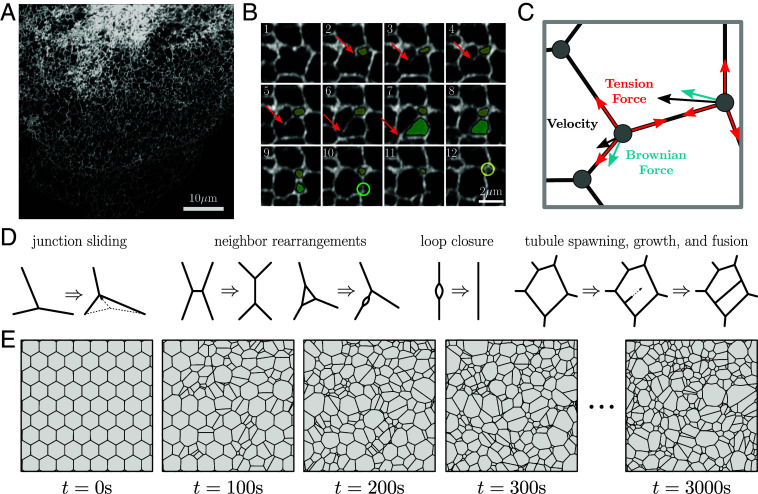
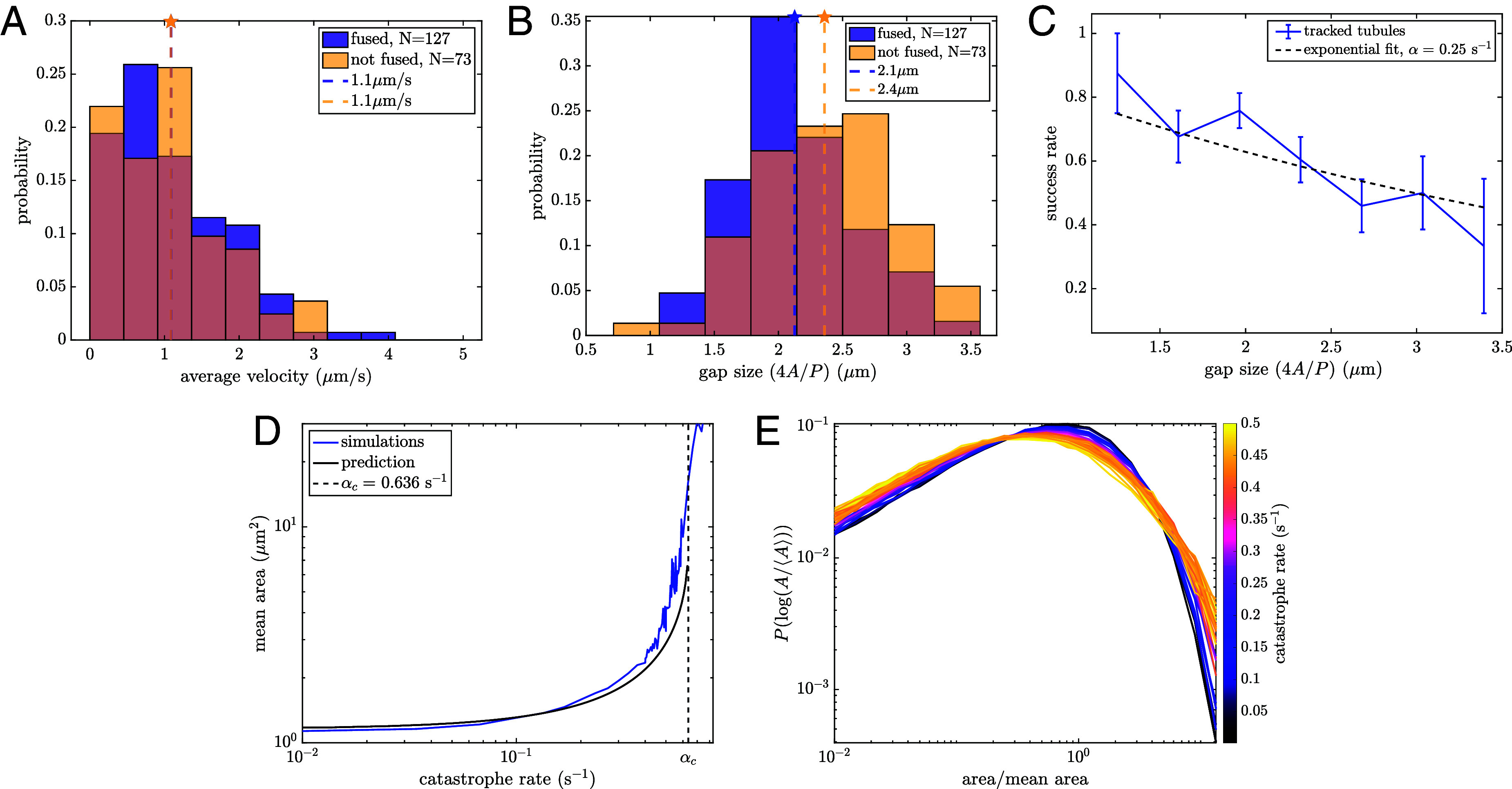
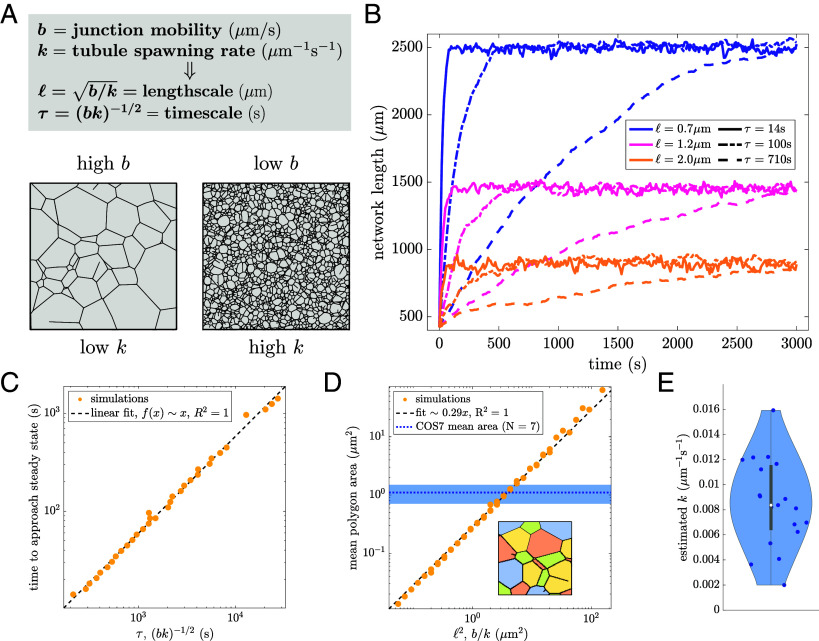
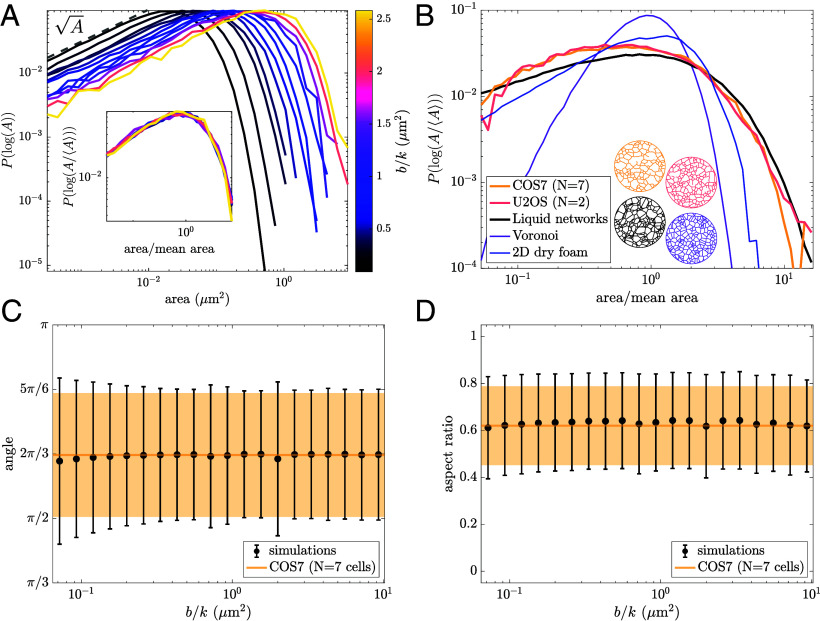
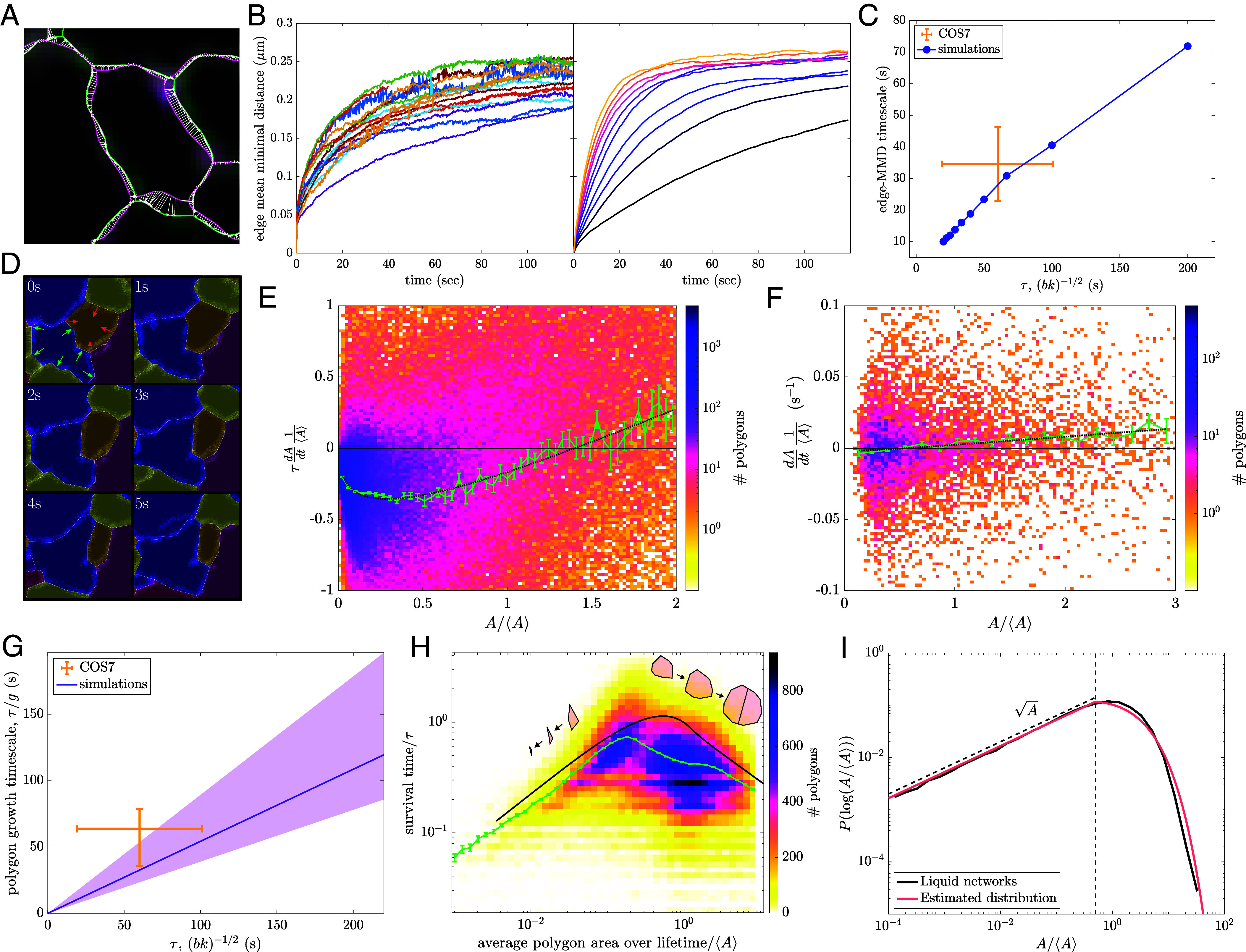
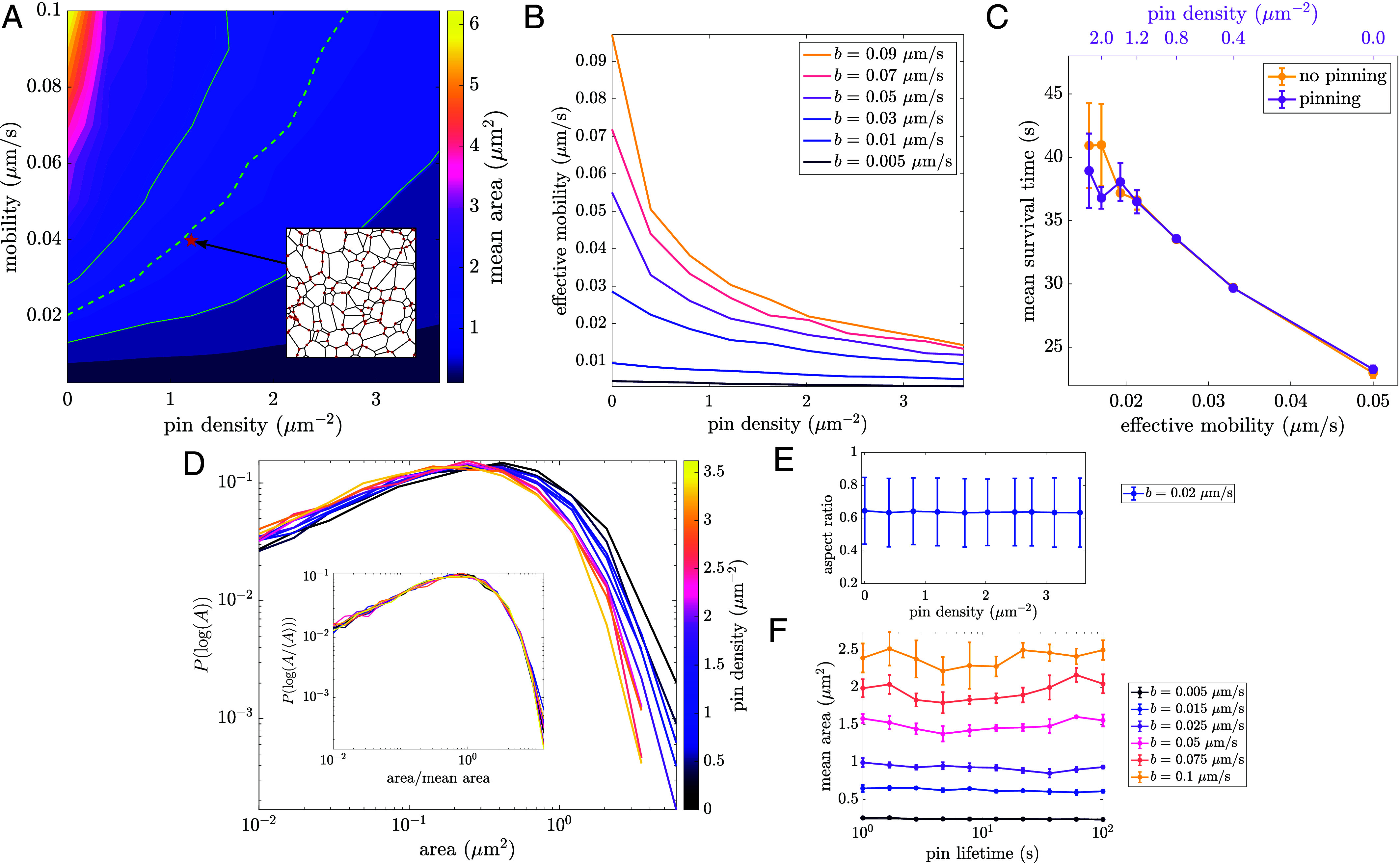
The peripheral endoplasmic reticulum (ER) forms a dense, interconnected, and constantly evolving network of membrane-bound tubules in eukaryotic cells. While individual structural elements and the morphogens that stabilize them have been described, a quantitative understanding of the dynamic large-scale network topology remains elusive. We develop a physical model of the ER as an active liquid network, governed by a balance of tension-driven shrinking and new tubule growth. This minimalist model gives rise to steady-state network structures with density and rearrangement timescales predicted from the junction mobility and tubule spawning rate. Several parameter-independent geometric features of the liquid network model are shown to be representative of ER architecture in live mammalian cells. The liquid network model connects the timescales of distinct dynamic features such as ring closure and new tubule growth in the ER. Furthermore, it demonstrates how the steady-state network morphology on a cellular scale arises from the balance of microscopic dynamic rearrangements.
真核细胞中的外周内质网 (ER) 形成了一个密集、相互连接且不断进化的膜结合小管网络。虽然已经描述了单个结构元素及其稳定的形态发生因子,但对动态大规模网络拓扑结构的定量理解仍然难以捉摸。我们将 ER 开发为一个主动的液体网络物理模型,由张力驱动的收缩和新小管生长的平衡来控制。这个最小模型产生了具有密度和重排时间尺度的稳态网络结构,这些时间尺度可以从连接点的流动性和小管产生率预测。显示液体网络模型的几个与参数无关的几何特征代表了活哺乳动物细胞中 ER 结构。液体网络模型连接了 ER 中的环闭合和新小管生长等不同动态特征的时间尺度。此外,它还展示了如何在细胞尺度上从微观动态重排的平衡中产生稳态网络形态。