Department of Gynecology, The First Affiliated Hospital of Xingtai Medical College, Xingtai, 054000, China.
Department of Endocrinology, Laizhou People's Hospital, Laizhou, 261400, China.
BMC Cancer. 2024 Oct 11;24(1):1267. doi: 10.1186/s12885-024-12989-x.
Immune checkpoint inhibitor (ICI) therapy activates the immune system to recognize and eliminate cancer cells that have escaped surveillance. This study aimed to compare the treatment outcome of advanced and recurrent cervical cancer patients treated with first-line platinum and paclitaxel with or without ICI.
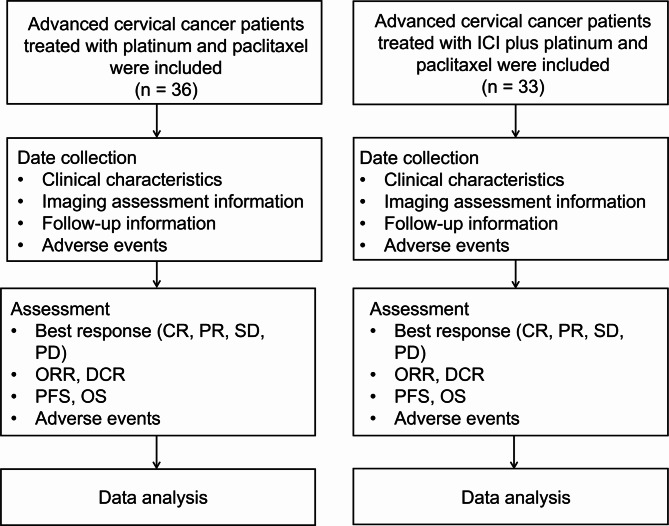
Data from 69 advanced and recurrent cervical cancer patients treated with first-line ICI plus platinum and paclitaxel (N = 33) or first-line platinum and paclitaxel (N = 36) were reviewed between March 2020 and January 2023 in this retrospective study. Patients chose treatment based on the actual disease condition, patient willingness, and medical advice. Additionally, objective response rate (ORR), disease control rate (DCR), progression-free survival (PFS), and overall survival (OS) were calculated, and adverse events were gained.
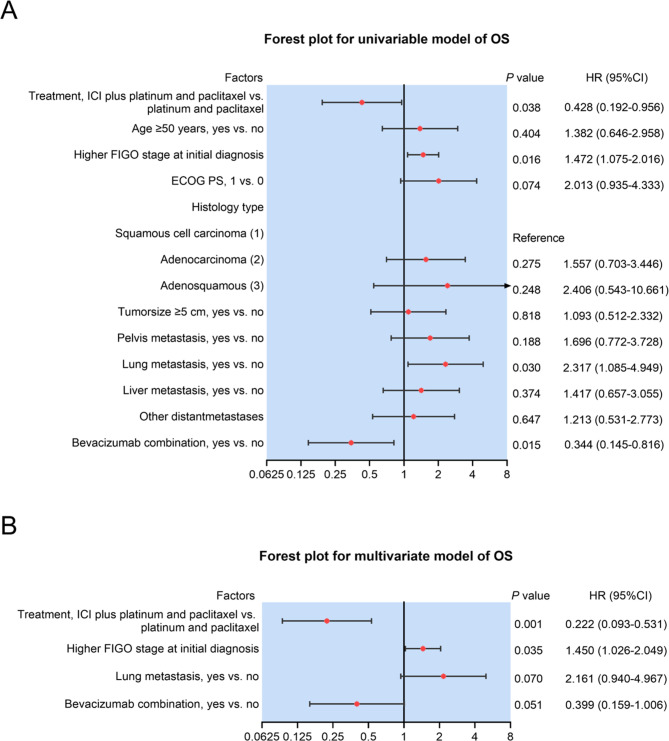
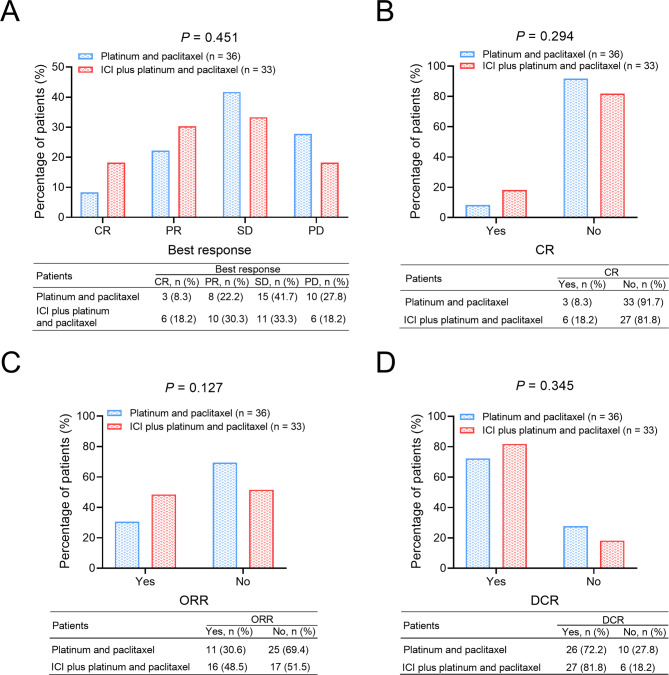
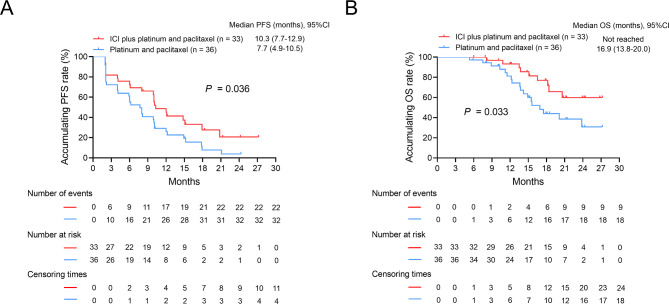
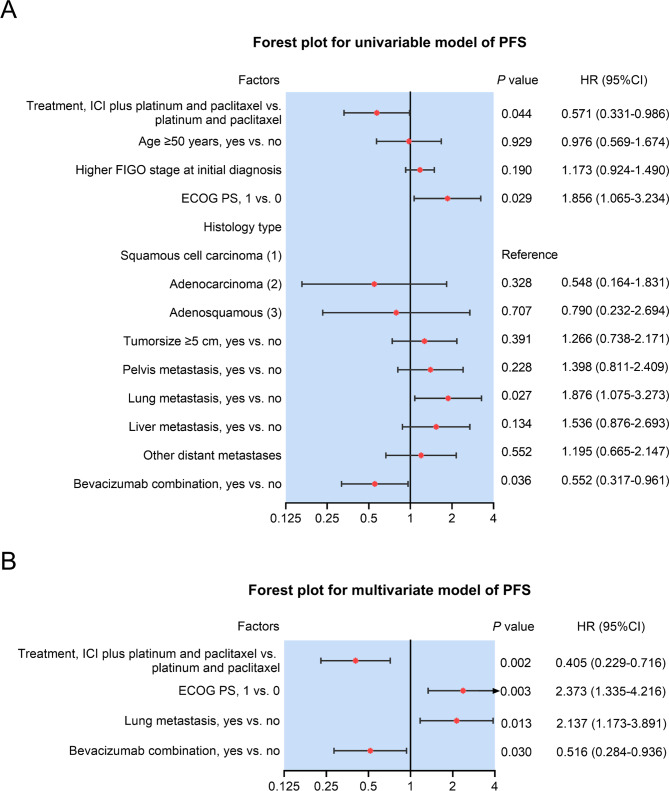
There was no difference in baseline data between patients receiving the two different treatments (all P > 0.05). Complete response rate (18.2% vs. 8.3%; P = 0.294), ORR (48.5% vs. 30.6%; P = 0.127), and DCR (81.8% vs. 72.2%; P = 0.345) tended to ascend in patients treated with ICI plus platinum and paclitaxel compared to those treated with platinum and paclitaxel, although there was no statistical significance. In patients treated with ICI plus platinum and paclitaxel, the median PFS was 10.3 months and the median OS was not reached. Meanwhile, the median PFS and OS were 7.7 and 16.9 months in patients treated with platinum and paclitaxel. PFS (P = 0.036) and OS (P = 0.033) were increased in patients treated with ICI plus platinum and paclitaxel versus those treated with platinum and paclitaxel, which was verified by multivariate Cox regression analyses (both P < 0.05). No difference was observed in the occurrence of adverse events between patients receiving the two different treatments (all P > 0.05).
First-line ICI plus platinum and paclitaxel yields better treatment responses, longer survival, and non-differential adverse events versus first-line platinum and paclitaxel in advanced and recurrent cervical cancer patients.
免疫检查点抑制剂(ICI)治疗激活免疫系统,以识别和消除逃脱监测的癌细胞。本研究旨在比较一线铂类和紫杉醇联合或不联合 ICI 治疗晚期和复发性宫颈癌患者的治疗结果。
本回顾性研究纳入了 2020 年 3 月至 2023 年 1 月期间接受一线 ICI 联合铂类和紫杉醇(n=33)或一线铂类和紫杉醇(n=36)治疗的 69 例晚期和复发性宫颈癌患者的数据。患者根据实际病情、患者意愿和医疗建议选择治疗方案。此外,计算了客观缓解率(ORR)、疾病控制率(DCR)、无进展生存期(PFS)和总生存期(OS),并获得了不良反应。
两组患者的基线数据无差异(均 P>0.05)。接受 ICI 联合铂类和紫杉醇治疗的患者完全缓解率(18.2% vs. 8.3%;P=0.294)、ORR(48.5% vs. 30.6%;P=0.127)和 DCR(81.8% vs. 72.2%;P=0.345)倾向于升高,但无统计学意义。接受 ICI 联合铂类和紫杉醇治疗的患者中位 PFS 为 10.3 个月,中位 OS 未达到。而接受铂类和紫杉醇治疗的患者中位 PFS 和 OS 分别为 7.7 个月和 16.9 个月。PFS(P=0.036)和 OS(P=0.033)在接受 ICI 联合铂类和紫杉醇治疗的患者中均有所改善,这在多因素 Cox 回归分析中得到验证(均 P<0.05)。接受两种不同治疗的患者不良反应的发生无差异(均 P>0.05)。
一线 ICI 联合铂类和紫杉醇治疗晚期和复发性宫颈癌患者的治疗反应、生存时间优于一线铂类和紫杉醇,且不良反应无差异。