Kim Jae Won, Kim Jun Hyeok, Lee Yoon Jae
Department of Plastic and Reconstructive Surgery, Yeouido St. Mary's Hospital, College of Medicine, The Catholic University of Korea, Seoul 07345, Republic of Korea.
Biomedicines. 2024 Jan 3;12(1):97. doi: 10.3390/biomedicines12010097.
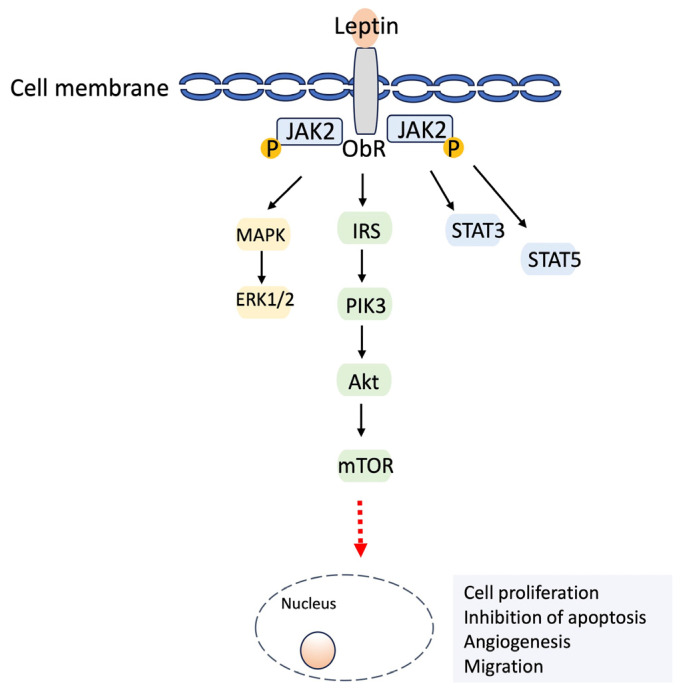
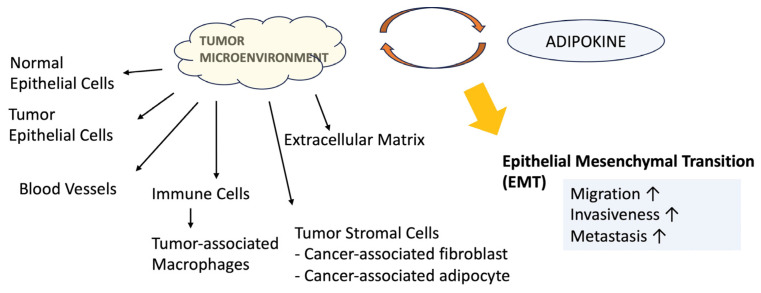
Obesity is a well-established risk factor for various malignancies and emerging evidence suggests that adipokines play a pivotal role in linking excess adiposity to tumorigenesis. Adipokines are bioactive molecules secreted by adipose tissue and their altered expression in obesity contributes to a pro-inflammatory, pro-angiogenic, and growth-promoting microenvironment conducive to tumorigenesis. Leptin, a key adipokine, activates survival and proliferative signaling pathways whereas adiponectin exhibits tumor-suppressive effects by inducing apoptosis and cell cycle arrest. Visfatin has also been documented to promote tumor growth, angiogenesis, migration, and invasion. Moreover, emerging studies suggest that adipokines, such as resistin, apelin, and chemerin, which are overexpressed in obesity, may also possess oncogenic functions. Despite advancements in our understanding of the roles of individual adipokines in cancer, the intricate interplay and crosstalk between adipokines, tumor cells, and the tumor microenvironment remain complex and multifaceted. This review highlights the evolving knowledge of how adipokines contribute to obesity-related tumorigenesis, shedding light on the potential of targeting adipokine signaling pathways as a novel therapeutic approach for obesity-associated cancers. Further research on the specific mechanisms and interactions between adipokines and tumor cells is crucial for a comprehensive understanding of obesity-associated cancer pathogenesis.
肥胖是多种恶性肿瘤公认的危险因素,新出现的证据表明,脂肪因子在将肥胖与肿瘤发生联系起来方面起着关键作用。脂肪因子是由脂肪组织分泌的生物活性分子,它们在肥胖状态下的表达改变有助于形成有利于肿瘤发生的促炎、促血管生成和促进生长的微环境。瘦素是一种关键的脂肪因子,可激活生存和增殖信号通路,而脂联素则通过诱导细胞凋亡和细胞周期停滞发挥肿瘤抑制作用。内脂素也被证明可促进肿瘤生长、血管生成、迁移和侵袭。此外,新出现的研究表明,肥胖时过度表达的抵抗素、Apelin和chemerin等脂肪因子也可能具有致癌功能。尽管我们对单个脂肪因子在癌症中的作用有了进展,但脂肪因子、肿瘤细胞和肿瘤微环境之间复杂的相互作用和串扰仍然复杂且多面。本综述强调了关于脂肪因子如何促进肥胖相关肿瘤发生的不断发展的知识,揭示了靶向脂肪因子信号通路作为肥胖相关癌症新治疗方法的潜力。进一步研究脂肪因子与肿瘤细胞之间的具体机制和相互作用对于全面理解肥胖相关癌症的发病机制至关重要。