Neuroendocrine Tumour Unit, King's College Hospital ENETS Centre of Excellence, London SE5 9RS, United Kingdom.
Department of Medical Oncology, Netherlands Cancer Institute ENETS Centre of Excellence, Amsterdam 1066 CX, Netherlands.
World J Gastroenterol. 2019 Mar 14;25(10):1171-1184. doi: 10.3748/wjg.v25.i10.1171.
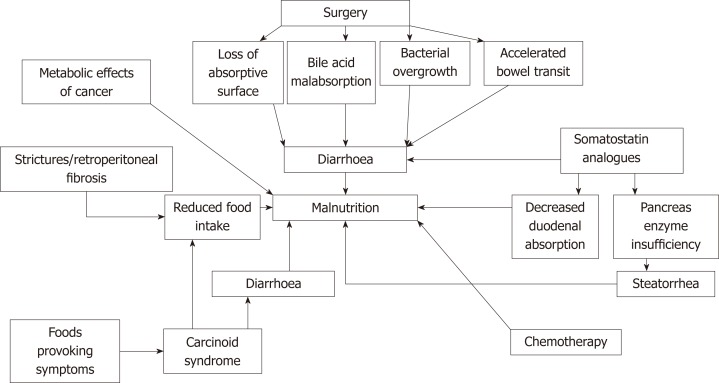
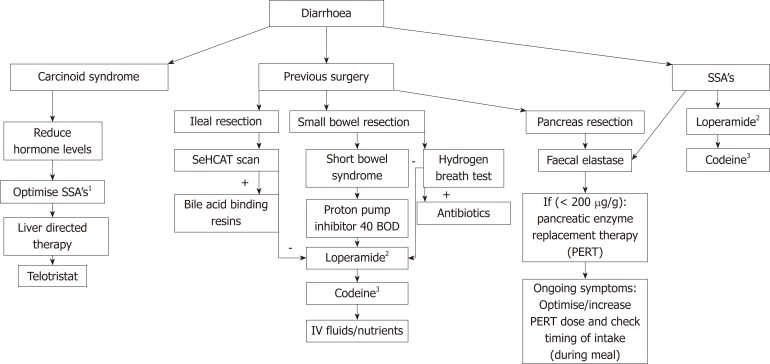
Symptoms of gastroenteropancreatic located neuroendocrine neoplasms (GEP-NENs) are often related to food intake and manifest as abdominal pain or diarrhoea which can influence patients nutritional status. Malnutrition is common in cancer patients and influences quality of life, treatment options and survival but is also present in up to 40% of patients with GEP-NENs. As part of malnutrition there are often deficiencies in fat-soluble vitamins, mainly vitamin D. Little knowledge exists on trace elements. Several factors influence the development of malnutrition such as size and localisation of the primary tumour as well as metastases, side effects from treatment but also hormone production of the tumour itself. One of the main influencing factors leading to malnutrition is diarrhoea which leads to dehydration and electrolyte disturbances. Treatment of diarrhoea should be guided by its cause. Screening for malnutrition should be part of routine care in every GEP-NEN patient. Multidisciplinary treatment including dietician support is necessary for all malnourished patients with GEP-NENs.
胃肠胰神经内分泌肿瘤(GEP-NENs)的症状常与进食有关,表现为腹痛或腹泻,这可能会影响患者的营养状况。营养不良在癌症患者中很常见,会影响生活质量、治疗选择和生存,但在多达 40%的 GEP-NEN 患者中也存在营养不良。作为营养不良的一部分,通常会出现脂溶性维生素缺乏,主要是维生素 D。关于微量元素的知识很少。有几个因素会影响营养不良的发展,例如原发肿瘤的大小和位置以及转移、治疗的副作用以及肿瘤自身的激素产生。导致营养不良的主要影响因素之一是腹泻,它会导致脱水和电解质紊乱。腹泻的治疗应根据其病因进行。对所有 GEP-NEN 患者,应将营养不良筛查纳入常规护理。对于所有患有 GEP-NEN 的营养不良患者,都需要包括营养师支持在内的多学科治疗。