Patrick G Johnston Centre for Cancer Research, Queen's University Belfast, Belfast.
Precision Medicine Centre of Excellence, The Patrick G. Johnston Centre for Cancer Research, Queen's University Belfast, Belfast.
ESMO Open. 2024 Nov;9(11):103930. doi: 10.1016/j.esmoop.2024.103930. Epub 2024 Oct 11.
The Dual Erb B Inhibition in Oesophago-gastric Cancer (DEBIOC) trial reported an acceptable safety profile for neoadjuvant oxaliplatin and capecitabine (Xelox) ± AZD8931 in oesophageal adenocarcinoma (OAC) but limited efficacy. We evaluated the impact of neoadjuvant Xelox ± AZD8931, a novel small-molecule inhibitor with equipotent activity against epidermal growth factor receptor (EGFR), human epidermal growth factor receptor (HER)2 and HER3, on biological pathways using a unique software-driven solution.
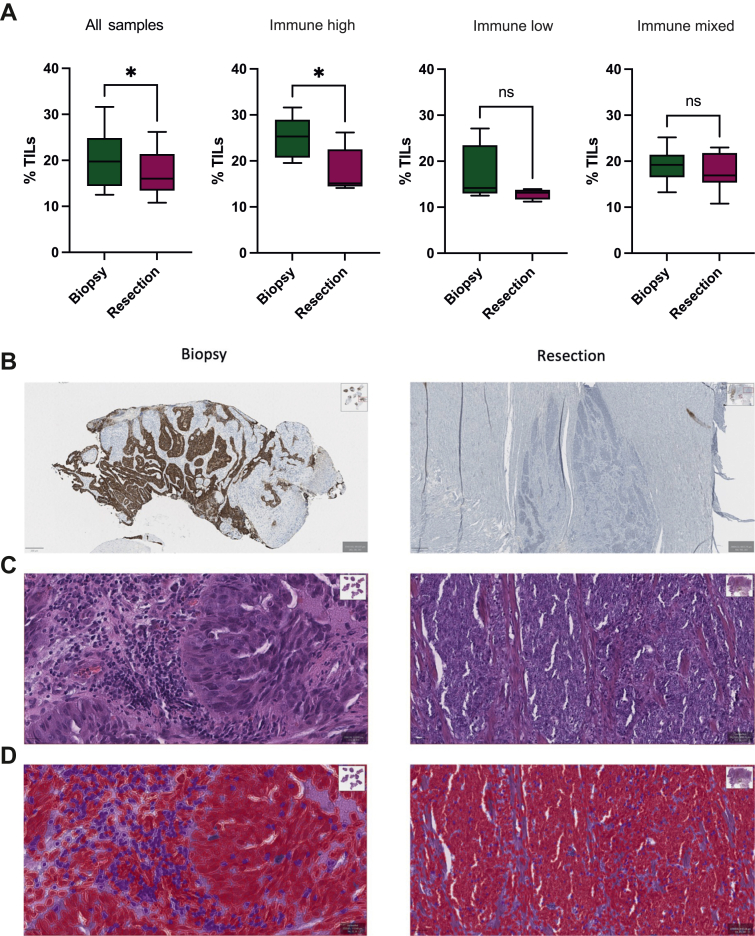
Transcriptomic profiles from 25 pre-treatment formalin-fixed paraffin-embedded OAC biopsies and 18 matched resection specimens, treated with Xelox + AZD8931 (n = 16) and Xelox alone (n = 9), were analysed using the Almac clara total mRNA report analysing 92 gene signatures, 100 unique single-gene drug targets and 7337 single genes across 10 hallmarks of cancer. Gene-set enrichment analysis (GSEA) was utilised to investigate pathways governing pathological response. Tumour-infiltrating lymphocytes (TILs) were assessed digitally using the QuPath software.
Hierarchical clustering identified three molecular subgroups classified by activation of innate immune signalling. The immune-high subgroup was associated with HER2 positivity, increased pathological response and a marked reduction in immune signalling and TILs following neoadjuvant therapy. The immune-low cluster was predominantly HER2/EGFR-negative, and EGFR positivity was associated with the immune-mixed subgroup. Treatment with neoadjuvant therapy induced common resistance mechanisms, such as angiogenesis and epithelial-mesenchymal transition signalling, and a reduction in DNA repair signatures. Addition of AZD8931 was associated with reduction of expression of EGFR, HER2 and AKT pathways and also promoted an immunosuppressive microenvironment. GSEA showed that patients with a pathological response to treatment had increased immune signalling, whereas non-responders to neoadjuvant therapy were enriched for nucleotide repair and cellular growth through the action of E2F transcription factors.
OAC may be subdivided into three immune-related subgroups which undergo modulation in response to neoadjuvant therapy with marked suppression of the immune microenvironment in HER2-positive/immune-high tumours.
Dual Erb B Inhibition in Oesophago-gastric Cancer(DEBIOC)试验报告了新辅助奥沙利铂和卡培他滨(Xelox)±AZD8931 在食管腺癌(OAC)中的可接受安全性,但疗效有限。我们使用独特的软件驱动解决方案评估了新辅助 Xelox±AZD8931 的影响,Xelox±AZD8931 是一种新型小分子抑制剂,对表皮生长因子受体(EGFR)、人表皮生长因子受体(HER)2 和 HER3 具有同等的活性。
25 例术前福尔马林固定石蜡包埋 OAC 活检和 18 例匹配的切除标本的转录组谱,用 Xelox+AZD8931(n=16)和 Xelox 单独治疗(n=9),用 Almac clara total mRNA report 进行分析,该报告分析了 92 个基因特征、100 个独特的单基因药物靶点和 7337 个单基因,跨越了癌症的 10 个标志。基因集富集分析(GSEA)用于研究控制病理反应的途径。使用 QuPath 软件对肿瘤浸润淋巴细胞(TILs)进行数字评估。
层次聚类鉴定了三个通过先天免疫信号激活分类的分子亚群。免疫高亚群与 HER2 阳性、病理反应增加以及新辅助治疗后免疫信号和 TILs 显著减少相关。免疫低聚类主要是 HER2/EGFR 阴性,EGFR 阳性与免疫混合亚群相关。新辅助治疗诱导了常见的耐药机制,如血管生成和上皮间质转化信号,以及 DNA 修复特征的减少。AZD8931 的加入与 EGFR、HER2 和 AKT 途径表达的减少有关,也促进了免疫抑制微环境。GSEA 显示,对治疗有病理反应的患者具有增加的免疫信号,而对新辅助治疗无反应的患者通过 E2F 转录因子的作用富集核苷酸修复和细胞生长。
OAC 可分为三个免疫相关亚群,这些亚群对新辅助治疗的反应发生调节,HER2 阳性/免疫高肿瘤的免疫微环境受到明显抑制。