Park Sangwoo, Sun Shuhan, Kovanda Lauren, Sokale Adebayo O, Barri Adriana, Kim Kwangwook, Li Xunde, Liu Yanhong
Department of Animal Science, University of California, Davis, CA, 95616, USA.
BASF Corporation, Florham Park, 07932, USA.
J Anim Sci Biotechnol. 2024 Oct 13;15(1):141. doi: 10.1186/s40104-024-01103-7.
Monoglycerides have emerged as a promising alternative to conventional practices due to their biological activities, including antimicrobial properties. However, few studies have assessed the efficacy of monoglyceride blend on weaned pigs and their impacts on performance, immune response, and gut health using a disease challenge model. Therefore, this study aimed to investigate the effects of dietary monoglycerides of short- and medium-chain fatty acids on the immunity and gut health of weaned pigs experimentally infected with an enterotoxigenic Escherichia coli F18.
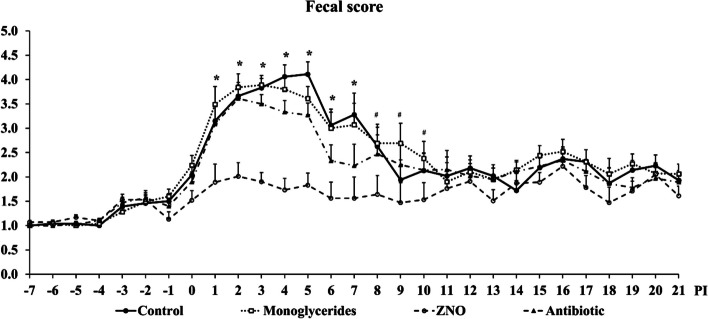
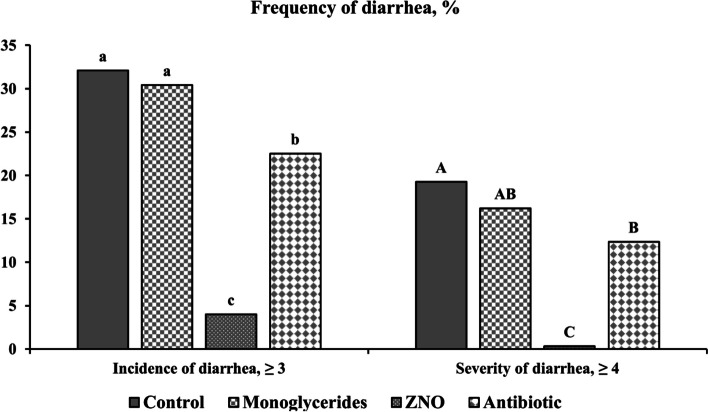
Pigs supplemented with high-dose zinc oxide (ZNO) had greater (P < 0.05) growth performance than other treatments, but no difference was observed in average daily feed intake between ZNO and monoglycerides groups during the post-challenge period. Pigs in ZNO and antibiotic groups had lower (P < 0.05) severity of diarrhea than control, but the severity of diarrhea was not different between antibiotic and monoglycerides groups. Pigs fed with monoglycerides or ZNO had lower (P < 0.05) serum haptoglobin on d 2 or 5 post-inoculation than control. Pigs in ZNO had greater (P < 0.05) goblet cell numbers per villus, villus area and height, and villus height:crypt depth ratio (VH:CD) in duodenum on d 5 post-inoculation than pigs in other treatments. Pigs supplemented with monoglycerides, ZNO, or antibiotics had reduced (P < 0.05) ileal crypt depth compared with control on d 5 post-inoculation, contributing to the increase (P = 0.06) in VH:CD. Consistently, pigs in ZNO expressed the lowest (P < 0.05) TNFa, IL6, IL10, IL12, IL1A, IL1B, and PTGS2 in ileal mucosa on d 5 post-inoculation, and no difference was observed in the expression of those genes between ZNO and monoglycerides. Supplementation of ZNO and antibiotic had significant impacts on metabolic pathways in the serum compared with control, particularly on carbohydrate and amino acid metabolism, while limited impacts on serum metabolites were observed in monoglycerides group when compared with control.
The results suggest that supplementation of monoglyceride blend may enhance disease resistance of weaned pigs by alleviating the severity of diarrhea and mitigating intestinal and systemic inflammation, although the effectiveness may not be comparable to high-dose zinc oxide.
由于甘油单酯具有包括抗菌特性在内的生物活性,已成为传统做法的一种有前景的替代物。然而,很少有研究使用疾病攻毒模型评估甘油单酯混合物对断奶仔猪的功效及其对生产性能、免疫反应和肠道健康的影响。因此,本研究旨在探讨日粮中短链和中链脂肪酸甘油单酯对实验感染产肠毒素大肠杆菌F18的断奶仔猪免疫力和肠道健康的影响。
高剂量氧化锌(ZNO)组仔猪的生长性能高于其他处理组(P < 0.05),但在攻毒后期间,ZNO组和甘油单酯组之间的平均日采食量没有差异。ZNO组和抗生素组仔猪的腹泻严重程度低于对照组(P < 0.05),但抗生素组和甘油单酯组之间的腹泻严重程度没有差异。接种后第2天或第5天,饲喂甘油单酯或ZNO的仔猪血清触珠蛋白含量低于对照组(P < 0.05)。接种后第5天,ZNO组仔猪十二指肠每绒毛杯状细胞数量、绒毛面积和高度以及绒毛高度与隐窝深度比(VH:CD)均高于其他处理组(P < 0.05)。接种后第5天,与对照组相比,补充甘油单酯、ZNO或抗生素的仔猪回肠隐窝深度降低(P < 0.05),这有助于VH:CD的增加(P = 0.06)。同样,接种后第5天,ZNO组仔猪回肠黏膜中TNFa、IL6、IL10、IL12、IL1A、IL1B和PTGS2的表达最低(P < 0.05),ZNO组和甘油单酯组之间这些基因的表达没有差异。与对照组相比,补充ZNO和抗生素对血清中的代谢途径有显著影响,特别是对碳水化合物和氨基酸代谢,而与对照组相比,甘油单酯组对血清代谢物的影响有限。
结果表明,补充甘油单酯混合物可能通过减轻腹泻严重程度和减轻肠道及全身炎症来增强断奶仔猪的抗病能力,尽管其效果可能不如高剂量氧化锌。