Department of Infectious Disease Epidemiology, Robert Koch Institute, Berlin, Germany.
Centre for Biological Threats and Special Pathogens German Consultant Laboratory for Poxviruses Highly Pathogenic Viruses (ZBS 1) WHO Collaboration Center for Emerging Threats and Special Pathogens, Berlin, Germany.
BMC Infect Dis. 2024 Oct 14;24(1):1153. doi: 10.1186/s12879-024-10066-z.
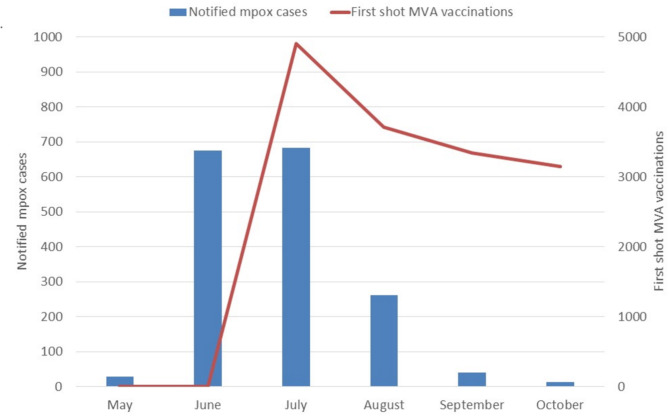
During the mpox outbreak in 2022, the highest number of cases in Germany were registered in Berlin, almost all of them in men who have sex with men (MSM). However, the frequency of clinically undiagnosed infections is unknown.
A cross-sectional study was conducted among MSM in Berlin, Germany. Participants were recruited from private practices and community-based checkpoints specialised in HIV and STI care for MSM. They were asked to complete an online questionnaire on socio-demographic data, mpox diagnosis, vaccination history and sexual behaviour, and to provide a blood sample for serological analysis. The samples were tested for antibodies against a range of antigens to distinguish between antibodies induced by mpox infection and MVA vaccination, with pre-immune sera from childhood smallpox vaccination as a confounding factor. Associations of behavioural variables with reported and suspected mpox diagnosis as the outcome were tested using univariable and multivariable logistic regression models.
Between the 11th April and 1st July 2023, 1,119 participants were recruited in eight private practices and two community-based checkpoints in Berlin. All participants provided a blood sample for serological testing. Information for the online questionnaire was provided by 728 participants; core data on age and mpox history for participants who did not provide questionnaire data were provided by the practices for an additional 218 participants. A previous diagnosis of mpox was reported for/by 70 participants (7.4%). Using a conservative and strict case definition, we serologically identified an additional 91 individuals with suspected undiagnosed mpox infection. Individuals with reported or suspected mpox infections reported more condomless anal sex partners in the past 3 months (OR = 5.93; 95% CI 2.10-18.35 for 5-10 partners; OR = 9.53; 95% CI 2.72-37.54 for > 10 partners) and were more likely to report sexual contact with partners diagnosed with mpox (OR = 2.87; 95% CI 1.39-5.84).
A substantial proportion of mpox infections were clinically undiagnosed. The number of condomless anal sex partners was strongly associated with both confirmed and suspected undiagnosed mpox infection. Therefore, mpox control measures based on clinical diagnosis of mpox are likely to have limited effectiveness in preventing mpox transmission in outbreak situations because many infections remain unrecognised and undiagnosed.
在 2022 年猴痘疫情期间,德国报告的病例数量最多的是柏林,几乎所有病例都发生在男男性行为者(MSM)中。然而,临床未确诊感染的频率尚不清楚。
在德国柏林对 MSM 进行了一项横断面研究。参与者从私人诊所和社区为 MSM 提供 HIV 和性传播感染(STI)护理的专门检查点招募。他们被要求完成一份关于社会人口统计学数据、猴痘诊断、疫苗接种史和性行为的在线问卷,并提供血液样本进行血清学分析。这些样本针对一系列抗原进行了抗体检测,以区分由猴痘感染和 MVA 疫苗接种引起的抗体,将儿童时期接种天花疫苗的预免疫血清作为混杂因素。使用单变量和多变量逻辑回归模型测试报告和疑似猴痘诊断作为结果的行为变量之间的关联。
在 2023 年 4 月 11 日至 7 月 1 日期间,在柏林的八家私人诊所和两家社区检查点招募了 1119 名参与者。所有参与者均提供了血液样本进行血清学检测。728 名参与者提供了在线问卷信息;对于未提供问卷数据的参与者,诊所提供了核心数据(年龄和猴痘病史),另有 218 名参与者提供了核心数据。70 名参与者(7.4%)报告了以前的猴痘诊断。使用保守和严格的病例定义,我们通过血清学方法鉴定出另外 91 名疑似未确诊猴痘感染的个体。报告或疑似患有猴痘感染的个体在过去 3 个月内报告的无保护肛交性伴侣更多(OR=5.93;95%CI 2.10-18.35 为 5-10 名伴侣;OR=9.53;95%CI 2.72-37.54 为 >10 名伴侣),并且更有可能报告与诊断患有猴痘的伴侣发生性接触(OR=2.87;95%CI 1.39-5.84)。
很大一部分猴痘感染未得到临床诊断。无保护肛交性伴侣的数量与确诊和疑似未确诊猴痘感染均密切相关。因此,基于临床诊断的猴痘控制措施可能在预防疫情情况下的猴痘传播方面效果有限,因为许多感染仍然未被发现和诊断。