Wang Tianyi, Che Mandy, Huilgol Yash S, Keane Holly, Goodman Deborah, Soonavala Rashna, Ozanne Elissa, Shieh Yiwey, Belkora Jeffrey K, Fiscalini Allison Stover, Esserman Laura J
UC San Francisco Department of Surgery, San Francisco, CA, USA.
University of Michigan Medical School, Ann Arbor, MI, USA.
NPJ Breast Cancer. 2024 Oct 14;10(1):90. doi: 10.1038/s41523-024-00681-z.
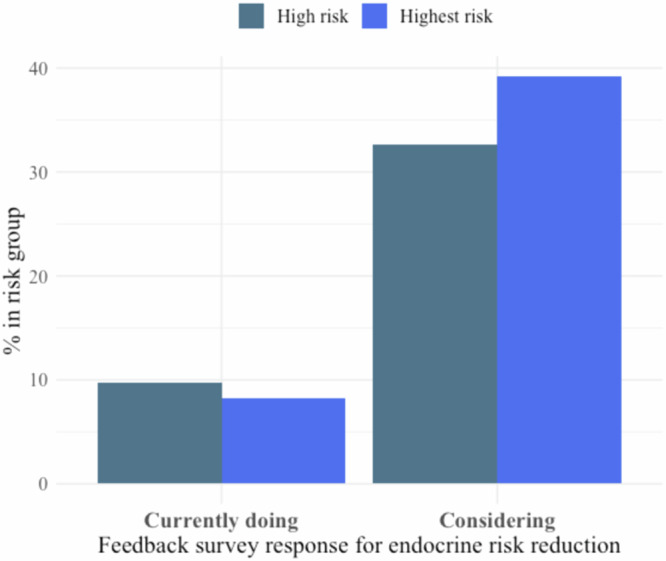
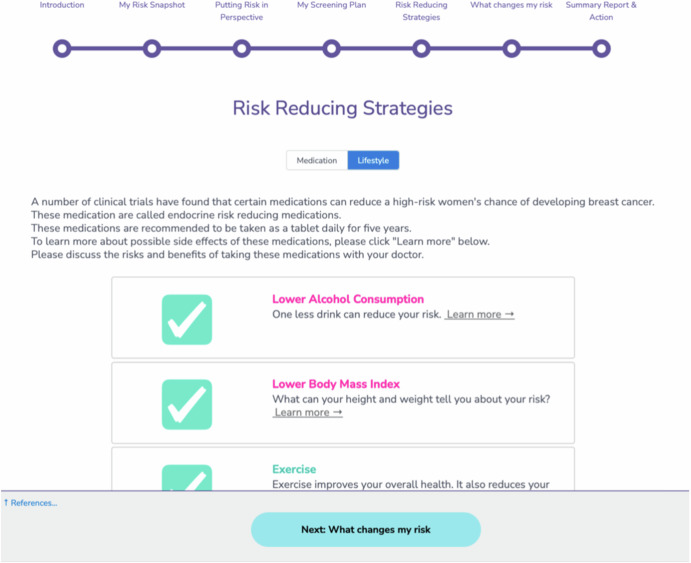
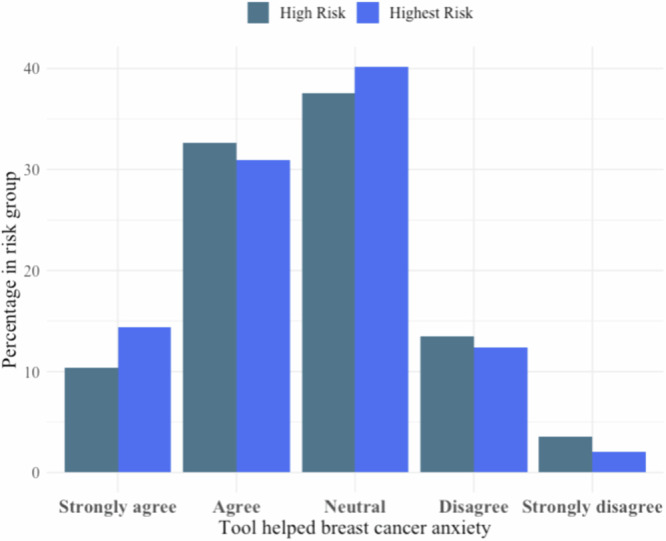
Breast cancer risk reduction strategies have been well-validated, but barriers remain for high-risk individuals to adopt them. We performed a study among participants with high risk of breast cancer to validate whether a virtual breast health decision tool impacted a participant's willingness to start risk-reducing activities, identify barriers to adopting these strategies, and understand if it affects breast cancer anxiety. The study sample was 318 participants in the personalized (investigational) arm of the Women Informed to Screen Depending on Measures of risk (WISDOM) clinical trial. After reviewing the tool, these participants completed a feedback survey. We demonstrated that 15 (4.7%) women were taking endocrine risk reduction, 123 (38.7%) were reducing alcohol intake, and 199 (62.6%) were exercising. In the three-month follow-up survey of 109 respondents, only 8 of 61 (13.1%) women who considered endocrine risk reduction pursued it. In contrast, 11 of 16 (68%) participants who considered alcohol reduction pursued the activity, and 14 of 24 (58%) women who considered exercise followed through. Participants listed fear of side effects as the most common barrier to endocrine risk reduction. We also present further steps to be taken to improve the effectiveness of the Breast Health Decisions tool.
降低乳腺癌风险的策略已得到充分验证,但高危个体在采用这些策略方面仍存在障碍。我们对乳腺癌高危参与者进行了一项研究,以验证虚拟乳房健康决策工具是否会影响参与者开始降低风险活动的意愿,识别采用这些策略的障碍,并了解其是否会影响乳腺癌焦虑。研究样本为参与“明智筛查女性风险评估”(WISDOM)临床试验个性化(研究性)组的318名参与者。在查看该工具后,这些参与者完成了一份反馈调查。我们发现,15名(4.7%)女性正在采取内分泌风险降低措施,123名(38.7%)正在减少酒精摄入量,199名(62.6%)正在进行锻炼。在对109名受访者进行的三个月随访调查中,在61名考虑采取内分泌风险降低措施的女性中,只有8名(13.1%)付诸行动。相比之下,在16名考虑减少酒精摄入的参与者中,有11名(68%)采取了行动,在24名考虑锻炼的女性中,有14名(58%)坚持了下来。参与者将对副作用的恐惧列为内分泌风险降低最常见的障碍。我们还提出了进一步的措施,以提高乳房健康决策工具的有效性。