Eklund Martin, Broglio Kristine, Yau Christina, Connor Jason T, Stover Fiscalini Allison, Esserman Laura J
Department of Medical Epidemiology and Biostatistics, Karolinska Intitutet, Stockholm, Sweden.
Berry Consultants LLC, Austin, TX.
JNCI Cancer Spectr. 2019 Jan 8;2(4):pky067. doi: 10.1093/jncics/pky067. eCollection 2018 Oct.
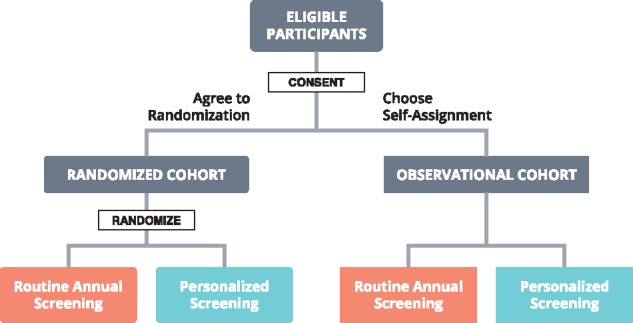
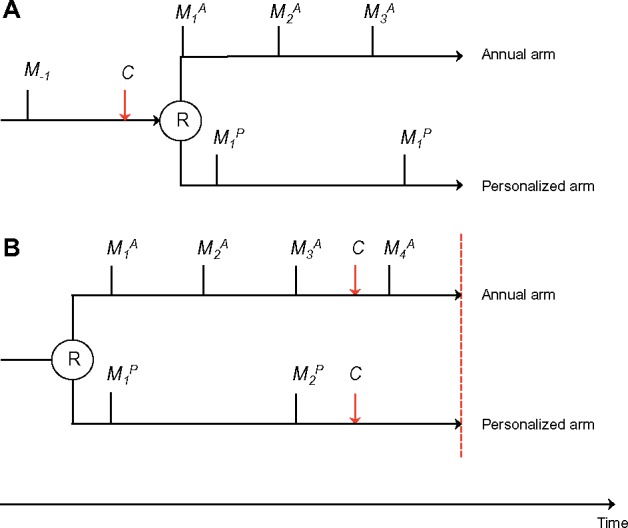
WISDOM (Women Informed to Screen Depending on Measures of Risk) is a randomized trial to assess whether personalized breast cancer screening-where women are screened biannually, annually, biennially, or not at all depending on risk and age-can prevent as many advanced (stage IIB or higher) cancers as annual screening in women ages 40-74 years across 5 years of trial time. The short study time in combination with design choices of not requiring study entry and exit mammograms for all participants may introduce different sources of bias in favor of either the personalized or the annual arm.
We designed a simulation model and performed 5000 virtual WISDOM trials to assess potential biases. Each virtual trial simulated 65 000 randomly assigned participants who were each assigned a risk stratum and a time to stage of at least IIB cancer sampled from an exponential distribution with the hazard rate based on the risk stratum. Results from the virtual trials were used to evaluate two candidate analysis strategies with respect to susceptibility for introducing bias: 1) difference between arms in total number of events over total trial time, and 2) difference in number of events within complete screening cycles.
Based on the simulations, about 86 stage IIB or higher cancers will be detected within the trial and the total exposure time will be about 74 000 years in each arm. Potential ascertainment bias is introduced at study entry and exit. Analysis strategy 1 works better for the nonscreened stratum, whereas method 2 is considerably more unbiased for the strata of women screened biennially or every 6 months.
Combining the two candidate analysis approaches gives a reasonably unbiased analysis based on the simulations and is the method we will use for the primary analysis in WISDOM. Publishing the WISDOM analysis approach provides transparency and can aid the design and analysis of other individualized screening trials.
WISDOM(基于风险评估的女性乳腺癌筛查)是一项随机试验,旨在评估个性化乳腺癌筛查(即根据风险和年龄,女性每半年、每年、每两年进行一次筛查或根本不进行筛查)在5年的试验期内,能否与每年进行筛查一样,预防40至74岁女性中尽可能多的晚期(IIB期或更高)癌症。研究时间较短,再加上设计上未要求所有参与者进行入组和退出时的乳房X光检查,可能会引入有利于个性化筛查组或每年筛查组的不同偏差来源。
我们设计了一个模拟模型,并进行了5000次虚拟的WISDOM试验,以评估潜在偏差。每次虚拟试验模拟65000名随机分配的参与者,每位参与者被分配一个风险分层,并从指数分布中抽取至少IIB期癌症的发病时间,其风险率基于风险分层。虚拟试验的结果用于评估两种候选分析策略在引入偏差方面的敏感性:1)试验总时间内两组事件总数的差异;2)完整筛查周期内事件数量的差异。
基于模拟,试验中将检测到约86例IIB期或更高期别的癌症,每组的总暴露时间约为74000人年。在研究入组和退出时会引入潜在的确定偏差。分析策略1对未筛查组效果更好,而方法2对每两年或每六个月进行筛查的女性组偏差要小得多。
结合这两种候选分析方法,基于模拟可得到一个偏差合理的分析结果,这也是我们将在WISDOM试验中用于主要分析的方法。公布WISDOM分析方法可提高透明度,并有助于其他个性化筛查试验的设计和分析。