Mousa Emad, Taha Eman O, Lotfy Salah, Anwar Ahmad
Physics Department, Faculty of Science, Cairo University, Giza, 12613, Egypt.
Petroleum Applications Department, Egyptian Petroleum Research Institute (EPRI), Cairo, Egypt.
Sci Rep. 2024 Oct 13;14(1):23917. doi: 10.1038/s41598-024-73676-2.
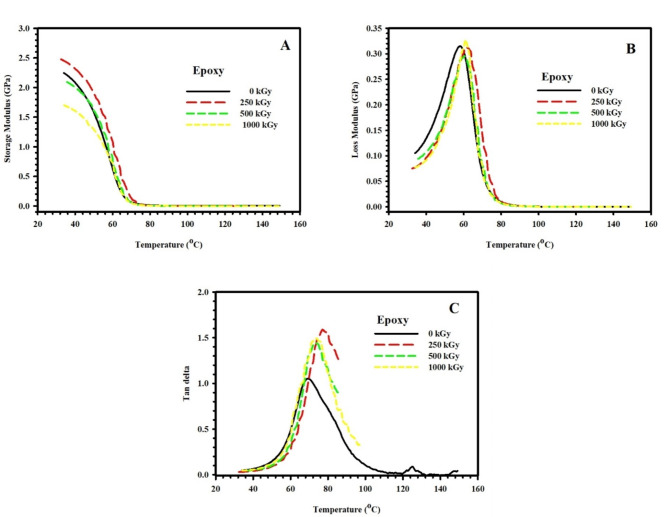
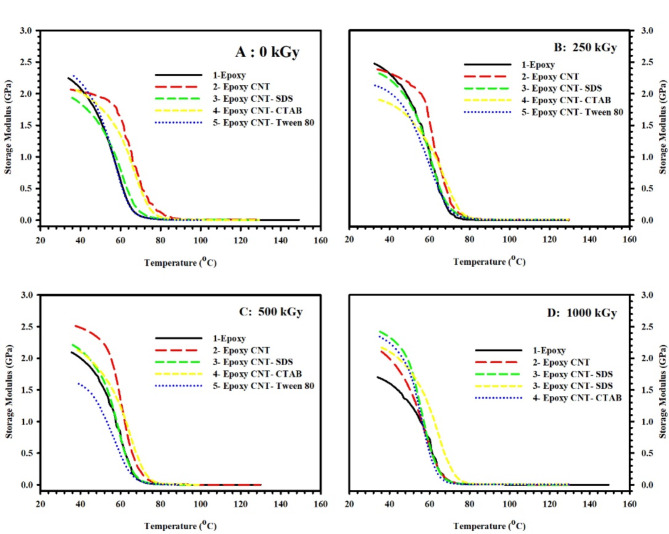
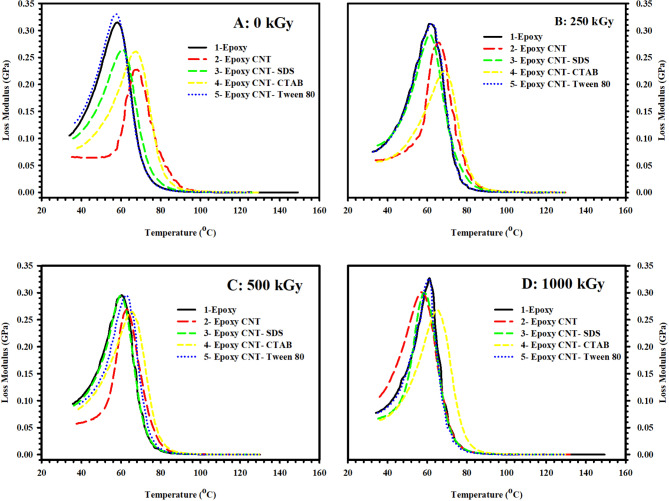
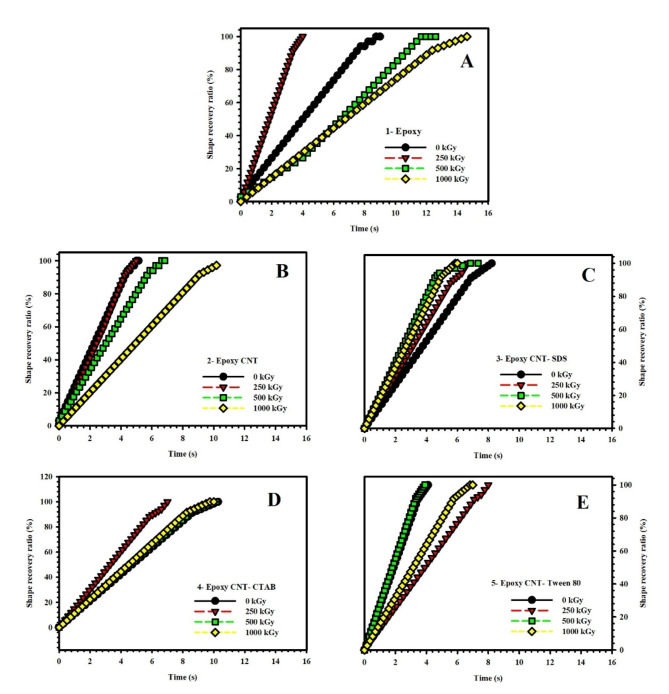
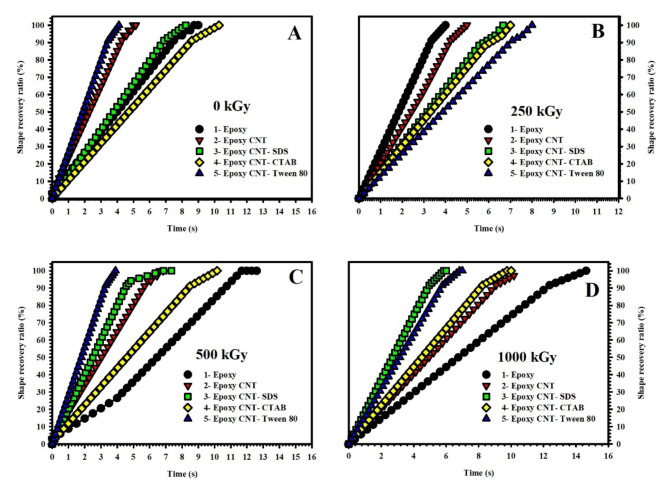
This research investigates the impact of gamma irradiation on epoxy-MWCNT nanocomposites for satellite deployment mechanisms. Nanocomposites, enhanced with surfactants, were meticulously prepared and subjected to controlled gamma irradiation (250-1000 kGy) utilizing the Cobalt-60 facility Industrial Mega Gamma-1 at NCRRT in Egypt. Surface tension measurements explored surfactant effects on epoxy-MWCNT composites in acetone. Acetone reduced tension from 26.7 to be 24.2 (mN/m). Surfactants (Tween 80, SDS) effectively lowered tension (24.4 mN/m), while surfactant-free systems had higher tension (25.1 mN/m). Cationic surfactant (CTAB) slightly increased tension (25.4 mN/m) but aided MWCNT dispersion. Nonionic and anionic surfactants showed superior dispersing power, aligning with MWCNTs and enhancing dispersion. Thermogravimetric analysis (TGA) unveiled alterations in the thermal stability of epoxy-MWCNT nanocomposites induced by radiation, particularly evident at elevated doses (500 and 1000 kGy). Notably, surfactant-modified specimens exhibited discernible effects on various thermal stability parameters. DMA analysis revealed radiation-induced changes in viscoelastic properties. Unirradiated epoxy exhibited a T of 58 °C, while 250 kGy irradiation enhanced crosslinking (T: 64 °C). Higher doses (500 kGy, 1000 kGy) caused marginal T changes. Surfactant-modified samples showed varied effects, with Tween 80 emphasizing its role in phase separation. Results highlighted radiation's influence on stiffness and energy dissipation. Shape memory behavior indicated increased recovery time with higher doses, except at 250 kGy. Epoxy-MWCNT exhibited a stable recovery time, suggesting a MWCNT stabilizing effect. Fixation rates consistently reached 100%, indicating improved shape recovery influenced by MWCNTs and surfactants. This study provides insights into optimizing nanocomposites for satellite deployment applications.
本研究调查了伽马辐射对用于卫星展开机构的环氧-多壁碳纳米管纳米复合材料的影响。精心制备了添加表面活性剂的纳米复合材料,并利用埃及国家辐射研究与技术中心的钴-60设施“工业巨型伽马-1”对其进行了可控伽马辐射(250-1000千戈瑞)。表面张力测量探究了表面活性剂对环氧-多壁碳纳米管复合材料在丙酮中的影响。丙酮使表面张力从26.7降低至24.2(毫牛/米)。表面活性剂(吐温80、十二烷基硫酸钠)有效降低了表面张力(24.4毫牛/米),而无表面活性剂体系的表面张力更高(25.1毫牛/米)。阳离子表面活性剂(十六烷基三甲基溴化铵)略微提高了表面张力(25.4毫牛/米),但有助于多壁碳纳米管的分散。非离子和阴离子表面活性剂表现出更强的分散能力,与多壁碳纳米管相互作用并增强了分散效果。热重分析(TGA)揭示了辐射引起的环氧-多壁碳纳米管纳米复合材料热稳定性的变化,在较高剂量(500和1000千戈瑞)下尤为明显。值得注意的是,表面活性剂改性的试样对各种热稳定性参数表现出明显影响。动态热机械分析(DMA)显示了辐射引起的粘弹性性能变化。未辐照的环氧树脂的玻璃化转变温度为58℃,而250千戈瑞的辐射增强了交联作用(玻璃化转变温度:64℃)。更高剂量(500千戈瑞、1000千戈瑞)导致玻璃化转变温度的变化较小。表面活性剂改性的样品表现出不同的效果,吐温80突出了其在相分离中的作用。结果突出了辐射对刚度和能量耗散的影响。形状记忆行为表明,除了250千戈瑞外,剂量越高恢复时间越长。环氧-多壁碳纳米管表现出稳定的恢复时间,表明多壁碳纳米管具有稳定作用。固定率始终达到100%,表明多壁碳纳米管和表面活性剂对形状恢复有改善作用。本研究为优化用于卫星展开应用的纳米复合材料提供了见解。