Borges Thiago J, Ganchiku Yoshikazu, Aceves Jeffrey O, van Gaal Ronald, Uzel Sebastien G M, Rosales Ivy A, Rubins Jonathan E, Kobayashi Kenichi, Hiratsuka Ken, Tekguc Murat, Ribas Guilherme T, Lima Karina, Gassen Rodrigo B, Morizane Ryuji, Lewis Jennifer A, Riella Leonardo V
Center for Transplantation Sciences, Massachusetts General Hospital, Harvard Medical School, Boston, MA, United states.
Paulson School of Engineering and Applied Sciences, Harvard University, Cambridge, MA, United states.
iScience. 2024 Sep 13;27(10):110957. doi: 10.1016/j.isci.2024.110957. eCollection 2024 Oct 18.
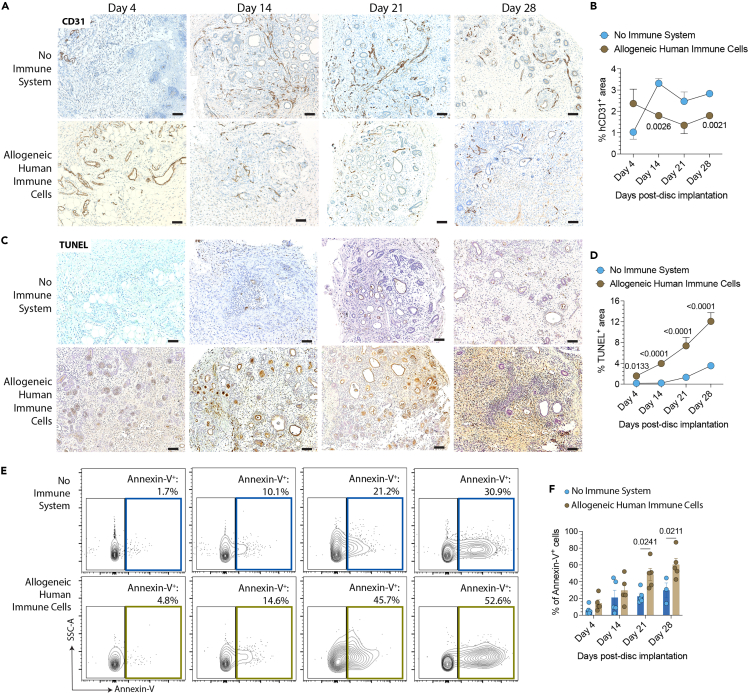
The increasing scarcity of organs and the significant morbidity linked to dialysis require the development of engineered kidney tissues from human-induced pluripotent stem cells. Integrative approaches that synergize scalable kidney organoid differentiation, tissue biomanufacturing, and comprehensive assessment of their immune response and host integration are essential to accomplish this. Here, we create engineered human kidney tissues composed of organoid building blocks (OBBs) and transplant them into mice reconstituted with allogeneic human immune cells. Tissue-infiltrating human immune cells are composed of effector T cells and innate cells. This immune infiltration leads to kidney tissue injury characterized by reduced microvasculature, enhanced kidney cell apoptosis, and an inflammatory gene signature comparable to kidney organ transplant rejection in humans. Upon treatment with the immunosuppressive agent rapamycin, the induced immune response is greatly suppressed. Our model is a translational platform to study engineered kidney tissue immunogenicity and develop therapeutic targets for kidney rejection.
器官日益稀缺以及与透析相关的严重发病率促使人们利用人诱导多能干细胞开发工程化肾组织。将可扩展的肾类器官分化、组织生物制造以及对其免疫反应和宿主整合的全面评估相结合的方法对于实现这一目标至关重要。在此,我们创建了由类器官构建模块(OBB)组成的工程化人肾组织,并将其移植到用同种异体人免疫细胞重建的小鼠体内。组织浸润的人免疫细胞由效应T细胞和固有细胞组成。这种免疫浸润导致肾组织损伤,其特征为微血管减少、肾细胞凋亡增加以及炎症基因特征,类似于人类肾器官移植排斥反应。在用免疫抑制剂雷帕霉素治疗后,诱导的免疫反应得到极大抑制。我们的模型是一个转化平台,用于研究工程化肾组织的免疫原性并开发肾排斥的治疗靶点。