Crowder R, Kato-Maeda M, Schwem B, Dela Tonga A, Geocaniga-Gaviola D M, Lopez E, Valdez C L, Lim A R, Hunat N, Sedusta A G, Sacopon C A, Atienza G A M, Bulag E, Lim D, Bascuña J, Shah K, Basillio R P, Berger C A, Lopez M C D P, Sen S, Allender C, Folkerts M, Karaoz U, Brodie E, Mitarai S, Garfin A M C, Ama M C, Engelthaler D M, Cattamanchi A, Destura R
Division of Pulmonary and Critical Care Medicine, San Francisco General Hospital, University of California San Francisco, San Francisco, CA, USA.
Center for Tuberculosis, University of California San Francisco, San Francisco, CA, USA.
IJTLD Open. 2024 Oct 1;1(10):466-472. doi: 10.5588/ijtldopen.24.0343. eCollection 2024 Oct.
Poor treatment outcomes among people with drug-resistant TB (DR-TB) are a major concern. Heteroresistance (presence of susceptible and resistant in the same sample) has been identified in some people with TB, but its impact on treatment outcomes is unknown.
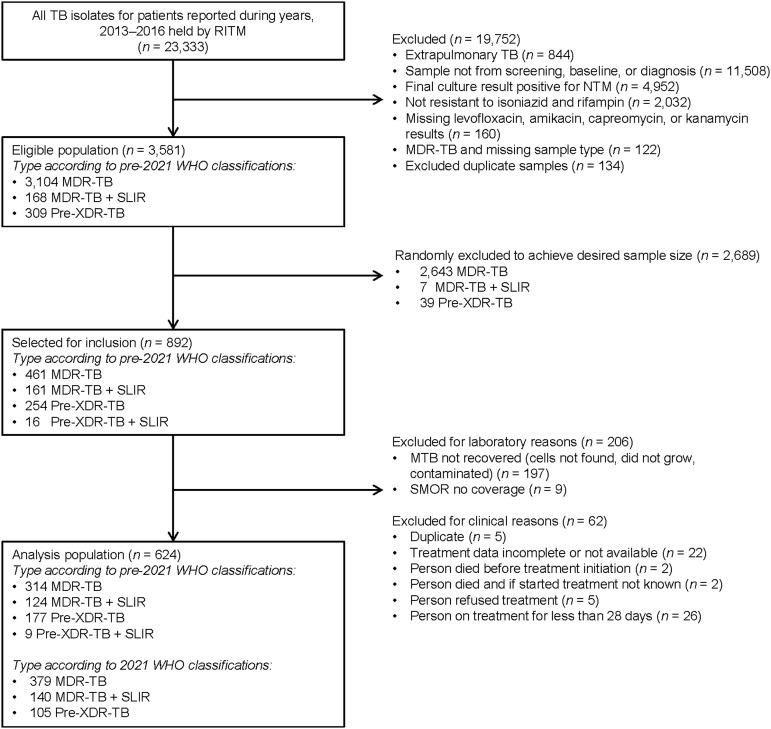
We used targeted deep sequencing to identify mutations associated with DR-TB and heteroresistance in culture samples of 624 people with DR-TB. We evaluated the association between heteroresistance and time to unfavorable treatment outcome using Cox proportional hazards regression.
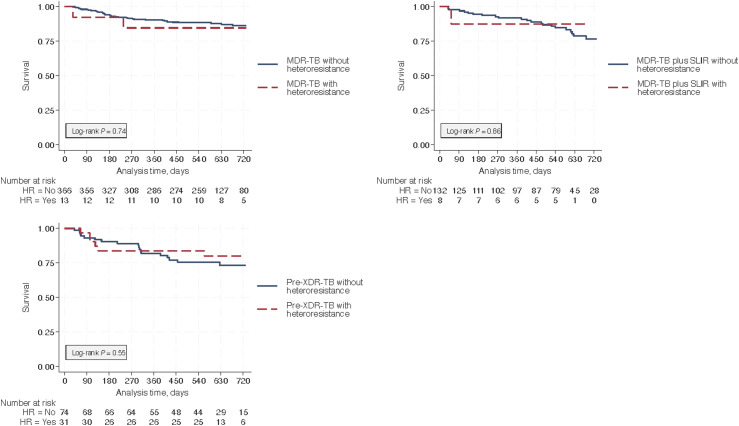
The proportion of drug-resistant isolates with a known mutation conferring resistance was lower for streptomycin (45.2%) and second-line injectables (79.1%) than for fluoroquinolones (86.7%), isoniazid (93.2%) and rifampin (96.5%). Fifty-two (8.3%) had heteroresistance, and it was more common for fluoroquinolones (4.6%) than rifampin (2.2%), second-line injectables (1.4%), streptomycin (1.7%), or isoniazid (1.3%). There was no association between heteroresistance and time to unfavorable outcome among people with multidrug-resistant TB (adjusted hazard ratio [aHR] 1.74, 95% CI 0.39-7.72) or pre-extensively DR-TB (aHR 0.65, 95% CI 0.24-1.72).
Heteroresistance was relatively common (8.3%) among people with DR-TB in the Philippines. However, we found insufficient evidence to demonstrate an impact on unfavorable treatment outcomes.
耐多药结核病(DR-TB)患者治疗效果不佳是一个主要问题。在一些结核病患者中已发现异质性耐药(同一样本中存在敏感菌和耐药菌),但其对治疗效果的影响尚不清楚。
我们使用靶向深度测序来鉴定624例耐多药结核病患者培养样本中与耐多药结核病和异质性耐药相关的突变。我们使用Cox比例风险回归评估异质性耐药与不良治疗结局时间之间的关联。
已知具有耐药性突变的耐药菌株比例,链霉素(45.2%)和二线注射剂(79.1%)低于氟喹诺酮类(86.7%)、异烟肼(93.2%)和利福平(96.5%)。52例(8.3%)存在异质性耐药,氟喹诺酮类(4.6%)比利福平(2.2%)、二线注射剂(1.4%)、链霉素(1.7%)或异烟肼(1.3%)更常见。在耐多药结核病患者(调整后风险比[aHR]1.74,95%置信区间0.39-7.72)或广泛耐药结核病前期患者(aHR 0.65,95%置信区间0.24-1.72)中,异质性耐药与不良结局时间之间无关联。
在菲律宾的耐多药结核病患者中,异质性耐药相对常见(8.3%)。然而,我们发现没有足够的证据证明其对不良治疗结局有影响。