Sabater Agustina, Sanchis Pablo, Seniuk Rocio, Pascual Gaston, Anselmino Nicolas, Alonso Daniel, Cayol Federico, Vazquez Elba, Marti Marcelo, Cotignola Javier, Toro Ayelen, Labanca Estefania, Bizzotto Juan, Gueron Geraldine
Departamento de Química Biológica, Facultad de Ciencias Exactas y Naturales, Universidad de Buenos Aires, Buenos Aires C1428EGA, Argentina.
Instituto de Química Biológica de la Facultad de Ciencias Exactas y Naturales (IQUIBICEN), CONICET-Universidad de Buenos Aires, Buenos Aires, C1428EGA, Argentina.
medRxiv. 2024 Sep 25:2024.09.24.24314303. doi: 10.1101/2024.09.24.24314303.
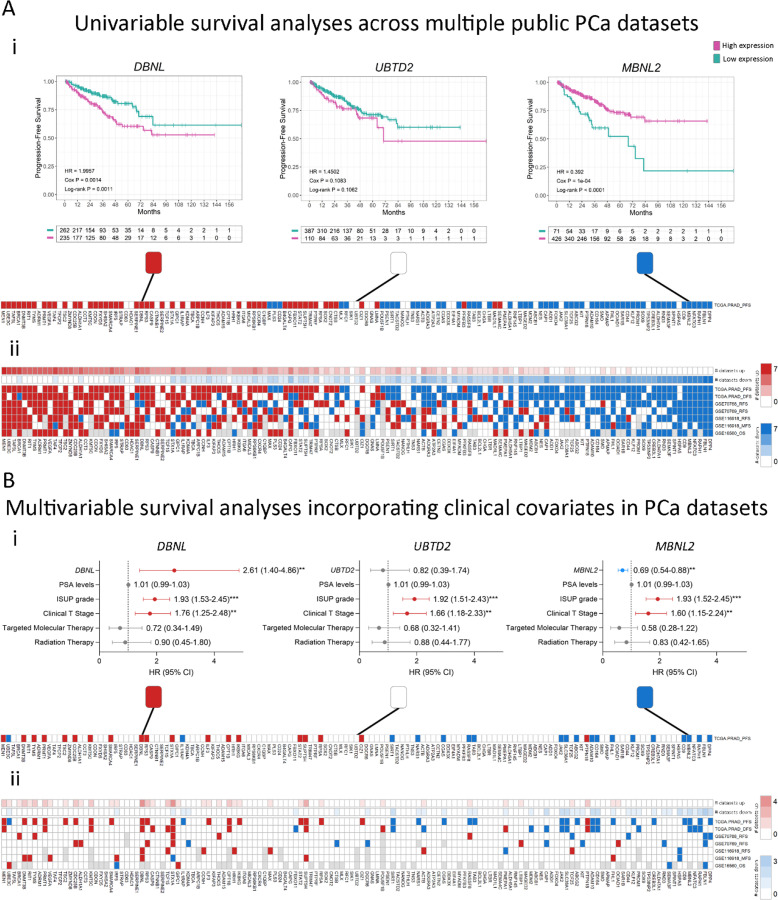
Prostate cancer (PCa) poses a significant global health challenge, particularly due to its progression into aggressive forms like neuroendocrine prostate cancer (NEPC). This study developed and validated a stemness-associated gene signature using advanced machine learning techniques, including Random Forest and Lasso regression, applied to large-scale transcriptomic datasets. The resulting 7-gene signature () was validated across independent cohorts and patient-derived xenograft (PDX) models. The signature demonstrated strong prognostic value for progression-free, disease-free, relapse-free, metastasis-free, and overall survival. Importantly, the signature not only identified specific NEPC subtypes, such as large-cell neuroendocrine carcinoma, which is associated with very poor outcomes, but also predicted a poor prognosis for PCa cases that exhibit this molecular signature, even when they were not histopathologically classified as NEPC. This dual prognostic and classifier capability makes the 7-gene signature a robust tool for personalized medicine, providing a valuable resource for predicting disease progression and guiding treatment strategies in PCa management.
前列腺癌(PCa)是一项重大的全球健康挑战,尤其是因为它会发展成侵袭性形式,如神经内分泌前列腺癌(NEPC)。本研究利用先进的机器学习技术,包括随机森林和套索回归,应用于大规模转录组数据集,开发并验证了一种与干性相关的基因特征。由此产生的7基因特征在独立队列和患者来源的异种移植(PDX)模型中得到了验证。该特征对无进展生存期、无病生存期、无复发生存期、无转移生存期和总生存期具有很强的预后价值。重要的是,该特征不仅识别出特定的NEPC亚型,如与非常差的预后相关的大细胞神经内分泌癌,而且还预测了表现出这种分子特征的PCa病例的不良预后,即使它们在组织病理学上未被分类为NEPC。这种双重预后和分类能力使7基因特征成为个性化医疗的强大工具,为预测PCa管理中的疾病进展和指导治疗策略提供了宝贵资源。