Kim Seungwon, Kigozi Godfrey, Martin Michael A, Galiwango Ronald M, Quinn Thomas C, Redd Andrew D, Ssekubugu Robert, Bonsall David, Ssemwanga Deogratius, Rambaut Andrew, Herbeck Joshua T, Reynolds Steven J, Foley Brian, Abeler-Dörner Lucie, Fraser Christophe, Ratmann Oliver, Kagaayi Joseph, Laeyendecker Oliver, Grabowski Mary K
Department of Pathology, Johns Hopkins School of Medicine, 600 N. Wolfe Street, Baltimore, MD 21205, United States.
Research Department, Rakai Health Sciences Program, 4-6 Sanitary Lane, Old Bukoba Road, Kalisizo, Uganda.
Virus Evol. 2024 Aug 24;10(1):veae065. doi: 10.1093/ve/veae065. eCollection 2024.
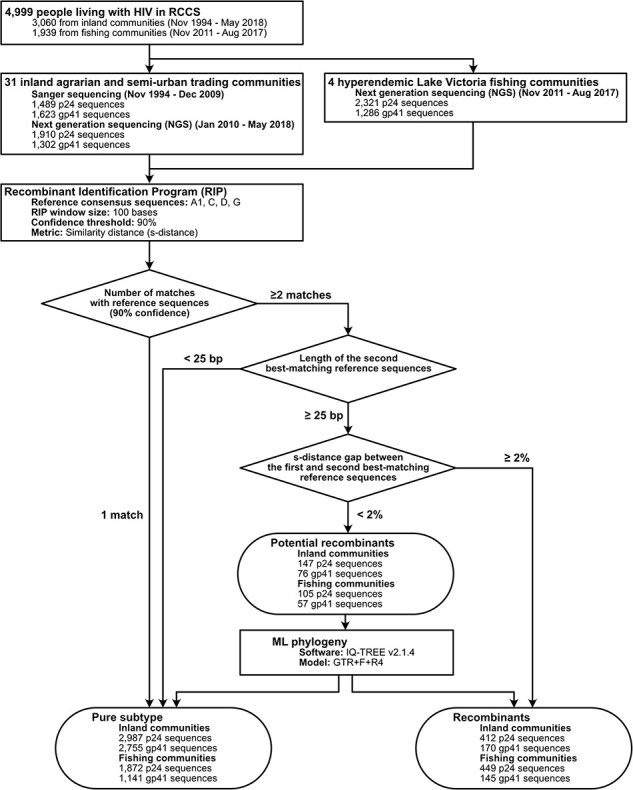
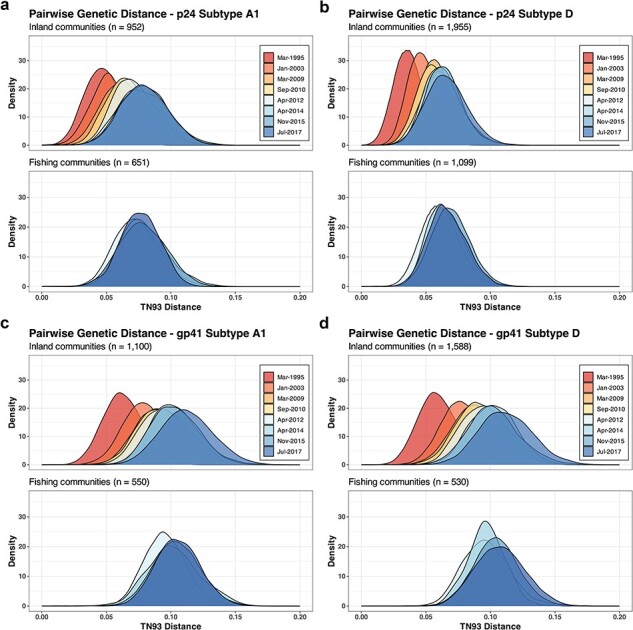
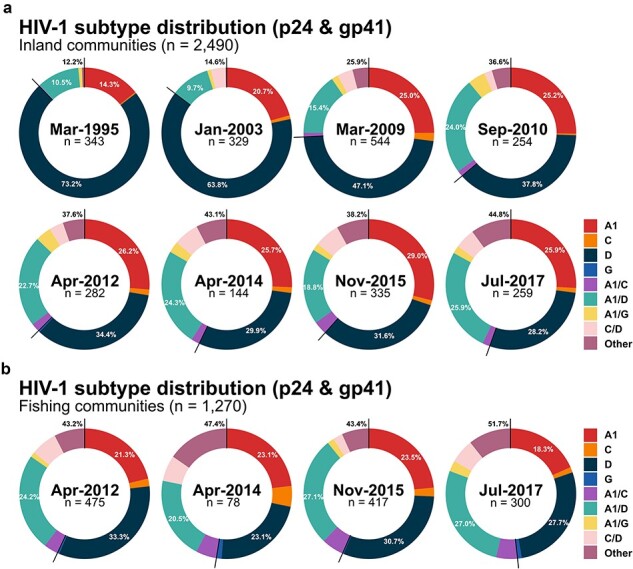
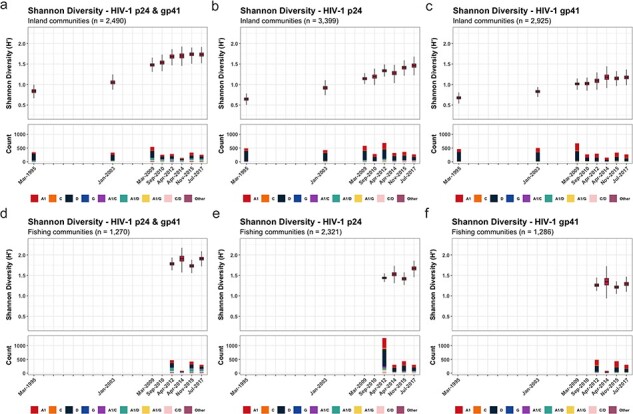
There is limited data on human immunodeficiency virus (HIV) evolutionary trends in African populations. We evaluated changes in HIV viral diversity and genetic divergence in southern Uganda over a 24-year period spanning the introduction and scale-up of HIV prevention and treatment programs using HIV sequence and survey data from the Rakai Community Cohort Study, an open longitudinal population-based HIV surveillance cohort. (p24) and (gp41) HIV data were generated from people living with HIV (PLHIV) in 31 inland semi-urban trading and agrarian communities (1994-2018) and four hyperendemic Lake Victoria fishing communities (2011-2018) under continuous surveillance. HIV subtype was assigned using the Recombination Identification Program with phylogenetic confirmation. Inter-subtype diversity was evaluated using the Shannon diversity index, and intra-subtype diversity with the nucleotide diversity and pairwise TN93 genetic distance. Genetic divergence was measured using root-to-tip distance and pairwise TN93 genetic distance analyses. Demographic history of HIV was inferred using a coalescent-based Bayesian Skygrid model. Evolutionary dynamics were assessed among demographic and behavioral population subgroups, including by migration status. 9931 HIV sequences were available from 4999 PLHIV, including 3060 and 1939 persons residing in inland and fishing communities, respectively. In inland communities, subtype A1 viruses proportionately increased from 14.3% in 1995 to 25.9% in 2017 ( < .001), while those of subtype D declined from 73.2% in 1995 to 28.2% in 2017 ( < .001). The proportion of viruses classified as recombinants significantly increased by nearly four-fold from 12.2% in 1995 to 44.8% in 2017. Inter-subtype HIV diversity has generally increased. While intra-subtype p24 genetic diversity and divergence leveled off after 2014, intra-subtype gp41 diversity, effective population size, and divergence increased through 2017. Intra- and inter-subtype viral diversity increased across all demographic and behavioral population subgroups, including among individuals with no recent migration history or extra-community sexual partners. This study provides insights into population-level HIV evolutionary dynamics following the scale-up of HIV prevention and treatment programs. Continued molecular surveillance may provide a better understanding of the dynamics driving population HIV evolution and yield important insights for epidemic control and vaccine development.
关于非洲人群中人类免疫缺陷病毒(HIV)进化趋势的数据有限。我们利用来自拉凯社区队列研究的HIV序列和调查数据,评估了乌干达南部在24年期间HIV病毒多样性和遗传分化的变化,该研究是一个基于人群的开放性纵向HIV监测队列,涵盖了HIV预防和治疗项目的引入及扩大阶段。HIV数据(p24和gp41)来自于持续监测下的31个内陆半城市贸易和农业社区(1994 - 2018年)以及四个艾滋病高发的维多利亚湖渔业社区(2011 - 2018年)中的HIV感染者(PLHIV)。使用重组鉴定程序并经系统发育确认来确定HIV亚型。使用香农多样性指数评估亚型间多样性,使用核苷酸多样性和成对TN93遗传距离评估亚型内多样性。使用根到 tip 距离和成对TN93遗传距离分析来测量遗传分化。使用基于溯祖的贝叶斯Skygrid模型推断HIV的人口统计学历史。在包括移民状况在内的人口和行为人群亚组中评估进化动态。从4999名PLHIV中获得了9931条HIV序列,其中分别有3060人和1939人居住在内陆社区和渔业社区。在内陆社区,A1亚型病毒的比例从1995年的14.3% 相应增加到2017年的25.9%(<0.001),而D亚型病毒的比例从1995年的73.2% 下降到2017年的28.2%(<0.001)。被归类为重组体的病毒比例从1995年的12.2% 显著增加了近四倍,到2017年达到44.8%。HIV亚型间多样性总体上有所增加。虽然2014年后亚型内p24遗传多样性和分化趋于平稳,但到2017年,亚型内gp41多样性、有效种群大小和分化仍在增加。在所有人口和行为人群亚组中,包括在近期无迁移史或社区外性伴侣的个体中,亚型内和亚型间病毒多样性均有所增加。本研究为HIV预防和治疗项目扩大后人群水平的HIV进化动态提供了见解。持续的分子监测可能有助于更好地理解驱动人群HIV进化的动态,并为疫情控制和疫苗开发提供重要见解。