Minimally Invasive Interventional Therapy Center, Qingdao Hospital University of Health and Rehabilitation Sciences (Qingdao Municipal Hospital), Qingdao, China.
Department of Ultrasound, Qingdao Hospital University of Health and Rehabilitation Sciences (Qingdao Municipal Hospital), Qingdao, China.
PeerJ. 2024 Oct 8;12:e18017. doi: 10.7717/peerj.18017. eCollection 2024.
Previous meta-analysis has demonstrated that no association was validated between passive smoking and pancreatic cancer. However, there is growing evidence on this issue recently. This study aimed to confirm this association.
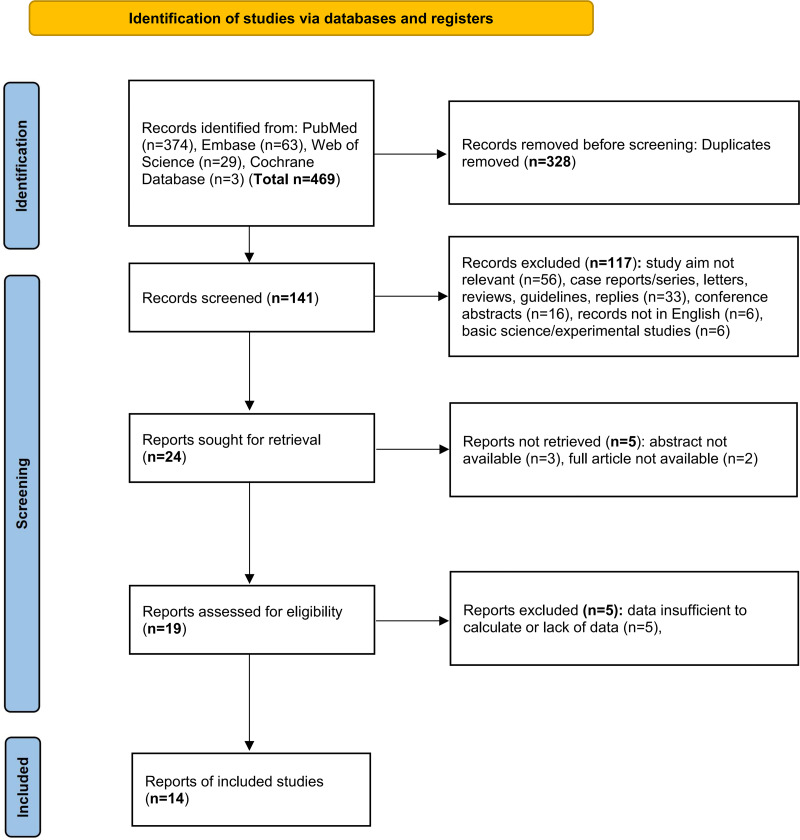
PubMed, Embase, Web of Science, and Cochrane Library databases were searched up to April 2024 for retrieval of full articles. Studies with the exposure of passive smoking and outcome of pancreatic cancer were eligible for the analysis. We generated pooled relative risks (RRs) and 95% confidence intervals (CIs) using DerSimonian-Laird random-effects models. Quality of evidence was assessed using the GRADE system.
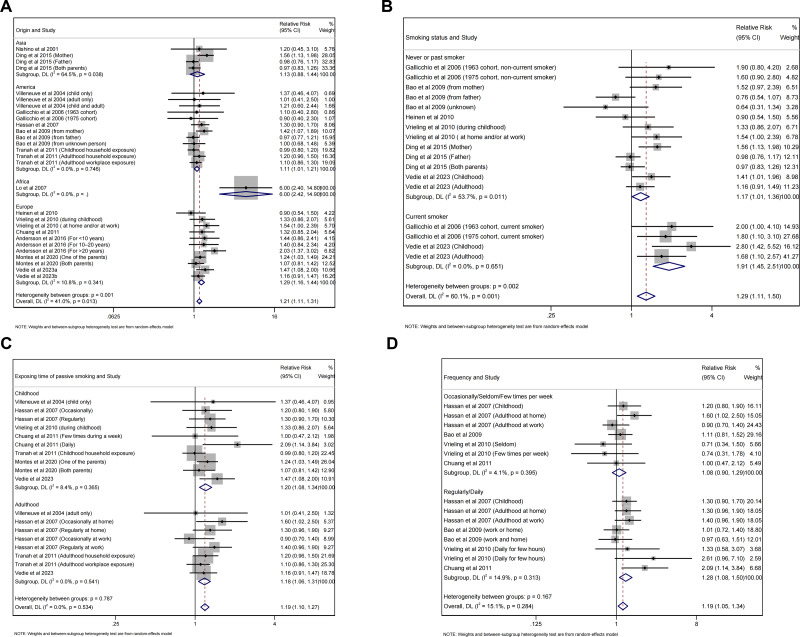
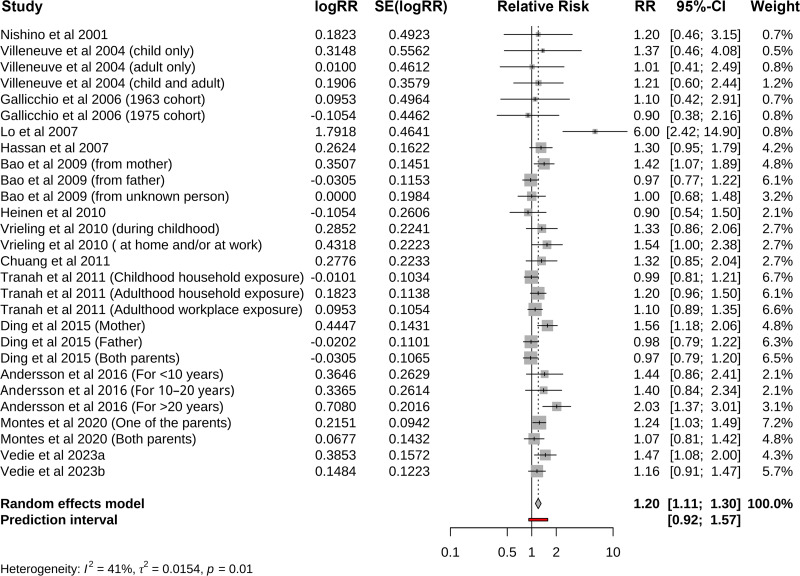
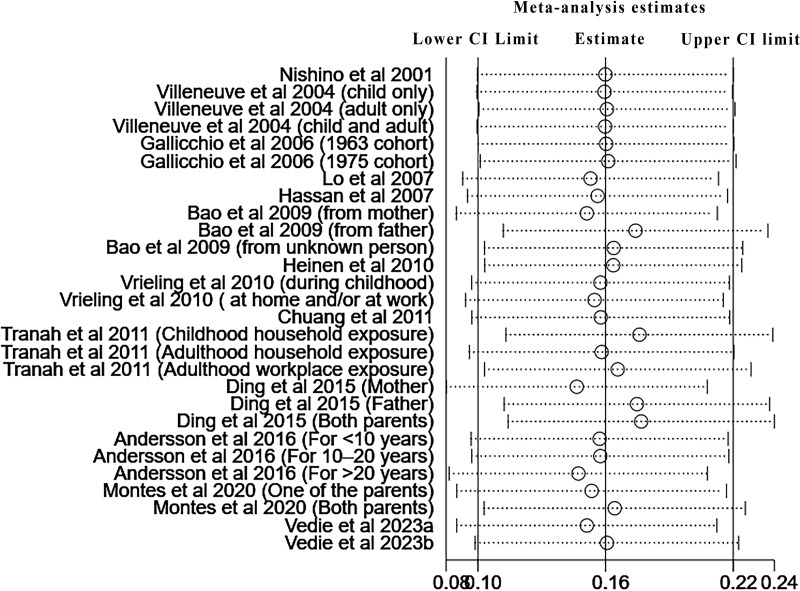
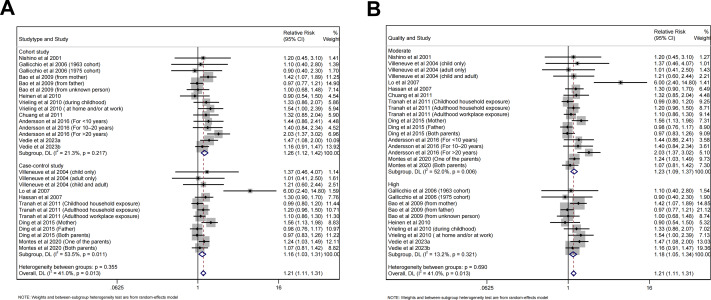
Fourteen studies were included, with 5,560 pancreatic cancer patients. Passive smoking was associated with a moderate increased risk of pancreatic cancer (RR = 1.20, 95% CI: 1.11-1.30, < 0.001). The results were consistent in both case-control (=0.013) and cohort studies ( < 0.001) and in studies with high ( = 0.007) and moderate quality ( < 0.001). In subgroup analysis, the risk was significant for both current (RR=1.91, 95% CI: 1.45-2.51, < 0.001) and non-current smokers (RR = 1.17, 95% CI: 1.01-1.36, = 0.037), for exposure both in adulthood (RR = 1.18, 95% CI: 1.06-1.31, = 0.002) and childhood (RR = 1.20, 95% CI: 1.08-1.34, = 0.001). However, only regular or daily exposure (RR=1.28, 95% CI: 1.08-1.50, = 0.003), rather than exposing occasionally, seldom or few times per week ( = 0.421), to passive smoking could increase the risk of pancreatic cancer.
Passive smoking exposure confers a significant increased risk for pancreatic cancer. The risk was valid in both case-control and cohort, high and moderate quality studies, in current and non-current smokers, and for both childhood and adulthood exposure. Regular or daily exposure rather than exposing occasionally, seldom or few times per week could exert a detrimental effect on pancreatic cancer.
先前的荟萃分析表明,被动吸烟与胰腺癌之间不存在关联。然而,最近有越来越多的证据表明并非如此。本研究旨在证实这种关联。
检索了 PubMed、Embase、Web of Science 和 Cochrane Library 数据库,以获取截至 2024 年 4 月的全文文章。符合分析条件的研究是针对暴露于被动吸烟和胰腺癌结局的研究。我们使用 DerSimonian-Laird 随机效应模型生成合并的相对风险(RR)和 95%置信区间(CI)。使用 GRADE 系统评估证据质量。
纳入了 14 项研究,共纳入 5560 例胰腺癌患者。被动吸烟与胰腺癌的风险呈中度增加相关(RR=1.20,95%CI:1.11-1.30,<0.001)。病例对照研究(=0.013)和队列研究(<0.001)以及高质量(=0.007)和中等质量(<0.001)的研究结果一致。在亚组分析中,当前吸烟者(RR=1.91,95%CI:1.45-2.51,<0.001)和非当前吸烟者(RR=1.17,95%CI:1.01-1.36,=0.037)的风险均有统计学意义,在成年期(RR=1.18,95%CI:1.06-1.31,=0.002)和儿童期(RR=1.20,95%CI:1.08-1.34,=0.001)的暴露风险也有统计学意义。然而,只有经常或每天暴露(RR=1.28,95%CI:1.08-1.50,=0.003),而不是偶尔、很少或每周几次(=0.421)暴露于被动吸烟,才会增加患胰腺癌的风险。
被动吸烟暴露会显著增加患胰腺癌的风险。这种风险在病例对照和队列、高质量和中等质量的研究中均成立,无论是当前吸烟者还是非当前吸烟者,无论在成年期还是儿童期暴露,都成立。经常或每天暴露而不是偶尔、很少或每周几次暴露会对胰腺癌产生不利影响。