Orak Foruzan, Saadat Maryam, Saki Malehi Amal, Behdarvandan Amin, Esfandiarpour Fateme
Student Research Committee, School of Rehabilitation Sciences, Ahvaz Jundishapur University of Medical Sciences, Ahvaz,Iran.
Rehabilitation Research Center, Ahvaz Jundishapur University of Medical Sciences, Ahvaz, Iran.
Med J Islam Repub Iran. 2024 Apr 30;38:48. doi: 10.47176/mjiri.38.48. eCollection 2024.
The evaluation of VTE risk using risk assessment scales for each hospitalized patient is recommended by the National Institute for Health and Care Excellence. The purpose of this study was to compare the predictive accuracy of two common assessment scales, the Autar and Padua deep vein thrombosis (DVT) risk assessment scales.
This prospective cohort study was conducted on 228 ICU hospitalized patients. The risk of VTE was estimated using the Autar and Padua scales during the first 48 hours after admission. The predictive accuracy of the above two risk assessment scales for VTE in ICU patients was compared based on the area under the receiver operating curve (ROC).
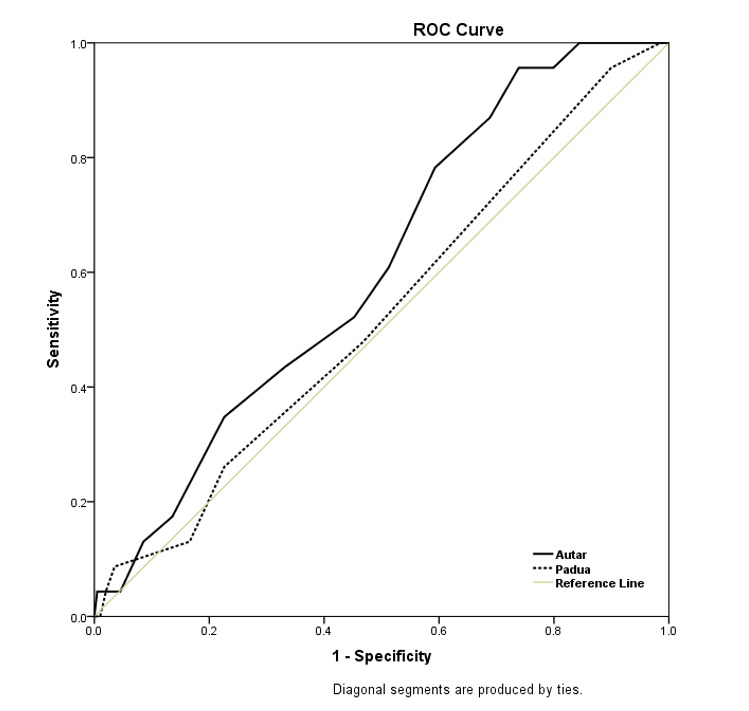
Results of ROC analysis indicated the area under the curve (AUC) values for the Autar (0.61 ± 0.05) and Pauda (0.53 ± 0.06). Log-rank test showed no difference in AUCs ( = 0.19). Moreover, the accuracy of the Autar scale and Padua obtained 24% and 14% respectively. Both scales had 100% sensitivity but their specificity was low (Autar 14% and Padua 3%). The positive likelihood ratios (LR+) were 1.17 for Autar and 1.03 for Padua. The negative likelihood ratios (LR-) were 0 for Autar and 0.89 for Padua. Inter-rater agreement values obtained 0.99 and 0.95 respectively for the the Autar and Padua scales.
The AUC, accuracy, and LR+ of the Autar risk assessment scale were higher than the Padua scale in predicting VTE. However, both scales had excellent reliability, high sensitivity and low specificity. It is recommended that the risk of VTE is recorded by the Autar scale for patients admitted to ICUs. It can help the healthcare team in the use of prophylaxis for those that are at high risk for VTE.
英国国家卫生与临床优化研究所建议,对每位住院患者使用风险评估量表评估静脉血栓栓塞(VTE)风险。本研究的目的是比较两种常用评估量表——奥塔尔(Autar)和帕多瓦(Padua)深静脉血栓形成(DVT)风险评估量表的预测准确性。
本前瞻性队列研究针对228例入住重症监护病房(ICU)的患者进行。入院后头48小时内使用奥塔尔和帕多瓦量表评估VTE风险。基于受试者工作特征曲线(ROC)下的面积,比较上述两种风险评估量表对ICU患者VTE的预测准确性。
ROC分析结果显示,奥塔尔量表的曲线下面积(AUC)值为0.61±0.05,帕多瓦量表为0.53±0.06。对数秩检验显示AUCs无差异(P = 0.19)。此外,奥塔尔量表和帕多瓦量表的准确率分别为24%和14%。两种量表的敏感度均为100%,但特异度较低(奥塔尔量表为14%,帕多瓦量表为3%)。奥塔尔量表的阳性似然比(LR+)为1.17,帕多瓦量表为1.03。奥塔尔量表的阴性似然比(LR-)为0,帕多瓦量表为0.89。奥塔尔量表和帕多瓦量表的评分者间一致性值分别为0.99和0.95。
在预测VTE方面,奥塔尔风险评估量表的AUC、准确率和LR+均高于帕多瓦量表。然而,两种量表都具有出色的可靠性、高敏感度和低特异度。建议对入住ICU的患者使用奥塔尔量表记录VTE风险。这有助于医疗团队对VTE高危患者采取预防措施。