Zhakhina Gulnur, Sakko Yesbolat, Yerdessov Sauran, Aimyshev Temirgali, Makhammajanov Zhalaliddin, Abbay Anara, Vinnikov Denis, Fakhradiyev Ildar, Yermakhanova Zhanar, Solak Yalcin, Salustri Alessandro, Gaipov Abduzhappar
Department of Medicine, School of Medicine, Nazarbayev University, Astana, Kazakhstan.
Department of Biomedical Sciences, School of Medicine, Nazarbayev University, Astana, Kazakhstan.
J Epidemiol Glob Health. 2024 Dec;14(4):1609-1618. doi: 10.1007/s44197-024-00313-6. Epub 2024 Oct 14.
Peripheral artery disease (PAD) is a global health concern associated with arterial narrowing or blockage, leading to significant morbidity and mortality. The aim of this study is to assess the disease burden and trends in mortality utilizing nationwide administrative health data.
This retrospective study utilized data from the Unified National Electronic Healthcare System (UNEHS) from 2014 to 2021. Patients meeting PAD criteria were included, with demographic and clinical data analyzed. Cox regression and Competing Risk Analysis assessed mortality risks.
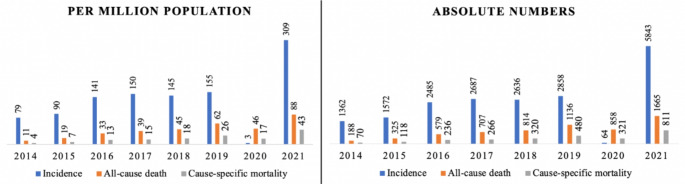
Between 2014 and 2021, 19,507 individuals were hospitalized due to PAD, with 8,332 (43%) being women and 11,175 (57%) men. The incidence of PAD increased markedly over the observation period, rising from 79 individuals per million population (PMP) in 2014 to 309 PMP in 2021. Concurrent heart failure (HF), acute myocardial infarction (AMI), diabetes, and essential hypertension were prevalent in 50%, 27%, 27%, and 26% of the PAD patients, respectively. Competing Risk Analysis showed a subdistribution hazard ratio (SHR) of 6.53 [95% CI: 4.65-9.19] for individuals over 80 years. Heart failure was associated with lower all-cause HR [0.80, 95% CI: 0.76-0.86, p < 0.001] but higher SHR [1.30, 95% CI: 1.18-1.44, p < 0.001]. Comorbidities such as heart failure, stroke, and acute myocardial infarction significantly increased mortality risks, while essential hypertension was associated with lower risk of death.
The significant rise in the incidence rate of PAD underscores the growing burden of the disease, highlighting the urgent need for targeted preventive and management strategies in Kazakhstan.
外周动脉疾病(PAD)是一个全球性的健康问题,与动脉狭窄或阻塞相关,会导致严重的发病率和死亡率。本研究的目的是利用全国性的行政卫生数据评估疾病负担和死亡率趋势。
这项回顾性研究使用了2014年至2021年统一国家电子医疗系统(UNEHS)的数据。纳入符合PAD标准的患者,并对人口统计学和临床数据进行分析。采用Cox回归和竞争风险分析评估死亡风险。
2014年至2021年期间,有19507人因PAD住院,其中女性8332人(43%),男性11175人(57%)。在观察期内,PAD的发病率显著上升,从2014年的每百万人口79人(PMP)增至2021年的309 PMP。分别有50%、27%、27%和26%的PAD患者并发心力衰竭(HF)、急性心肌梗死(AMI)、糖尿病和原发性高血压。竞争风险分析显示,80岁以上人群的亚分布风险比(SHR)为6.53 [95%置信区间:4.65 - 9.19]。心力衰竭与较低的全因风险比[0.80,95%置信区间:0.76 - 0.86,p < 0.001]相关,但与较高的SHR[1.30,95%置信区间:1.18 - 1.44,p < 0.001]相关。心力衰竭、中风和急性心肌梗死等合并症显著增加死亡风险,而原发性高血压与较低的死亡风险相关。
PAD发病率的显著上升凸显了该疾病负担的不断增加,突出了哈萨克斯坦针对性预防和管理策略的迫切需求。