College of Science and Engineering, Flinders University, Bedford Park, South Australia, Australia.
The Aerobiome Innovation and Research Hub, Flinders University, Bedford Park, South Australia, Australia.
Microb Biotechnol. 2024 Oct;17(10):e70018. doi: 10.1111/1751-7915.70018.
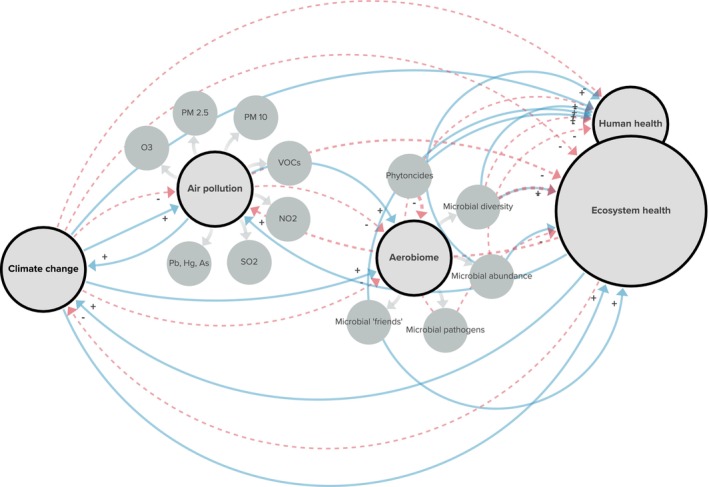
The interrelationship between climate change, pollution and the aerobiome (the microbiome of the air) is a complex ecological dynamic with profound implications for human and ecosystem health. This mini-review explores the multifaceted relationships among these factors. By synthesising existing research and integrating interdisciplinary perspectives, we examine the mechanisms driving interactions within the climate change-pollution-aerobiome nexus. We also explore synergistic and cascading effects and potential impacts on human health (including both communicable and non-communicable diseases) and that of wider ecosystems. Based on our mini-review results, climate change influences air pollution and, independently, air pollution affects the composition, diversity and activity of the aerobiome. However, we apply a 'systems thinking' approach and create a set of systems diagrams to show that climate change likely influences the aerobiome (including bacteria and fungi) via climate change-pollution interactions in complex ways. Due to the inherent complexity of these systems, we emphasise the importance of holistic and/or interdisciplinary approaches and collaborative efforts in understanding this nexus to safeguard planetary health in an era of rapid environmental change.
气候变化、污染和空气微生物组(空气微生物群落)之间的相互关系是一个复杂的生态动态系统,对人类和生态系统健康有着深远的影响。本综述探讨了这些因素之间的多方面关系。通过综合现有研究和整合跨学科观点,我们研究了在气候变化-污染-空气微生物组关联体内部相互作用的驱动机制。我们还探讨了协同和级联效应以及对人类健康(包括传染病和非传染病)和更广泛生态系统的潜在影响。基于我们的综述结果,气候变化影响空气污染,而空气污染独立地影响空气微生物组的组成、多样性和活性。然而,我们应用“系统思维”方法并创建了一组系统图,以表明气候变化可能通过气候变化-污染相互作用以复杂的方式影响空气微生物组(包括细菌和真菌)。由于这些系统的固有复杂性,我们强调在快速环境变化时代,采用整体的和/或跨学科的方法以及协作努力来理解这一关联体以维护行星健康的重要性。