Department of Microbiology, University of Alabama at Birminghamgrid.265892.2, Birmingham, Alabama, USA.
UAB Genomics Core Facility, Department of Genetics, University of Alabama at Birminghamgrid.265892.2, Birmingham, Alabama, USA.
J Virol. 2021 Oct 13;95(21):e0135721. doi: 10.1128/JVI.01357-21. Epub 2021 Aug 18.
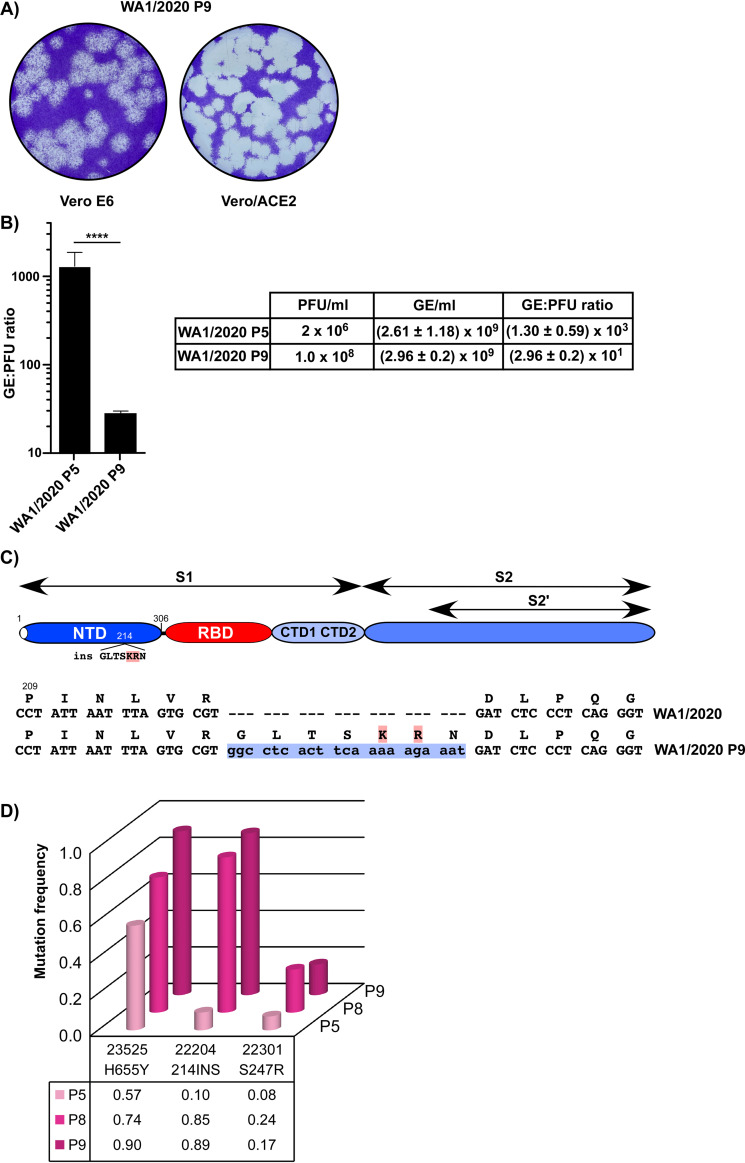
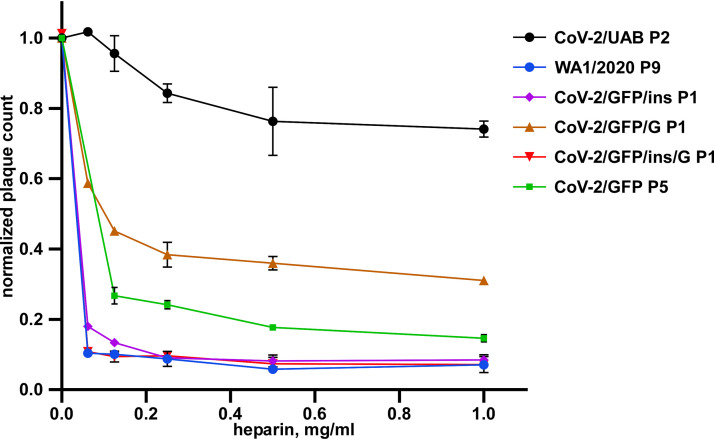
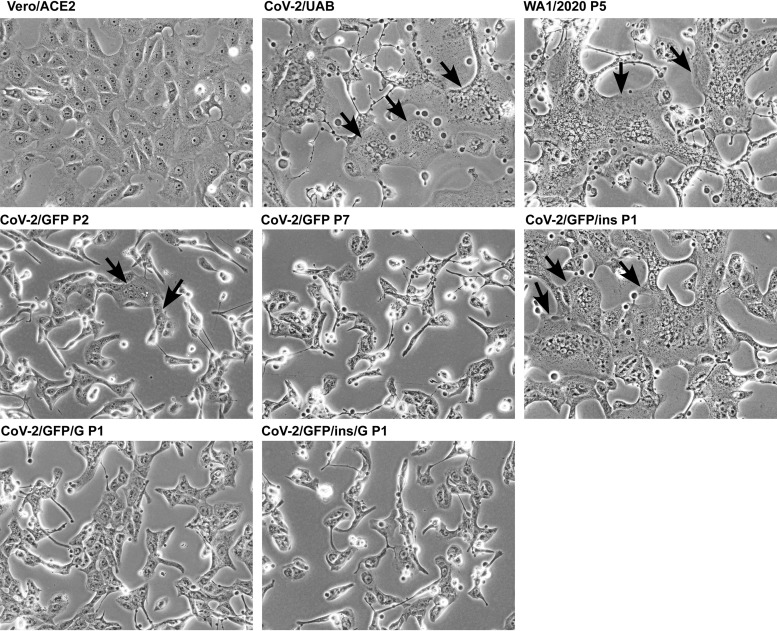
One of the severe acute respiratory syndrome coronavirus 2 (SARS-CoV-2) virulence factors is the ability to interact with high affinity to the ACE2 receptor, which mediates viral entry into cells. The results of our study demonstrate that within a few passages in cell culture, both the natural isolate of SARS-CoV-2 and the recombinant cDNA-derived variant acquire an additional ability to bind to heparan sulfate (HS). This promotes a primary attachment of viral particles to cells before their further interactions with the ACE2. Interaction with HS is acquired through multiple mechanisms. These include (i) accumulation of point mutations in the N-terminal domain (NTD) of the S protein, which increases the positive charge of the surface of this domain, (ii) insertions into the NTD of heterologous peptides containing positively charged amino acids, and (iii) mutation of the first amino acid downstream of the furin cleavage site. This last mutation affects S protein processing, transforms the unprocessed furin cleavage site into the heparin-binding peptide, and makes viruses less capable of syncytium formation. These viral adaptations result in higher affinity of viral particles to heparin, dramatic increase in plaque sizes, more efficient viral spread, higher infectious titers, and 2 orders of magnitude higher infectivity. The detected adaptations also suggest an active role of NTD in virus attachment and entry. As in the case of other RNA-positive (RNA) viruses, evolution to HS binding may result in virus attenuation . The spike protein of SARS-CoV-2 is a major determinant of viral pathogenesis. It mediates binding to the ACE2 receptor and, later, fusion of viral envelope and cellular membranes. The results of our study demonstrate that SARS-CoV-2 rapidly evolves during propagation in cultured cells. Its spike protein acquires mutations in the NTD and in the P1' position of the furin cleavage site (FCS). The amino acid substitutions or insertions of short peptides in NTD are closely located on the protein surface and increase its positive charge. They strongly increase affinity of the virus to heparan sulfate, make it dramatically more infectious for the cultured cells, and decrease the genome equivalent to PFU (GE/PFU) ratio by orders of magnitude. The S686G mutation also transforms the FCS into the heparin-binding peptide. Thus, the evolved SARS-CoV-2 variants efficiently use glycosaminoglycans on the cell surface for primary attachment before the high-affinity interaction of the spikes with the ACE2 receptor.
严重急性呼吸综合征冠状病毒 2(SARS-CoV-2)的一个毒力因子是与 ACE2 受体高亲和力相互作用的能力,该受体介导病毒进入细胞。我们的研究结果表明,在细胞培养中经过几次传代后,SARS-CoV-2 的天然分离株和重组 cDNA 衍生的变体都获得了与肝素硫酸盐(HS)结合的额外能力。这促进了病毒颗粒在与 ACE2 进一步相互作用之前与细胞的初步附着。与 HS 的相互作用是通过多种机制获得的。这些机制包括:(i)在 S 蛋白的 N 端结构域(NTD)中积累点突变,从而增加该结构域表面的正电荷,(ii)插入 NTD 中含有正电荷氨基酸的异源肽,以及(iii)在弗林切割位点下游的第一个氨基酸的突变。最后一个突变影响 S 蛋白的加工,将未加工的弗林切割位点转化为肝素结合肽,并使病毒更难以形成合胞体。这些病毒适应性导致病毒颗粒对肝素的亲和力更高,斑块大小急剧增加,病毒传播效率更高,感染滴度更高,感染性提高 2 个数量级。检测到的适应性也表明 NTD 在病毒附着和进入中起积极作用。与其他 RNA 阳性(RNA)病毒一样,向 HS 结合的进化可能导致病毒衰减。SARS-CoV-2 的刺突蛋白是病毒发病机制的主要决定因素。它介导与 ACE2 受体的结合,随后是病毒包膜和细胞膜的融合。我们的研究结果表明,SARS-CoV-2 在细胞培养中繁殖时会迅速进化。其刺突蛋白在 NTD 和弗林切割位点(FCS)的 P1'位置获得突变。NTD 中氨基酸取代或短肽插入与蛋白质表面紧密相邻,并增加其正电荷。它们强烈增加病毒对肝素硫酸盐的亲和力,使它对培养细胞的感染力大大增强,并使基因组等效物与 PFU(GE/PFU)的比值降低几个数量级。S686G 突变还将 FCS 转化为肝素结合肽。因此,进化后的 SARS-CoV-2 变体在与 ACE2 受体的高亲和力相互作用之前,能够有效地利用细胞表面的糖胺聚糖进行初步附着。