Dan Weichao, Fan Yizeng, Wang Yuzhao, Hou Tao, Wei Yi, Liu Bo, Li Mengxing, Chen Jiaqi, Fang Qixiang, Que Taotao, Lei Yuzeshi, Guo Chendong, Wang Chi, Gao Yang, Zeng Jin, Li Lei
Department of Urology, The First Affiliated Hospital of Xi'an Jiaotong University, Xi'an, 710061, P. R. China.
Key Laboratory for Tumor Precision Medicine of Shaanxi Province, The First Affiliated Hospital of Xi'an Jiaotong University, Xi'an, 710061, P. R. China.
Adv Sci (Weinh). 2024 Dec;11(45):e2405441. doi: 10.1002/advs.202405441. Epub 2024 Oct 14.
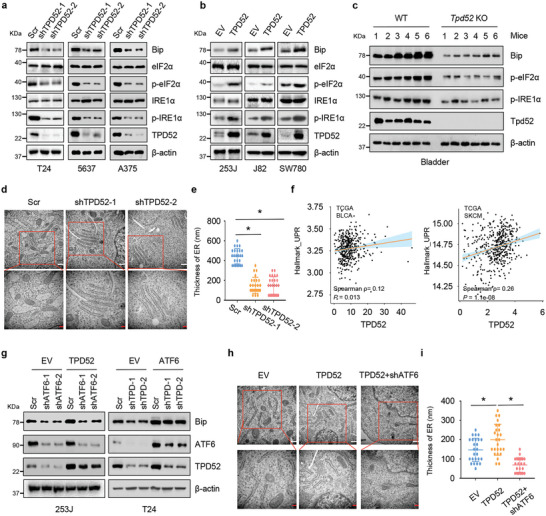
Aberrant regulation of unfolded protein response (UPR)/endoplasmic reticulum (ER) stress pathway is associated with cancer development, metastasis, and relapse, and the UPR signal transducer ATF6 has been proposed as a diagnostic and prognostic marker for many cancers. However, a causal molecular link between ATF6 activation and carcinogenesis is not established. Here, it is found that tumor protein D52 (TPD52) integrates ER stress and UPR signaling with the chaperone machinery by promoting S2P-mediated cleavage of ATF6. Although TPD52 has been generally considered as an oncogene, TPD52 is identified as a novel tumor suppressor in bladder cancer. Significantly, attenuation of the ER stress via depletion of TPD52 facilitated tumorigenesis in a subset of human carcinomas. Furthermore, the APC E3 ligase is validated as the upstream regulator marking TPD52 for polyubiquitination-mediated proteolysis. In addition, inactivation of Cdc20 sensitized cancer cells to treatment with the ER stress inducer in a TPD52-dependent manner. Thus, the study suggests that TPD52 is a novel Cdc20 substrate that may modulate ER stress to prevent tumorigenesis.
未折叠蛋白反应(UPR)/内质网(ER)应激途径的异常调节与癌症的发生、转移和复发相关,并且UPR信号转导因子ATF6已被提议作为多种癌症的诊断和预后标志物。然而,ATF6激活与致癌作用之间的因果分子联系尚未确立。在此,研究发现肿瘤蛋白D52(TPD52)通过促进S2P介导的ATF6裂解,将内质网应激和UPR信号与伴侣机制整合在一起。尽管TPD52通常被认为是一种癌基因,但在膀胱癌中TPD52被鉴定为一种新的肿瘤抑制因子。值得注意的是,通过消耗TPD52减轻内质网应激促进了一部分人类癌症的肿瘤发生。此外,APC E3连接酶被确认为标记TPD52进行多聚泛素化介导的蛋白水解的上游调节因子。另外,Cdc20失活以TPD52依赖的方式使癌细胞对内质网应激诱导剂治疗敏感。因此,该研究表明TPD52是一种新的Cdc20底物,可能调节内质网应激以预防肿瘤发生。