Pförtner Timo-Kolja, Gube Monika, Koch Thilo, Michels Josef, Dohle Simone, Demirer Ibrahim
Research Methods Division, Faculty of Human Sciences, University of Cologne, Cologne, Germany.
Health Authority of the City and Area of Aachen, Aachen, Germany.
Pediatr Obes. 2025 Feb;20(2):e13181. doi: 10.1111/ijpo.13181. Epub 2024 Oct 14.
This study examined cross-level interaction between parental education and neighbourhood SES in predicting overweight including obesity among school-aged children.
This analysis used data from 19 984 children aged 5-6 years participating in the school-entry examination of the years 2015 to 2019 in the Aachen city region in Germany. We employed multilevel logistic regression models to predict overweight based on parental education and neighbourhood SES, along with their cross-level interaction, while controlling for several characteristics of the child.
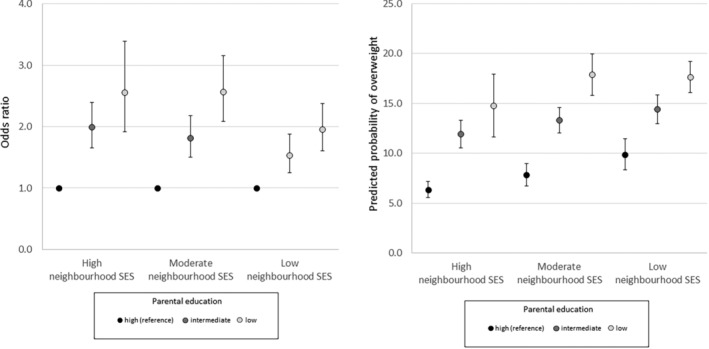
Children from families with intermediate (OR: 1.99; 95% CI, 1.65-2.40) and low parental education (OR: 2.55; 95% CI, 1.92-3.39) and from neighbourhoods with intermediate (OR: 1.25; 95% CI, 1.02-1.53) and low SES (OR: 1.61; 95% CI, 1.29-2.02) were at significantly higher odds for overweight. There was an indication of a cross-level interaction effect (p-value <0.10) to the disadvantage of children with higher parental education, suggesting that inequalities in overweight decrease in more deprived neighbourhoods. The predicted probability of overweight for children with high parental education increased from 6.4% in high SES neighbourhoods to 7.8% in intermediate and 9.9% in low SES neighbourhoods. Sensitivity analyses for obesity and a higher context level of spatial SES confirmed the results.
The results highlight the crucial role of both individual and contextual socioeconomic conditions in predicting childhood overweight. They also suggest that the impact of neighbourhood socioeconomic status on childhood overweight varies by parental education, particularly disadvantaging children with higher parental education, indicating a social contagion of overweight through spatial disadvantage.
本研究探讨了在预测学龄儿童超重(包括肥胖)方面,父母教育程度与邻里社会经济地位(SES)之间的跨层次交互作用。
本分析使用了来自德国亚琛市地区2015年至2019年参加入学考试的19984名5至6岁儿童的数据。我们采用多水平逻辑回归模型,在控制儿童的若干特征的同时,根据父母教育程度和邻里SES及其跨层次交互作用来预测超重情况。
父母教育程度中等(比值比[OR]:1.99;95%置信区间[CI],1.65 - 2.40)和低等(OR:2.55;95% CI,1.92 - 3.39)的家庭中的儿童,以及邻里SES中等(OR:1.25;95% CI,1.02 - 1.53)和低等(OR:1.61;95% CI,1.29 - 2.02)的儿童超重几率显著更高。有迹象表明存在对父母教育程度较高的儿童不利的跨层次交互作用效应(p值<0.10),这表明在更贫困的邻里中,超重方面不平等现象有所减少。父母教育程度高的儿童超重的预测概率从高SES邻里中的6.4%增加到中等SES邻里中的7.8%以及低SES邻里中的9.9%。对肥胖以及更高空间SES背景水平的敏感性分析证实了这些结果。
研究结果突出了个体和背景社会经济状况在预测儿童超重方面的关键作用。它们还表明,邻里社会经济地位对儿童超重的影响因父母教育程度而异,尤其对父母教育程度较高的儿童不利,这表明超重现象通过空间劣势存在社会传播。