Office of Analysis and Epidemiology, National Center for Health Statistics, Centers for Disease Control and Prevention, , Hyattsville, Maryland, USA.
J Epidemiol Community Health. 2014 Feb;68(2):123-9. doi: 10.1136/jech-2012-202245. Epub 2013 Sep 26.
Low-income and some racial and ethnic subpopulations are more likely to suffer from obesity. Inequities in the physical and social environment may contribute to disparities in paediatric obesity, but there is little empirical evidence to date. This study explored whether neighbourhood-level socioeconomic factors attenuate racial and ethnic disparities in obesity among youth in the U.S.A. and whether individual-level socioeconomic status (SES) interacts with neighbourhood deprivation.
This analysis used data from 17,100 youth ages 2-18 years participating in the 2001-2010 National Health and Nutrition Examination Survey linked to census tract-level socioeconomic characteristics. Multilevel logistic regression models were used to examine neighbourhood deprivation in association with odds of obesity (age-specific and sex-specific body mass index percentile ≥95).
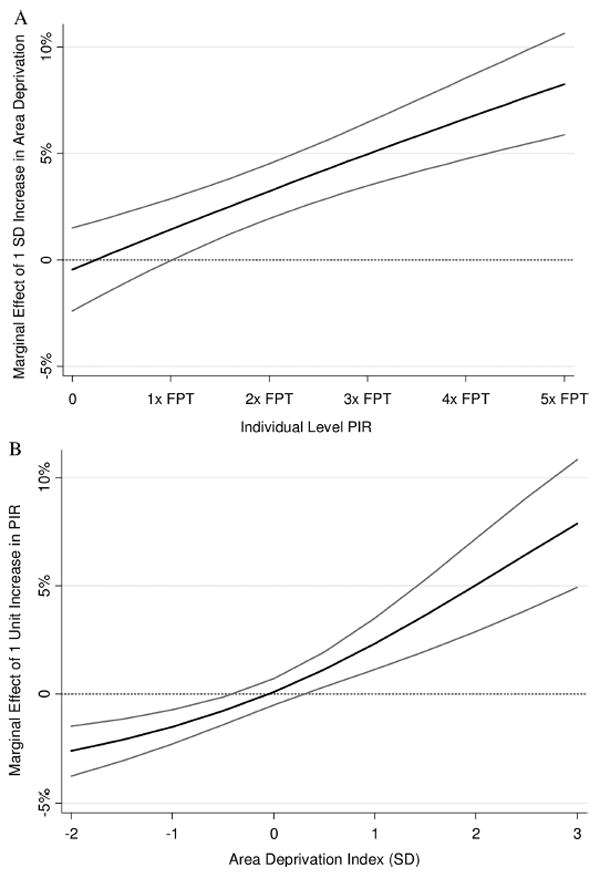
The unadjusted prevalence of obesity was 15% among non-Hispanic white children and 21% among non-Hispanic black and Mexican-American children. Adjustment for individual-level SES neighbourhood deprivation and the interaction between these two factors resulted in a 74% attenuation of the disparity in obesity between non-Hispanic black and non-Hispanic white children and a 49% attenuation of the disparity between Mexican-American and non-Hispanic white children. There was a significant interaction between individual-level SES and neighbourhood deprivation where higher individual-level income was protective for children living in low-deprivation neighbourhoods, but not for children who lived in high-deprivation areas. Conversely, area deprivation was associated with higher odds of obesity, but only among children who were above the poverty threshold.
Future research on disparities in obesity and other health outcomes should examine broader contextual factors and social determinants of inequities.
低收入人群以及某些种族和族裔亚群更容易肥胖。身体和社会环境中的不平等可能导致儿科肥胖的差异,但迄今为止,实证证据很少。本研究探讨了邻里层面的社会经济因素是否会减弱美国青少年肥胖的种族和族裔差异,以及个体社会经济地位(SES)是否与邻里贫困相互作用。
本分析使用了 2001-2010 年全国健康和营养检查调查中 17100 名 2-18 岁青少年的数据,并与普查区社会经济特征相关联。使用多水平逻辑回归模型来研究邻里贫困与肥胖几率(特定年龄和性别身体质量指数百分位数≥95)之间的关联。
未调整的非西班牙裔白种儿童肥胖患病率为 15%,非西班牙裔黑人和墨西哥裔美国儿童肥胖患病率为 21%。调整个体 SES 邻里贫困和这两个因素之间的相互作用后,非西班牙裔黑人和非西班牙裔白种儿童肥胖差异的减弱幅度为 74%,墨西哥裔美国和非西班牙裔白种儿童肥胖差异的减弱幅度为 49%。个体 SES 和邻里贫困之间存在显著的相互作用,个体 SES 较高的情况下,居住在低贫困邻里的儿童会受到保护,但对于居住在高贫困地区的儿童则没有保护作用。相反,地区贫困与肥胖几率增加有关,但仅在儿童收入超过贫困线的情况下才有关联。
未来关于肥胖和其他健康结果差异的研究应检查更广泛的背景因素和不平等的社会决定因素。