Population Health Program, QIMR Berghofer Medical Research Institute, Brisbane, QLD, Australia.
Parkville Familial Cancer Centre, Peter MacCallum Cancer Centre and Royal Melbourne Hospital, Melbourne, VIC, Australia.
Eur J Hum Genet. 2024 Dec;32(12):1632-1639. doi: 10.1038/s41431-024-01705-9. Epub 2024 Oct 14.
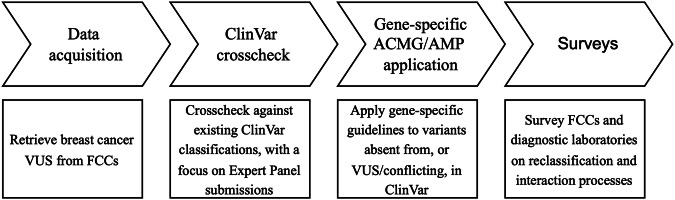
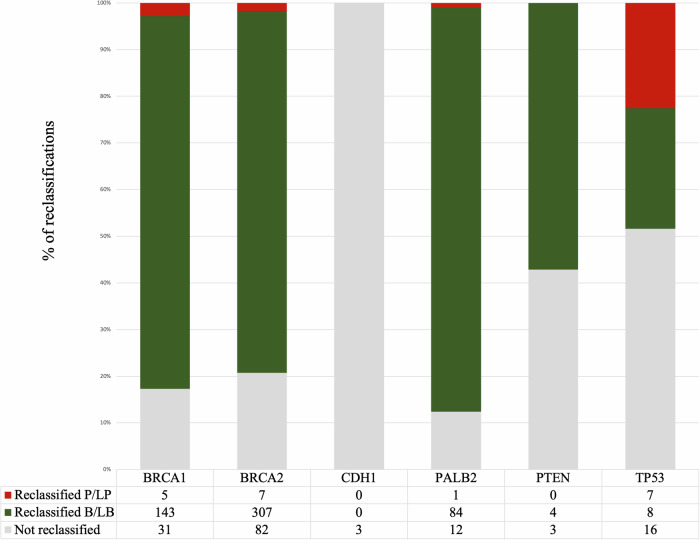
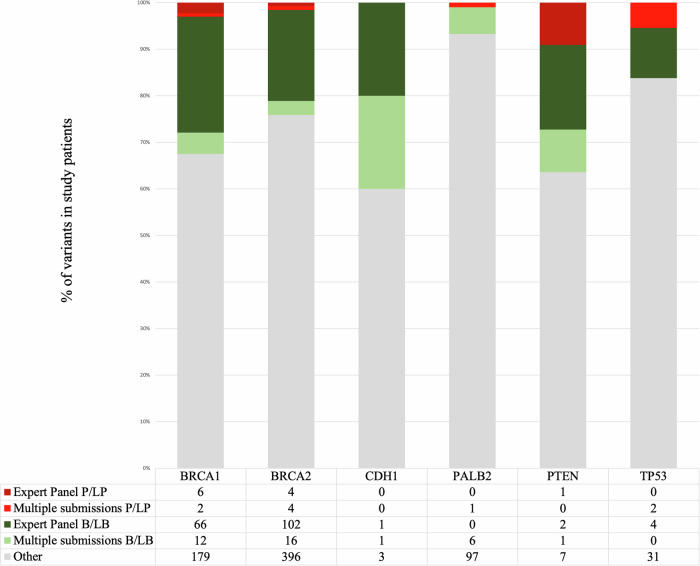
Breast cancer remains a significant global health challenge. In Australia, the adoption of publicly-funded multigene panel testing for eligible cancer patients has increased accessibility to personalised care, yet has also highlighted the increasing prevalence of variants of uncertain significance (VUS), complicating clinical decision-making. This project aimed to explore the spectrum and actionability of breast cancer VUS in Australian familial cancer centers (FCCs). Leveraging data from 11 FCCs participating in the Inherited Cancer Connect database, we retrieved VUS results from 1472 patients. Through ClinVar crosschecks and application of gene-specific ACMG/AMP guidelines, we showed the potential for reclassification of 4% of unique VUS as pathogenic or likely pathogenic, and 80% as benign or likely benign. Surveys conducted with FCCs and diagnostic laboratories described current practices and challenges in variant reclassifications, highlighting resource constraints preventing periodic VUS review and notifications from the laboratories to the FCCs. Our study suggests there are benefits to routine VUS review and reclassification, particularly in publicly-funded healthcare systems. Future research should focus on assessing the clinical impact and cost-effectiveness of implementing routine variant review practices, alongside efforts to enhance communication between FCCs and laboratories.
乳腺癌仍然是全球重大的健康挑战。在澳大利亚,为符合条件的癌症患者提供公共资金资助的多基因面板检测,增加了获得个性化护理的机会,但也凸显了不确定意义变异体(VUS)的日益流行,使临床决策变得更加复杂。本项目旨在探讨澳大利亚家族性癌症中心(FCC)中乳腺癌 VUS 的范围和可操作性。利用参与遗传性癌症连接数据库的 11 个 FCC 的数据,我们从 1472 名患者中检索到了 VUS 结果。通过 ClinVar 交叉检查和应用基因特异性 ACMG/AMP 指南,我们发现 4%的独特 VUS 有可能重新分类为致病性或可能致病性,80%为良性或可能良性。对 FCC 和诊断实验室进行的调查描述了当前在变异体重新分类方面的实践和挑战,突出了资源限制,这些限制阻碍了实验室对 FCC 进行定期 VUS 审查和通知。我们的研究表明,对 VUS 进行常规审查和重新分类是有益的,特别是在公共资助的医疗保健系统中。未来的研究应侧重于评估实施常规变异体审查实践的临床影响和成本效益,同时努力加强 FCC 和实验室之间的沟通。