Department of Cardiovascular Surgery, University Heart and Vascular Centre, Goethe University and University Hospital Frankfurt, Frankfurt/Main, Germany.
J Cardiothorac Surg. 2024 Oct 14;19(1):604. doi: 10.1186/s13019-024-03113-y.
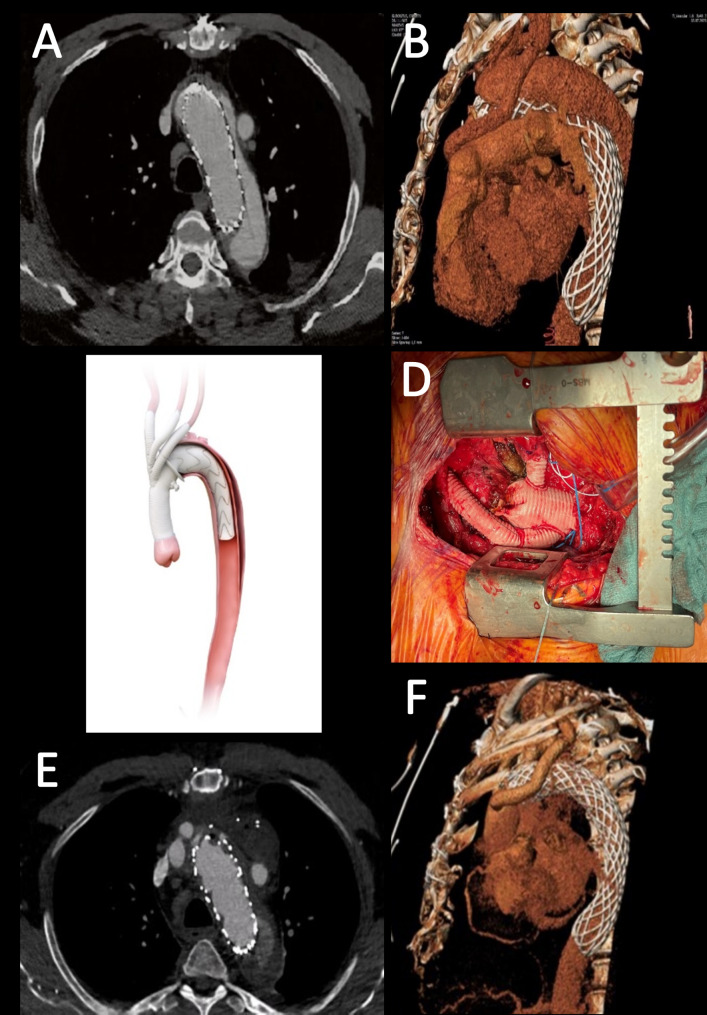
The management of acute type A aortic dissection (ATAAD) using the Ascyrus Medical Dissection Stent (AMDS) can lead to complications due to the persistence of the false lumen (FL). This case report presents two instances of failed AMDS treatment for ATAAD, highlighting the novel use of a trifurcated hybrid prosthesis for redo aortic arch repair using a minimally invasive frozen elephant trunk (FET) technique.
Case 1: A 57-year-old male, previously treated with AMDS for ATAAD, presented with an enlarging aortic arch and persistent FL two years post-surgery caused by re-entry in the distal aortic arch. Redo surgery using the FET technique with an E-vita OPEN NEO Trifurcated hybrid prosthesis resulted in successful repair and partial FL thrombosis. Case 2: A 51-year-old male with prior AMDS treatment for ATAAD presented with severe aortic valve regurgitation and a maintained FL perfusion due to a residual re-entry in the proximal region of the descending aorta. Redo surgery using the FET technique with the same hybrid prosthesis led to successful repair and good recovery, confirmed by follow-up imaging.
The use of the E-vita OPEN NEO Trifurcated hybrid prosthesis in the FET technique offers a promising solution for redo aortic arch repair in cases of failed AMDS treatment for ATAAD. This approach can improve patient outcomes by addressing complications associated with persistent FL and enhancing long-term survival.
使用 Ascyrus 医疗解剖支架(AMDS)治疗急性 A 型主动脉夹层(ATAAD)可能会因假腔(FL)持续存在而导致并发症。本病例报告介绍了 AMDS 治疗 ATAAD 失败的两例病例,重点介绍了使用三分支杂交假体进行 redo 主动脉弓修复的新颖方法,该方法采用微创冷冻象鼻技术(FET)。
病例 1:一名 57 岁男性,先前因 ATAAD 接受 AMDS 治疗,术后两年出现升主动脉扩大和 FL 持续存在,原因是远端主动脉弓再入。使用 FET 技术和 E-vita OPEN NEO 三分支杂交假体进行 redo 手术,成功修复并部分血栓形成 FL。病例 2:一名 51 岁男性,先前因 ATAAD 接受 AMDS 治疗,出现严重主动脉瓣反流和 FL 持续灌注,原因是降主动脉近端残留再入。使用相同的杂交假体通过 FET 技术进行 redo 手术,成功修复并恢复良好,随访影像学证实。
在 AMDS 治疗 ATAAD 失败的情况下,使用 E-vita OPEN NEO 三分支杂交假体在 FET 技术中为 redo 主动脉弓修复提供了一种有前途的解决方案。这种方法可以通过解决与 FL 持续存在相关的并发症并提高长期生存率来改善患者的预后。