Kivali Velma, Roesel Kristina, Dohoo Ian, Alinaitwe Lordrick, Bugeza James Katamba, Hoona Jolly Justine, Mugizi Denis Rwabiita, Kankya Clovice, Dang-Xuan Sinh, Szabo Istvan, Rösler Uwe, Friese Anika, Cook Elizabeth A J
Animal and Human Health Program, International Livestock Research Institute, Kampala, Uganda.
Animal and Human Health Program, International Livestock Research Institute, Nairobi, Kenya.
Front Vet Sci. 2024 Sep 17;11:1427773. doi: 10.3389/fvets.2024.1427773. eCollection 2024.
Non-typhoidal (NTS) is a major cause of gastroenteritis worldwide, often associated with meat consumption and meat processing. Research on NTS infection and circulating serovars in meat value chains in Uganda is limited. We aimed to establish NTS prevalence, antimicrobial resistance, and risk factors among slaughterhouse workers, and to identify potentially zoonotic serovars in the pork value chain.
We conducted a nationwide cross-sectional survey, collecting 364 stool samples from livestock slaughterhouse workers and 1,535 samples from the pork value chain: mesenteric lymph nodes, fecal samples, swabs of carcass splitting floor, cleaning water, meat handlers hand swabs, carcass swabs, raw pork, cooked pork, and mixed raw vegetables. Samples were cultured for isolation of NTS, and subsequently serotyped according to White-Kauffmann-Le Minor scheme. Antimicrobial resistance profiles were determined using tube microdilution and Sensititre EUVSEC3 plates. Semi- structured questionnaires with 35 questions were used to collect data on demographics, work related risk factors and activities outside the slaughterhouse.
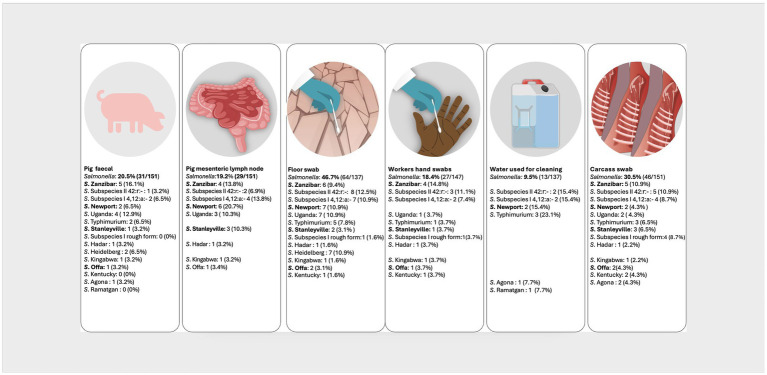
Overall NTS prevalence was 19.2% (365/1899). Proportions at slaughter were; 46.7% in floor swabs, 30.5% in carcass swabs, 20.5% in pig faeces,19.2% in mesenteric lymph nodes,18.4% in hand swabs, 9.5% in water and 5.2% in slaughterhouse workers. At retail, proportions were 33.8% in pork chopping surface, 33.1% in raw pork, 18.9% in hand swabs, 4.0% in cooked pork and 0.7% in vegetables. Sixty-one serovars were identified, with significant overlap between humans and the pork value chain. Overall, zoonotic . Zanzibar, monophasic serovars of . subspecies (II) and subspecies (I), . Typhimurium and . Newport, were the most prevalent. . Typhimurium was predominant in humans and exhibited multi-drug resistance. NTS infection was significantly associated with eating, drinking, or smoking while working (OR = 1.95, 95% CI: 0.67-2.90%, = 0.004). The detected NTS serovars in slaughterhouse workers could be a potential indicator of circulating serovars in the general population. The persistent presence of NTS along the pork value chain highlights occurrence of cross-contamination and the potential for transmission to consumers and slaughterhouse workers. This emphasizes the need to reduce prevalence on pig farms and improve hygiene and pork handling practices at slaughter and retail points.
非伤寒沙门氏菌(NTS)是全球肠胃炎的主要病因,常与肉类消费和肉类加工有关。乌干达肉类价值链中NTS感染及流行血清型的研究有限。我们旨在确定屠宰场工人中NTS的流行率、抗菌药物耐药性及风险因素,并识别猪肉价值链中潜在的人畜共患病血清型。
我们开展了一项全国性横断面调查,从牲畜屠宰场工人处收集了364份粪便样本,从猪肉价值链中收集了1535份样本:肠系膜淋巴结、粪便样本、胴体分割车间拭子、清洁用水、肉类处理人员手部拭子、胴体拭子、生猪肉、熟猪肉及混合生蔬菜。对样本进行培养以分离NTS,随后根据怀特-考夫曼-勒米诺分类法进行血清分型。使用试管微量稀释法和Sensititre EUVSEC3平板测定抗菌药物耐药谱。采用包含35个问题的半结构化问卷收集有关人口统计学、工作相关风险因素及屠宰场以外活动的数据。
NTS总体流行率为19.2%(365/1899)。屠宰环节的比例分别为:车间地面拭子中46.7%,胴体拭子中30.5%,猪粪便中20.5%,肠系膜淋巴结中19.2%,手部拭子中18.4%,水中9.5%,屠宰场工人中5.2%。零售环节的比例分别为:猪肉切割台面33.8%,生猪肉33.1%,手部拭子18.9%,熟猪肉4.0%,蔬菜0.7%。共鉴定出61种血清型,人与猪肉价值链之间存在显著重叠。总体而言,人畜共患病……桑给巴尔、亚种(II)和亚种(I)的单相血清型、……鼠伤寒沙门氏菌和……纽波特沙门氏菌最为常见。鼠伤寒沙门氏菌在人类中占主导地位并表现出多重耐药性。NTS感染与工作时进食、饮水或吸烟显著相关(比值比=1.95,95%置信区间:0.67 - 2.90%,P = 0.004)。屠宰场工人中检测到的NTS血清型可能是一般人群中流行血清型情况的潜在指标。NTS在猪肉价值链中持续存在凸显了交叉污染的发生以及向消费者和屠宰场工人传播的可能性。这强调了降低猪场患病率以及改善屠宰和零售点卫生及猪肉处理做法的必要性。