Seo Min Jae, Yu Wookyung
Department of Brain Sciences, DGIST, 333 Techno Jungang-daero, Daegu 42988, Republic of Korea.
Core Protein Resources Center, DGIST, 333 Techno Jungang-daero, Daegu 42988, Republic of Korea.
Comput Struct Biotechnol J. 2024 Sep 28;23:3445-3453. doi: 10.1016/j.csbj.2024.09.014. eCollection 2024 Dec.
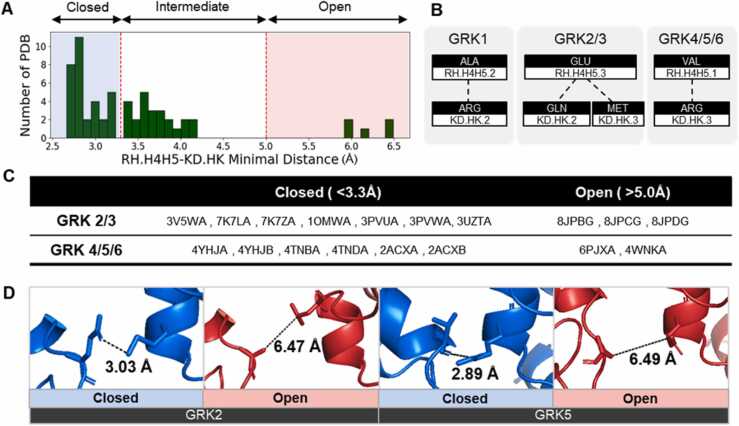
G protein-coupled receptor kinases (GRKs) are essential regulators of signaling pathways mediated by G protein-coupled receptors. Recent research suggests that GRK-mediated phosphorylation patterns dictate functional selectivity, leading to biased cellular responses. However, a comprehensive understanding of the structural mechanisms at the single-residue level remains elusive. This study aims to define the general conformational dynamics of GRKs with a particular focus on quantifying the transitions between the closed and open states. Specifically, we examined these transitions, classified based on the ionic lock between the regulatory G protein signaling homology domain and kinase domain. To facilitate a precise structural comparison, we assigned common labels to topologically identical positions across the 47 GRK structures retrieved from the Protein Data Bank. Our analysis identified both general and subfamily-specific dynamic movements within the networks and measured the conformational change scores between the two states. Elucidating these structural dynamics could provide significant insights into the regulatory mechanisms of GRK.
G蛋白偶联受体激酶(GRKs)是介导G蛋白偶联受体信号通路的重要调节因子。最近的研究表明,GRK介导的磷酸化模式决定了功能选择性,从而导致偏向性细胞反应。然而,在单残基水平上对其结构机制的全面理解仍然难以捉摸。本研究旨在确定GRKs的一般构象动力学,特别关注量化关闭状态和开放状态之间的转变。具体而言,我们研究了这些基于调节性G蛋白信号同源结构域与激酶结构域之间离子锁分类的转变。为便于进行精确的结构比较,我们为从蛋白质数据库检索到的47个GRK结构中拓扑相同的位置赋予了通用标签。我们的分析确定了网络内的一般和亚家族特异性动态运动,并测量了两种状态之间的构象变化分数。阐明这些结构动力学可为GRK的调节机制提供重要见解。