Taylor Rod S, Neville Quinton, Mullin Christopher M, Mekhail Nagy A, Kallewaard Jan W, Hayek Salim, Pope Jason E, Hunter Corey W, Costandi Shrif J, Kapural Leonardo, Gilmore Christopher A, Petersen Erika A, Patel Kiran V, Eldabe Sam, Levy Robert M, Gilligan Christopher, Durbhakula Shravani, Abd-Elsayed Alaa, Bedder Marshall, Buchanan Patrick, Hanson Erin, Leitner Angela, Soliday Nicole, Duarte Rui V, Clauw Daniel J, Nurmikko Turo J
MRC/CSO Social and Public Health Sciences Unit & Robertson Centre for Biostatistics, Institute of Health and Well Being, University of Glasgow, Glasgow, United Kingdom.
Division of Biostatistics, University of Minnesota, Minneapolis, MN, USA.
Pain Rep. 2024 Oct 14;9(6):e1202. doi: 10.1097/PR9.0000000000001202. eCollection 2024 Dec.
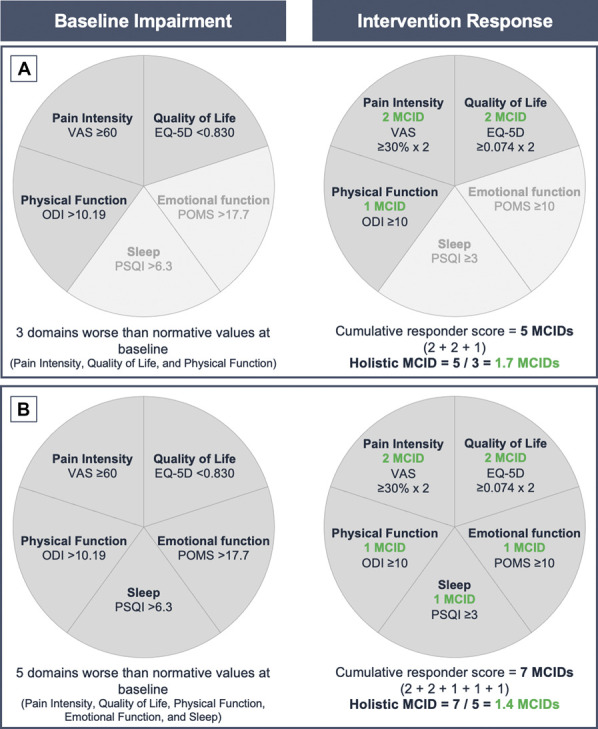
Chronic pain is a personal experience influenced by multiple biopsychosocial factors. Using a pain intensity measure alone to assess the effectiveness of a chronic pain intervention fails to fully evaluate its impact on the multifaceted chronic pain experience. The holistic minimal clinically important difference (MCID) is a composite outcome developed to provide a comprehensive assessment of chronic pain in response to intervention, across 5 outcome domains: pain intensity, health-related quality of life, sleep quality, physical, and emotional function. To focus on domains where the individual need is greatest, the holistic MCID reflects the cumulative MCID averaged over only the domains where subjects were impaired preintervention.
To assess the internal and construct validity of the Holistic MCID score to inform its future use as an evidence-based tool.
This validation study was undertaken using data from the EVOKE trial with 111 patients up to 24-month follow-up. Internal consistency of the holistic MCID was assessed using Cronbach alpha statistic and dimensional exploration using principal component analysis.
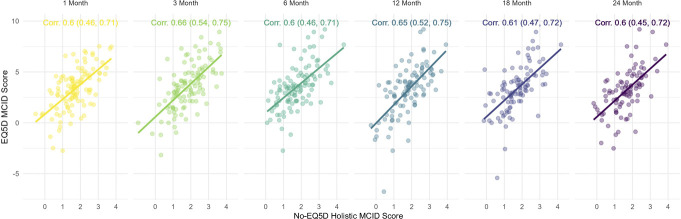
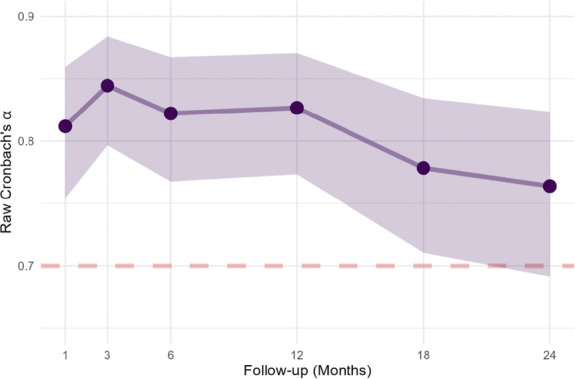
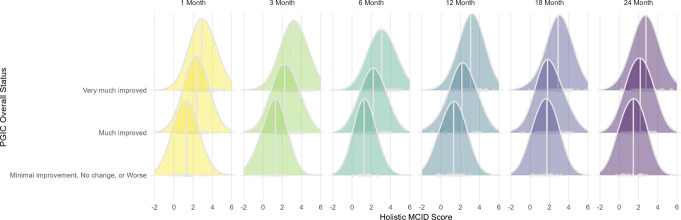
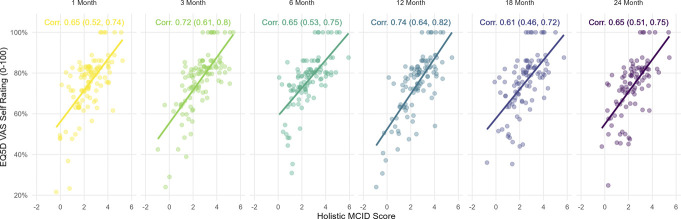
The holistic MCID measure demonstrated strong internal consistency with Cronbach alpha >0.7 at all follow-ups. Principal component analysis showed one overarching holistic dimension to be present in the composite. Construct validity was demonstrated by an increase in the holistic MCID score being associated with both increased Patients' Global Impression of Change, EuroQol visual analogue scale score, and each of the outcome domains in a "leave-one-out" analysis (all < 0.001).
The holistic MCID provides a valid measure for the comprehensive, personalized assessment of response after a chronic pain intervention. The validity of the holistic MCID requires further confirmation in other chronic pain populations and with different interventions.
慢性疼痛是一种受多种生物心理社会因素影响的个人体验。仅使用疼痛强度测量来评估慢性疼痛干预措施的有效性,无法全面评估其对多方面慢性疼痛体验的影响。整体最小临床重要差异(MCID)是一种综合结果指标,旨在全面评估慢性疼痛干预后的情况,涵盖5个结果领域:疼痛强度、健康相关生活质量、睡眠质量、身体功能和情绪功能。为了关注个体需求最大的领域,整体MCID仅反映干预前受损领域的平均累积MCID。
评估整体MCID评分的内部效度和结构效度,为其未来作为循证工具的应用提供依据。
本验证研究使用了EVOKE试验的数据,对111例患者进行了长达24个月的随访。使用Cronbach α统计量评估整体MCID的内部一致性,并使用主成分分析进行维度探索。
在所有随访中,整体MCID测量显示出较强的内部一致性,Cronbach α>0.7。主成分分析表明该综合指标中存在一个总体的整体维度。在“留一法”分析中,整体MCID评分的增加与患者总体变化印象、欧洲五维度健康量表视觉模拟评分以及每个结果领域的增加相关,证明了结构效度(所有P<0.001)。
整体MCID为慢性疼痛干预后反应的全面、个性化评估提供了一种有效的测量方法。整体MCID的效度需要在其他慢性疼痛人群和不同干预措施中进一步得到证实。