Chen Xiaoman, Zhang Shuo
Department of Neurology, Shengjing Hospital of China Medical University, Shenyang, Liaoning, 110004, China.
Heliyon. 2024 Sep 27;10(19):e38602. doi: 10.1016/j.heliyon.2024.e38602. eCollection 2024 Oct 15.
Early recognition and prediction of stroke mimics (SM) can avoid inappropriate recanalization therapy and delay in the management of SM etiology. The purpose of this study is to screen the predictors for SM and develop a novel predictive nomogram model for predicting SM. Meanwhile, the diagnostic performance of the nomogram model was evaluated and validated. The diagnostic efficacy of the nomogram model was also compared with four other SM structured scales.
The clinical data of eligible patients were retrospectively enrolled as training datasets from January 2020 to December 2021; and the clinical data of eligible patients were prospectively enrolled as validation datasets from February to December 2022 in stroke center, Shengjing hospital, respectively. Univariate analysis and Lasso regression were used to select the optimal predictors for the training set, and a nomogram model was constructed by multivariate logistics regression, predictive scoring based on nomogram model is performed for each subject suffering from suspected acute ischemic stroke. Area under the curve (AUC), Hosmer-Lemeshow goodness-of-fit test, Calibration curve, decision curve analysis (DCA), clinical impact curve (CIC) analysis and bootstrap sampling were performed to assess and validate the predictive performance and clinical utility of the nomogram model, and the DeLong test was used to compare the overall diagnostic performance of the nomogram model with the other four structured SM scales. The Delong test was also conducted to assess the external reliability of the SM nomogram model by comparing the predictive diagnostic performance of the validation set with the training set. Additionally, the Calibration curve was utilized to evaluate the diagnostic calibration capability of the SM nomogram model in the validation set.
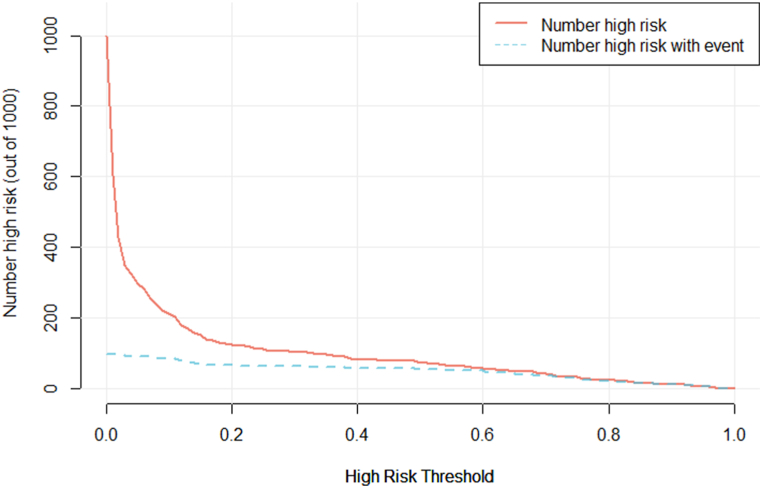
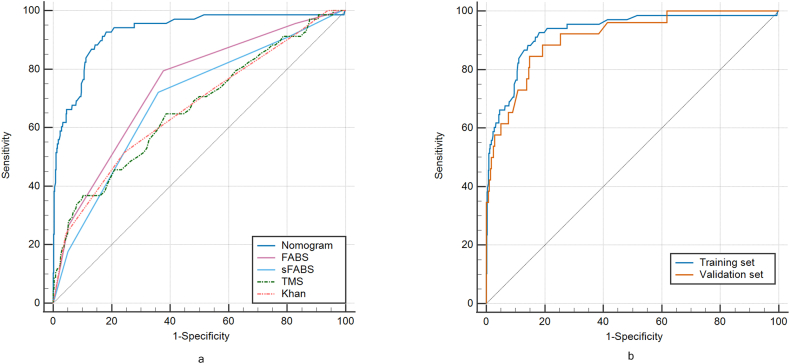
703 eligible patients (68 with SM, accounting for 9.7 %) were assigned to the training set, while 301 patients (26 with SM, accounting for 8.6 %) were assigned to the validation set. A nomogram model was then developed using these six parameters (SBP, history of epilepsy, isolated dizziness, isolated sensory impairment, headache, and absence of speech impairment symptoms), a dynamic web-based version of the nomogram was subsequently created. Comparing with four other scales, the nomogram model showed the highest overall diagnostic performance (AUC = 0.929, 95%CI = 0.908-0.947). The Hosmer-Lemeshow goodness-of-fit test was conducted to assess the agreement between the predicted SM values from the model and the observed SM values. The results of the test indicated a favorable consistency (χ = 9.299, = 0.3177) between the predicted and observed SM. The results obtained from the analysis of the Calibration curve, DCA curve, and CIC analysis suggested that the nomogram possesses a favorable predictive capacity and superior clinical usefulness. Furthermore, the external validation demonstrated that there is no significant difference in the overall predictive diagnostic performance between the validation set and training set (0.929 vs 0.910, > 0.05), thereby confirming the favorable stability of the nomogram model.
Our study firstly proposed a nomogram prediction approach based on the clinical features of SM, which could effectively predict the occurrence of SM. The utilization of the nomogram in stroke center proves advantageous for the identification and evaluation of SM, thereby enhancing diagnostic decision-making and strategies employed for suspected acute stroke patients.

早期识别和预测类卒中(SM)可避免不适当的再通治疗,并延缓对SM病因的处理。本研究旨在筛选SM的预测因素,并开发一种用于预测SM的新型预测列线图模型。同时,对列线图模型的诊断性能进行评估和验证。还将列线图模型的诊断效能与其他四种SM结构化量表进行比较。
回顾性纳入2020年1月至2021年12月符合条件患者的临床数据作为训练数据集;前瞻性纳入2022年2月至12月盛京医院卒中中心符合条件患者的临床数据作为验证数据集。采用单因素分析和Lasso回归为训练集选择最佳预测因素,并通过多因素逻辑回归构建列线图模型,对每例疑似急性缺血性卒中患者基于列线图模型进行预测评分。进行曲线下面积(AUC)、Hosmer-Lemeshow拟合优度检验、校准曲线、决策曲线分析(DCA)、临床影响曲线(CIC)分析和自助抽样,以评估和验证列线图模型的预测性能和临床实用性,并使用DeLong检验比较列线图模型与其他四种结构化SM量表的总体诊断性能。还通过比较验证集与训练集的预测诊断性能,进行DeLong检验以评估SM列线图模型的外部可靠性。此外,利用校准曲线评估SM列线图模型在验证集中的诊断校准能力。
703例符合条件的患者(68例SM,占9.7%)被纳入训练集,301例患者(26例SM,占8.6%)被纳入验证集。然后使用这六个参数(收缩压、癫痫病史、单纯头晕、单纯感觉障碍、头痛和无言语障碍症状)开发了列线图模型,随后创建了基于网络的动态列线图版本。与其他四种量表相比,列线图模型显示出最高的总体诊断性能(AUC = 0.929,95%CI = 0.908 - 0.947)。进行Hosmer-Lemeshow拟合优度检验以评估模型预测的SM值与观察到的SM值之间的一致性。检验结果表明预测值与观察到的SM之间具有良好的一致性(χ = 9.299,P = 0.3177)。校准曲线、DCA曲线和CIC分析的结果表明,列线图具有良好的预测能力和卓越的临床实用性。此外,外部验证表明验证集与训练集之间的总体预测诊断性能无显著差异(0.929对0.910,P > 0.05),从而证实了列线图模型具有良好的稳定性。
我们的研究首次提出了一种基于SM临床特征的列线图预测方法,可有效预测SM的发生。在卒中中心使用列线图有利于识别和评估SM,从而改善对疑似急性卒中患者的诊断决策和策略。