Department of Pathology, Microbiology & Immunology, New York Medical College, Valhalla, NY 10595, USA.
Genetics and Molecular Biology Research Group, School of Medicine, University of Cartagena, Cartagena 130001, Colombia.
Cells. 2024 Oct 1;13(19):1639. doi: 10.3390/cells13191639.
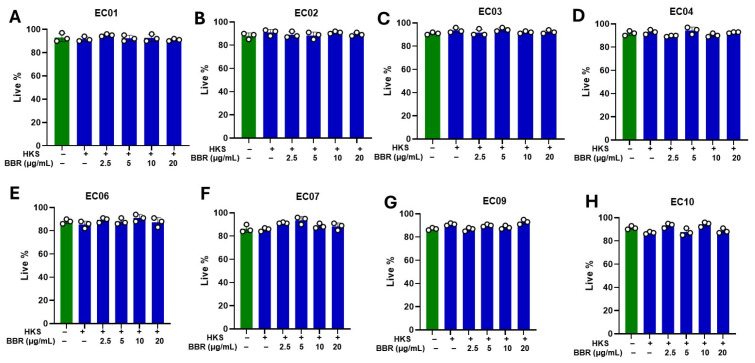
Atopic eczema patients exhibit high levels of () skin colonization. can stimulate macrophages and the expression of proinflammatory cytokines. Berberine (BBR), an alkaloid, attenuates toxin production. This study investigated if BBR suppressed bacterial growth and inflammatory response induced by eczema-patient-derived using murine macrophage (RAW 264.7) and human monocyte cell lines (U937). RAW 264.7 and U937 were treated with BBR at different concentrations and stimulated with heat-killed (ATCC #33591) or derived from severe eczema patients (EC01-EC10), who were undergoing topical steroid withdrawal, for 24 h. TNF-α protein levels were determined by ELISA, gene expression by qRT-PCR, cell cytotoxicity by trypan blue excursion, and reactive oxygen species (ROS) levels by fluorometric assay. BBR showed a bacteriostatic effect in (ATCC strain #33591 and clinical isolates (EC01-EC10) and suppressed TNF-α production in RAW 264.7 and U937 cells exposed to heat-killed (ATCC and clinical isolates) dose-dependently without any cell cytotoxicity. BBR (20 µg/mL) suppressed >90% of TNF-α production ( < 0.001), downregulated genes involved in inflammatory pathways, and inhibited ROS production in U937 and RAW 264.7 cells ( < 0.01). BBR suppresses -induced inflammation via inhibition of TNF-α release, ROS production, and expression of key genes involved in the inflammatory pathway.
特应性皮炎患者表现出高水平的 () 皮肤定植。 可以刺激巨噬细胞和前炎性细胞因子的表达。小檗碱 (BBR) 是一种生物碱,可减轻 毒素的产生。本研究探讨了 BBR 是否能抑制湿疹患者来源的 诱导的细菌生长和炎症反应,使用了小鼠巨噬细胞 (RAW 264.7) 和人单核细胞系 (U937)。RAW 264.7 和 U937 用不同浓度的 BBR 处理,并与热灭活的 (ATCC #33591)或来自严重湿疹患者(EC01-EC10)的 (EC01-EC10)一起孵育 24 小时,这些患者正在接受局部类固醇停药治疗。通过 ELISA 测定 TNF-α 蛋白水平,通过 qRT-PCR 测定基因表达,通过台盼蓝逸出测定细胞毒性,通过荧光测定法测定活性氧 (ROS) 水平。BBR 对 (ATCC 株 #33591 和临床分离株 (EC01-EC10))表现出抑菌作用,并在暴露于热灭活的 (ATCC 和临床分离株)的 RAW 264.7 和 U937 细胞中,剂量依赖性地抑制 TNF-α 的产生,而没有任何细胞毒性。BBR(20 µg/mL)抑制 >90%的 TNF-α产生( < 0.001),下调参与炎症途径的基因,并抑制 U937 和 RAW 264.7 细胞中的 ROS 产生( < 0.01)。BBR 通过抑制 TNF-α释放、ROS 产生和参与炎症途径的关键基因的表达来抑制 诱导的炎症。