Armocida Daniele, Bianconi Andrea, Zancana Giuseppa, Jiang Tingting, Pesce Alessandro, Tartara Fulvio, Garbossa Diego, Salvati Maurizio, Santoro Antonio, Serra Carlo, Frati Alessandro
Department of Neuroscience "Rita Levi Montalcini", Neurosurgery Unit, University of Turin, Via Cherasco 15, Turin (TO), 10126, Italy.
IRCCS "Neuromed", via Atinense 18, 86077, Pozzilli, IS, Italy.
J Neurooncol. 2025 Jan;171(1):241-252. doi: 10.1007/s11060-024-04848-3. Epub 2024 Oct 15.
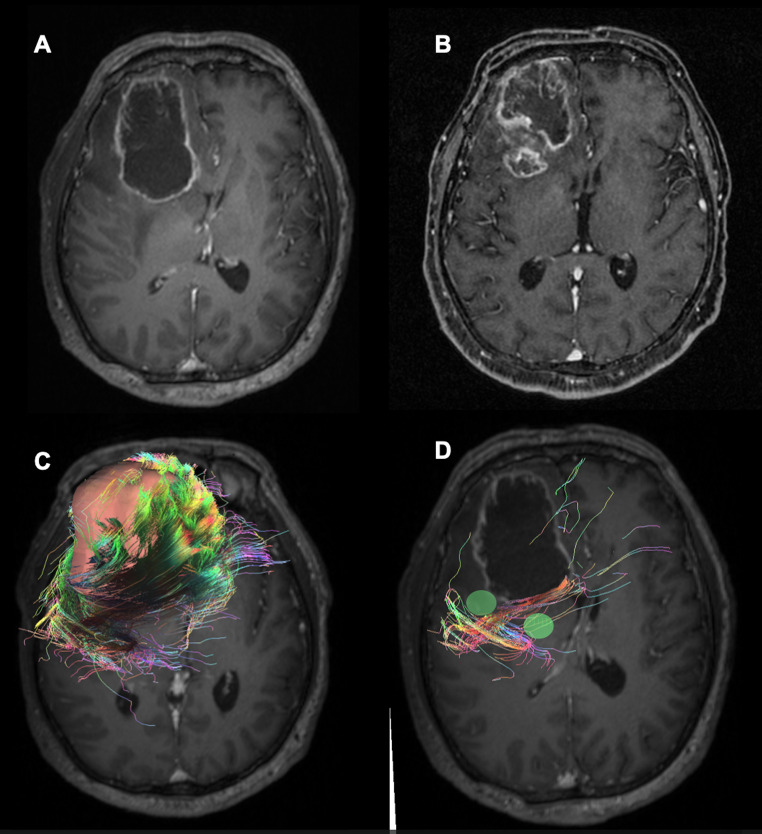
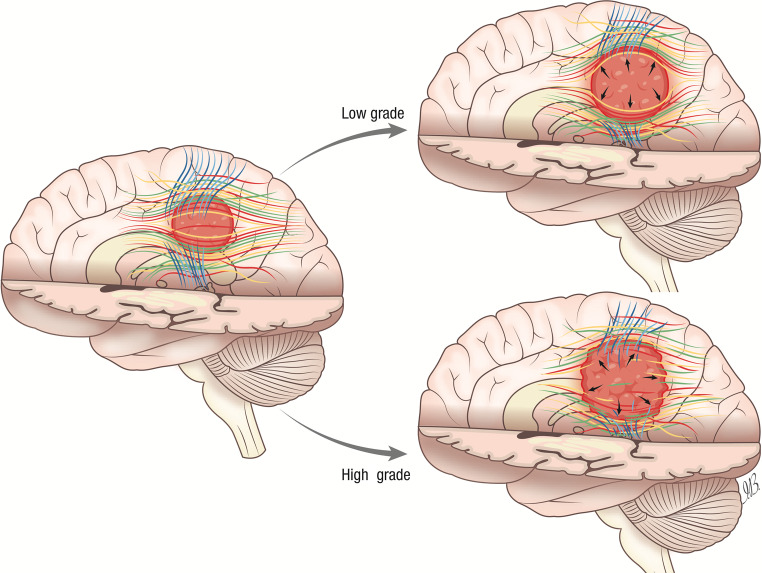
The goal of glioma surgery is maximal tumor resection associated with minimal post-operative morbidity. Diffusion tensor imaging-tractography/fiber tracking (DTI-FT) is a valuable white-matter (WM) visualization tool for diagnosis and surgical planning. Still, it assumes a descriptive role since the main DTI metrics and parameters showed several limitations in clinical use. New applications and quantitative measurements were recently applied to describe WM architecture that surround the tumor area. The brain adjacent tumor area (BAT) is defined as the region adjacent to the gross tumor volume, which contains signal abnormalities on T2-weighted or FLAIR sequences. The DTI-FT analysis of the BAT can be adopted as predictive values and a guide for safe tumor resection.
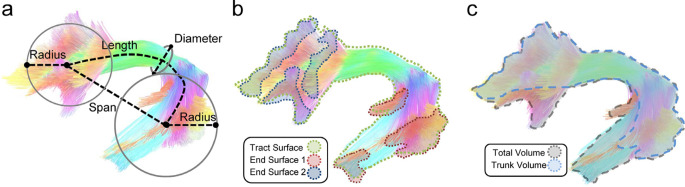
This is an observational prospective study on an extensive series of glioma patients who performed magnetic resonance imaging (MRI) with pre-operative DTI-FT analyzed on the BAT by two different software. We examined DTI parameters of Fractional anisotropy (FA mean, min-max), Mean diffusivity (MD), and the shape-metric "tract irregularity" (TI) grade, comparing it with the surgical series' clinical, radiological, and outcome data.
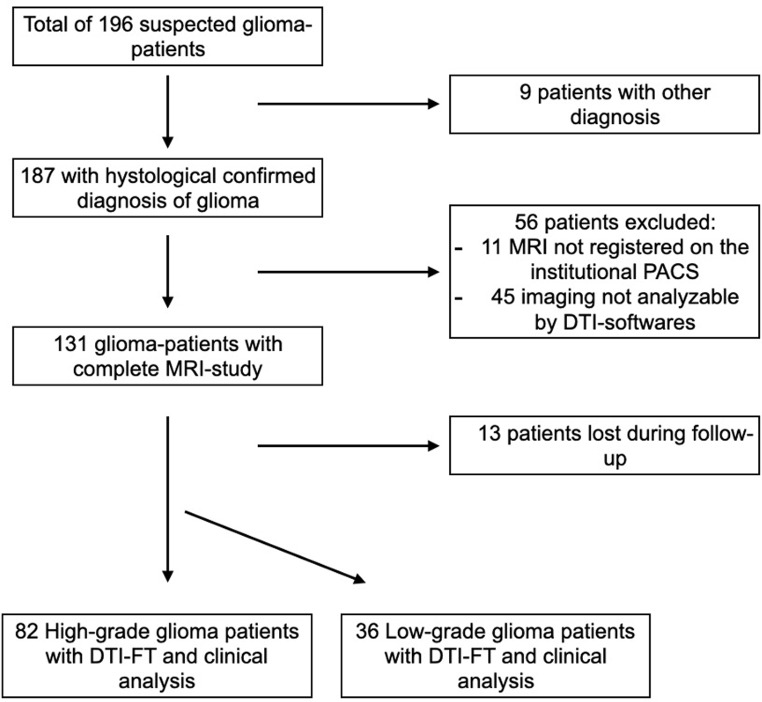
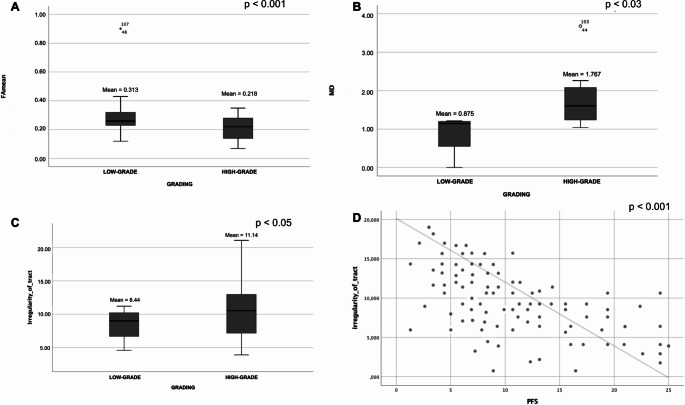
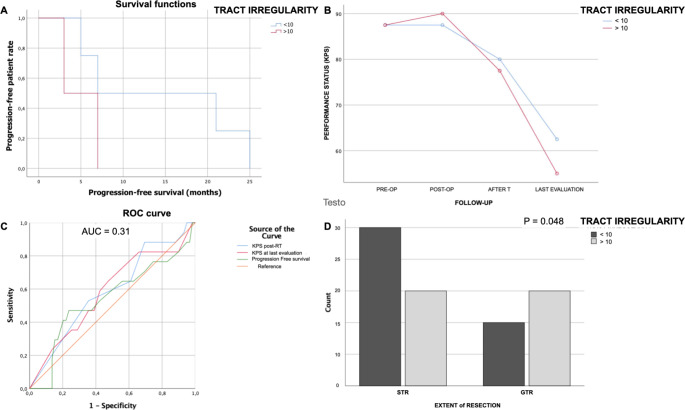
The population consisted of 118 patients, with a mean age of 60.6 years. 82 patients suffering from high-grade gliomas (69.5%), and 36 from low-grade gliomas (30.5%). A significant inverse relationship exists between the FA mean value and grading (p = 0.001). The relationship appears directly proportional regarding MD values (p = 0.003) and TI values (p = 0.005). FA mean and MD values are susceptible to significant variations with tumor and edema volume (p = 0.05). TI showed an independent relationship with grading regardless of tumor radiological features and dimensions, with a direct relationship with grading, ki67% (p = 0,05), PFS (p < 0.001), and EOR (p < 0.01).
FA, MD, and TI are useful predictive measures of the clinical behavior of glioma, and TI could be helpful for tumor grading identification and surgical planning.
脑胶质瘤手术的目标是在术后发病率最低的情况下实现最大程度的肿瘤切除。扩散张量成像纤维束示踪/纤维追踪(DTI-FT)是一种用于诊断和手术规划的有价值的白质(WM)可视化工具。然而,它仍起描述作用,因为主要的DTI指标和参数在临床应用中存在一些局限性。最近,新的应用和定量测量方法被用于描述肿瘤区域周围的白质结构。脑邻近肿瘤区域(BAT)被定义为与大体肿瘤体积相邻的区域,该区域在T2加权或液体衰减反转恢复(FLAIR)序列上显示信号异常。对BAT进行DTI-FT分析可作为预测值和安全肿瘤切除的指导。
这是一项对大量脑胶质瘤患者的观察性前瞻性研究,这些患者接受了磁共振成像(MRI)检查,并通过两种不同软件对BAT进行术前DTI-FT分析。我们检查了分数各向异性(FA均值、最小-最大值)、平均扩散率(MD)和形状度量“纤维束不规则性”(TI)等级的DTI参数,并将其与手术系列的临床、放射学和结果数据进行比较。
研究人群包括118名患者,平均年龄为60.6岁。82例为高级别胶质瘤患者(69.5%),36例为低级别胶质瘤患者(30.5%)。FA均值与分级之间存在显著的负相关关系(p = 0.001)。MD值(p = 0.003)和TI值(p = 0.005)的关系呈正比。FA均值和MD值易随肿瘤和水肿体积发生显著变化(p = 0.05)。无论肿瘤的放射学特征和大小如何,TI与分级均呈独立关系,与分级、ki67%(p = 0.05)、无进展生存期(PFS,p < 0.001)和切除程度(EOR,p < 0.01)呈正相关。
FA、MD和TI是脑胶质瘤临床行为的有用预测指标,TI有助于肿瘤分级鉴定和手术规划。