Institute for Behavioral Genetics, University of Colorado Boulder, Boulder, CO, USA.
Department of Psychology and Neuroscience, University of Colorado Boulder, Boulder, CO, USA.
Mol Autism. 2024 Oct 15;15(1):46. doi: 10.1186/s13229-024-00624-2.
Autism spectrum disorder (ASD) is a neurodevelopmental condition characterized by atypical patterns of social functioning and repetitive/restricted behaviors. ASD commonly co-occurs with ADHD and, despite their clinical distinctiveness, the two share considerable genetic overlap. Given their shared genetic liability, it is unclear which genetic pathways increase the likelihood of ASD independently of ADHD.
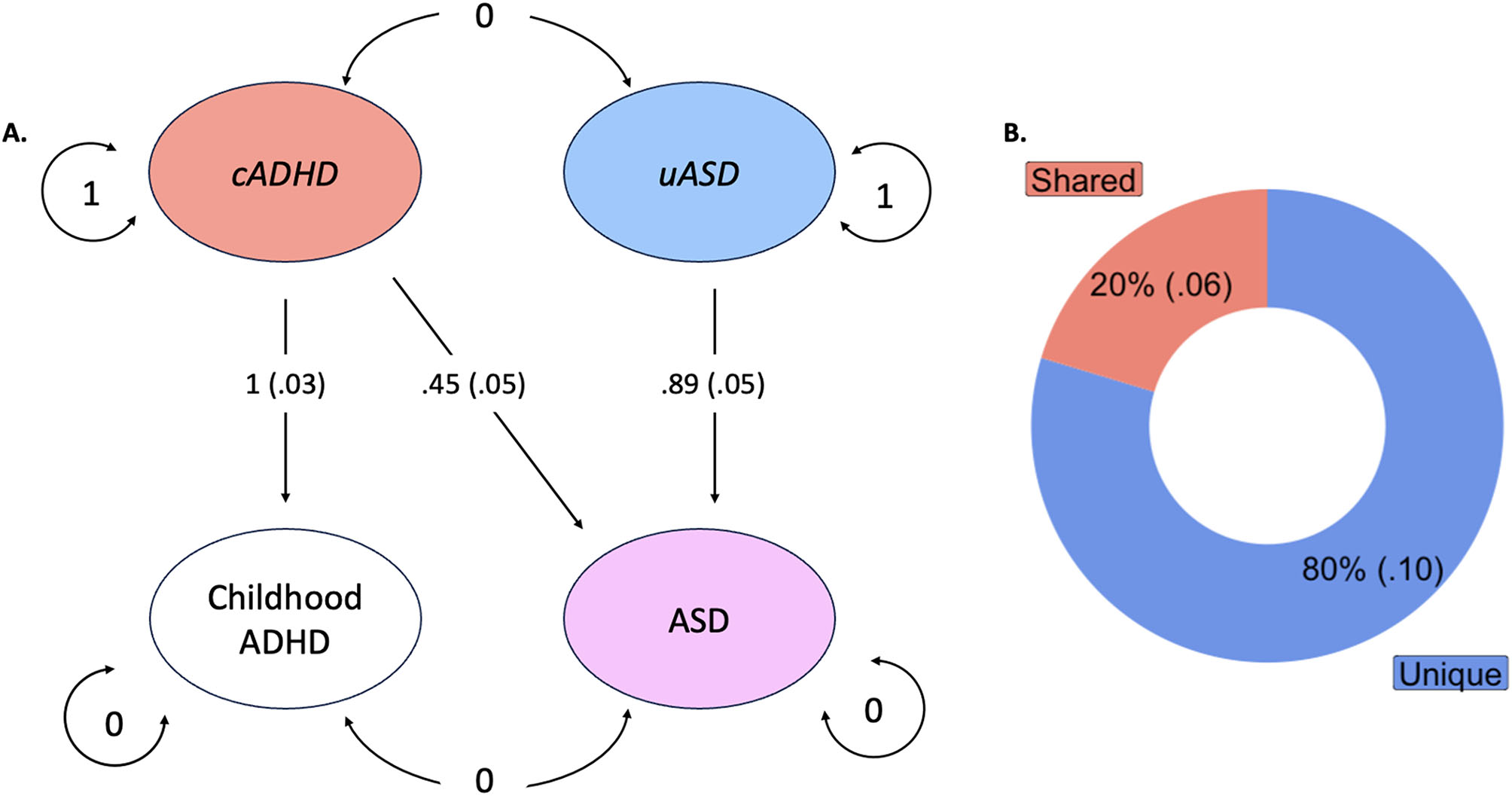
We applied Genomic Structural Equation Modeling (SEM) to GWAS summary statistics for ASD and childhood-diagnosed ADHD, decomposing the genetic variance for ASD into that which is unique to ASD (uASD) and that which is shared with ADHD. We computed genetic correlations between uASD and 83 external traits to estimate genetic overlap between uASD and other clinically relevant phenotypes. We went on to apply Stratified Genomic SEM to identify classes of genes enriched for uASD. Finally, we implemented Transcriptome-Wide SEM (T-SEM) to explore patterns of gene-expression associated with uASD.
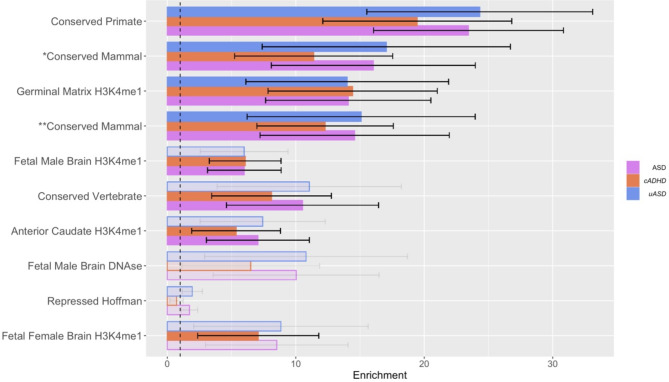
We observed positive genetic correlations between uASD and several external traits, most notably those relating to cognitive/educational outcomes and internalizing psychiatric traits. Stratified Genomic SEM showed that heritability for uASD was significantly enriched in genes involved in evolutionarily conserved processes, as well as for a histone mark in the germinal matrix. T-SEM revealed 83 unique genes with expression associated with uASD, 34 of which were novel with respect to univariate analyses. These genes were overrepresented in skin-related pathologies.
Our study was limited by summary statistics derived exclusively from individuals of European ancestry. Additionally, using data based on a general ASD diagnosis limits our ability to understand genetic factors contributing to the pronounced clinical heterogeneity in ASD.
Our findings delineate the unique genetic underpinnings of ASD that are independent of ADHD at the genome-wide, functional, and gene expression level of analysis. In addition, we identify novel associations previously masked by their diametric effects on ADHD. Collectively, these results provide insight into the processes that make ASD biologically unique.
自闭症谱系障碍(ASD)是一种神经发育障碍,其特征是社会功能的非典型模式和重复/受限行为。ASD 通常与 ADHD 共同发生,尽管它们在临床上有明显的区别,但两者有相当大的遗传重叠。鉴于它们共同的遗传易感性,尚不清楚哪些遗传途径会增加 ASD 的可能性,而与 ADHD 无关。
我们应用基因组结构方程模型(SEM)对 ASD 和儿童期诊断的 ADHD 的 GWAS 汇总统计数据进行分析,将 ASD 的遗传方差分解为 ASD 特有的(uASD)和与 ADHD 共享的部分。我们计算了 uASD 与 83 个外部特征之间的遗传相关性,以估计 uASD 与其他临床相关表型之间的遗传重叠。接着,我们应用分层基因组 SEM 来识别富集 uASD 的基因类别。最后,我们实施了转录组范围 SEM(T-SEM)来探索与 uASD 相关的基因表达模式。
我们观察到 uASD 与几个外部特征之间存在正遗传相关性,尤其是与认知/教育结果和内化性精神特质相关的特征。分层基因组 SEM 显示,uASD 的遗传度在涉及进化保守过程的基因以及在生殖基质中的组蛋白标记中显著富集。T-SEM 揭示了 83 个与 uASD 相关的独特基因的表达,其中 34 个是与单变量分析相比的新基因。这些基因在皮肤相关病理中过表达。
我们的研究仅限于源自欧洲血统个体的汇总统计数据。此外,使用基于一般 ASD 诊断的数据限制了我们理解对 ASD 明显临床异质性有贡献的遗传因素的能力。
我们的研究结果描绘了在全基因组、功能和基因表达水平上,ASD 的独特遗传基础,与 ADHD 无关。此外,我们发现了以前被 ADHD 的相反效应所掩盖的新关联。总的来说,这些结果为了解使 ASD 在生物学上具有独特性的过程提供了深入的认识。