Ostrowska-Czyżewska Aleksandra, Zgliczyński Wojciech, Bednarek-Papierska Lucyna, Mrozikiewicz-Rakowska Beata
Department of Endocrinology, Centre of Postgraduate Medical Education, Marymoncka St. 99/103, 01-813 Warsaw, Poland.
J Clin Med. 2024 Sep 28;13(19):5801. doi: 10.3390/jcm13195801.
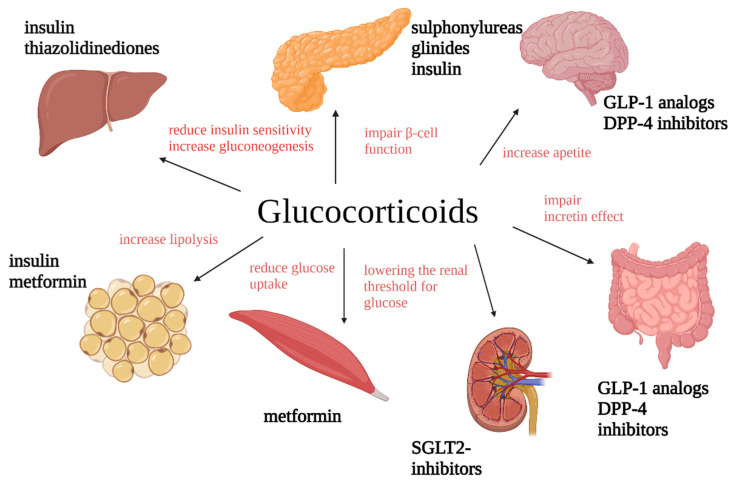
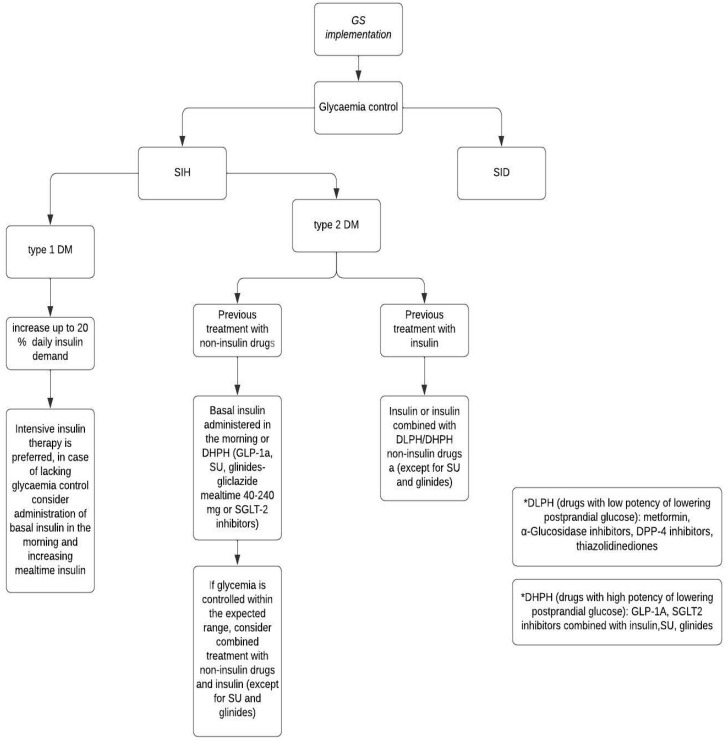
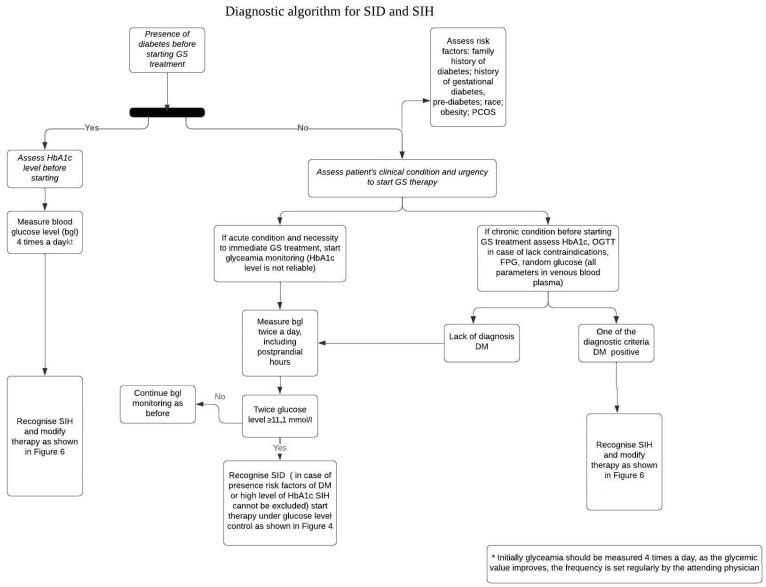
Glucocorticoids (GS) are widely used in multiple medical indications due to their anti-inflammatory, immunosuppressive, and antiproliferative effects. Despite their effectiveness in treating respiratory, skin, joint, renal, and neoplastic diseases, they dysregulate glucose metabolism, leading to steroid-induced diabetes (SID) or a significant increase of glycemia in people with previously diagnosed diabetes. The risk of adverse event development depends on the prior therapy, the duration of the treatment, the form of the drug, and individual factors, i.e., BMI, genetics, and age. Unfortunately, SID and steroid-induced hyperglycemia (SIH) are often overlooked, because the fasting blood glucose level, which is the most commonly used diagnostic test, is insufficient for excluding both conditions. The appropriate control of post-steroid hyperglycemia remains a major challenge in everyday clinical practice. Recently, the most frequently used antidiabetic strategies have been insulin therapy with isophane insulin or multiple injections in the basal-bolus regimen. Alternatively, in patients with lower glycemia, sulphonylureas or glinides were used. Taking into account the pathogenesis of post-steroid-induced hyperglycemia, the initiation of therapy with glucagon-like peptide 1 (GLP-1) analogs and dipeptidyl peptidase 4 (DPP-4) inhibitors should be considered. In this article, we present a universal practical diagnostic algorithm of SID/SIH in patients requiring steroids, in both acute and chronic conditions, and we present a new pharmacotherapy algorithm taking into account the use of all currently available antidiabetic drugs.
糖皮质激素(GS)因其抗炎、免疫抑制和抗增殖作用而广泛应用于多种医学适应症。尽管它们在治疗呼吸道、皮肤、关节、肾脏和肿瘤疾病方面有效,但会使葡萄糖代谢失调,导致类固醇诱导的糖尿病(SID)或使先前诊断为糖尿病的患者血糖显著升高。不良事件发生的风险取决于先前的治疗、治疗持续时间、药物剂型以及个体因素,即体重指数、遗传因素和年龄。不幸的是,SID和类固醇诱导的高血糖症(SIH)常常被忽视,因为最常用的诊断测试空腹血糖水平不足以排除这两种情况。在日常临床实践中,对类固醇后高血糖症进行适当控制仍然是一项重大挑战。最近,最常用的抗糖尿病策略是使用低精蛋白胰岛素进行胰岛素治疗或采用基础-餐时方案进行多次注射。另外,对于血糖较低的患者,使用磺脲类药物或格列奈类药物。考虑到类固醇诱导后高血糖症的发病机制,应考虑开始使用胰高血糖素样肽1(GLP-1)类似物和二肽基肽酶4(DPP-4)抑制剂进行治疗。在本文中,我们提出了一种针对需要使用类固醇的急性和慢性疾病患者的SID/SIH通用实用诊断算法,并提出了一种考虑到所有当前可用抗糖尿病药物使用情况的新药物治疗算法。