Alessa Tourkiah, Alhussaini Khalid, de Witte Luc
Department of Biomedical Technology, College of Applied Medical Science, King Saud University, Riyadh P.O. Box 10219, Saudi Arabia.
Center of Expertise Health Innovation, The Hague University of Applied Science, 2521 EN Den Haag, The Netherlands.
Healthcare (Basel). 2024 Sep 26;12(19):1929. doi: 10.3390/healthcare12191929.
This study investigates patients' use of eHealth services, their awareness of the availability of these services, and their intention to use them in primary care. It also examines patient characteristics and factors that influence the use of these services.
A cross-sectional design using questionnaires was conducted. Based on the unified theory of acceptance and use of technology (UTAUT), the participants rated the two most common services. Descriptive analyses and linear correlation analyses were performed. A simple linear regression was conducted to identify factors influencing the participants' intention to use eHealth services.
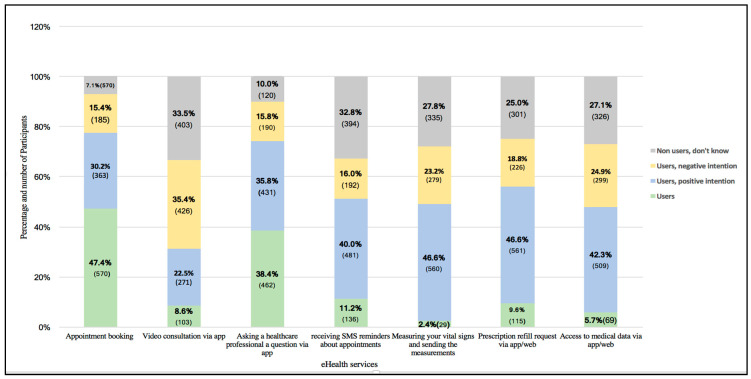
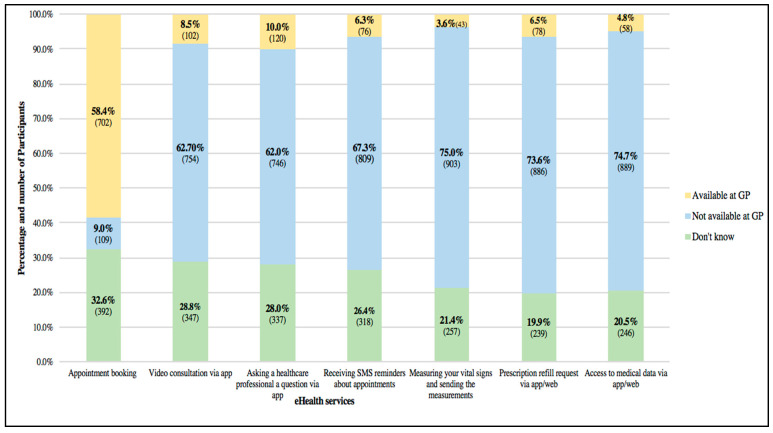
In total, 1203 participants with an average age of 43.7 years were surveyed. The participants' usage rates varied, with the lowest at 2.4%, for measuring vital signs, and the highest at 47.4%, for booking appointments. The intentions to use the services ranged from 22.5%, for video consultations, to 46.6%, for prescription refill requests. Approximately 20% of the respondents were unaware of each service's availability. Positive associations were found between all the constructs and the intention to use online services, with a younger age being the most significant factor.
The use of and intention to use eHealth services varied greatly. The participants were often unaware of the availability of these services. Promoting the availability and benefits of eHealth services could enhance patient engagement in primary care settings.
本研究调查了患者对电子健康服务的使用情况、对这些服务可用性的认知以及他们在初级保健中使用这些服务的意愿。它还考察了患者特征以及影响这些服务使用的因素。
采用问卷调查进行横断面设计。基于技术接受与使用统一理论(UTAUT),参与者对两种最常见的服务进行评分。进行了描述性分析和线性相关分析。进行简单线性回归以确定影响参与者使用电子健康服务意愿的因素。
总共调查了1203名平均年龄为43.7岁的参与者。参与者的使用率各不相同,测量生命体征的使用率最低,为2.4%,预约挂号的使用率最高,为47.4%。使用这些服务的意愿从视频咨询的22.5%到处方续开申请的46.6%不等。约20%的受访者不知道每项服务的可用性。在所有结构与使用在线服务的意愿之间发现了正相关,年龄较小是最显著的因素。
电子健康服务的使用情况和使用意愿差异很大。参与者常常不知道这些服务的可用性。宣传电子健康服务的可用性和益处可以提高患者在初级保健环境中的参与度。