Chang Haegak, Ryu Seiyoung, Choi Ilyoung, Kwon Angela Eunyoung, Kim Jaekyeong
School of Management, Kyung Hee University, Seoul 02447, Republic of Korea.
Department of Bigdata Analytics, Kyung Hee University, Seoul 02447, Republic of Korea.
Healthcare (Basel). 2024 Oct 4;12(19):1982. doi: 10.3390/healthcare12191982.
BACKGROUND/OBJECTIVES: In Korea's emergency medical system, when an emergency patient arises, patients receive on-site treatment and care during transport at the pre-hospital stage, followed by inpatient treatment upon hospitalization. From the perspective of emergency patient management, it is critical to identify the high death rate of patients with certain conditions in the emergency room. Therefore, it is necessary to compare and analyze the determinants of the death rate of patients admitted via the emergency room and generally hospitalized patients. In fact, previous studies investigating determinants of survival periods or length of stay (LOS) primarily used multiple or logistic regression analyses as their main research methodology. Although medical data often exhibit censored characteristics, which are crucial for analyzing survival periods, the aforementioned methods of analysis fail to accommodate these characteristics, presenting a significant limitation.
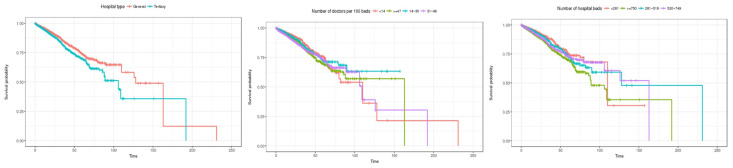
Therefore, in this study, survival analyses were performed to investigate factors affecting the dying risk of general inpatients as well as patients admitted through the emergency room. For this purpose, this study collected and analyzed the sample cohort DB for a total of four years from 2016 to 2019 provided by the Korean National Health Insurance Services (NHIS). After data preprocessing, the survival probability was estimated according to sociodemographic, patient, health checkup records, and institutional features through the Kaplan-Meier survival estimation. Then, the Cox proportional hazards models were additionally utilized for further econometric validation.
As a result of the analysis, in terms of the 'city' feature among the sociodemographic characteristics, the small and medium-sized cities exert the most influence on the death rate of general inpatients, whereas the metropolitan cities exert the most influence on the death rate of inpatients admitted through the emergency room. In terms of institution characteristics, it was found that there is a difference in determinants affecting the death rate of the two groups of study, such as the number of doctors per 100 hospital beds, the number of nurses per 100 hospital beds, the number of hospital beds, the number of surgical beds, and the number of emergency beds.
Based on the study results, it is expected that an efficient plan for distributing limited medical resources can be established based on inpatients' LOS.
背景/目的:在韩国的紧急医疗系统中,当出现急诊患者时,患者在院前阶段接受现场治疗和转运过程中的护理,随后住院接受住院治疗。从急诊患者管理的角度来看,确定急诊室中某些病情患者的高死亡率至关重要。因此,有必要比较和分析通过急诊室入院的患者和一般住院患者死亡率的决定因素。事实上,以往研究生存期限或住院时间(LOS)决定因素时,主要采用多元或逻辑回归分析作为主要研究方法。尽管医学数据常常呈现删失特征,这对分析生存期限至关重要,但上述分析方法无法适应这些特征,存在重大局限性。
因此,在本研究中,进行了生存分析以调查影响普通住院患者以及通过急诊室入院患者死亡风险的因素。为此,本研究收集并分析了韩国国民健康保险服务(NHIS)提供的2016年至2019年共四年的样本队列数据库。经过数据预处理后,通过Kaplan-Meier生存估计,根据社会人口统计学、患者、健康检查记录和机构特征估计生存概率。然后,额外使用Cox比例风险模型进行进一步的计量经济学验证。
分析结果显示,在社会人口统计学特征中的“城市”特征方面,中小城市对普通住院患者死亡率影响最大,而大城市对通过急诊室入院患者的死亡率影响最大。在机构特征方面,发现影响两组研究对象死亡率的决定因素存在差异,如每100张病床的医生数量、每100张病床的护士数量、病床数量、手术床数量和急诊床数量。
基于研究结果,预计可以根据住院患者的住院时间制定有效的有限医疗资源分配计划。