NIHR Nottingham Biomedical Research Centre and Academic Unit of Injury, Recovery and Inflammation Science, School of Medicine, University of Nottingham, Nottingham NG7 2RD, UK.
School of Life Sciences, University of Nottingham, Nottingham NG7 2RD, UK.
Nutrients. 2024 Sep 30;16(19):3326. doi: 10.3390/nu16193326.
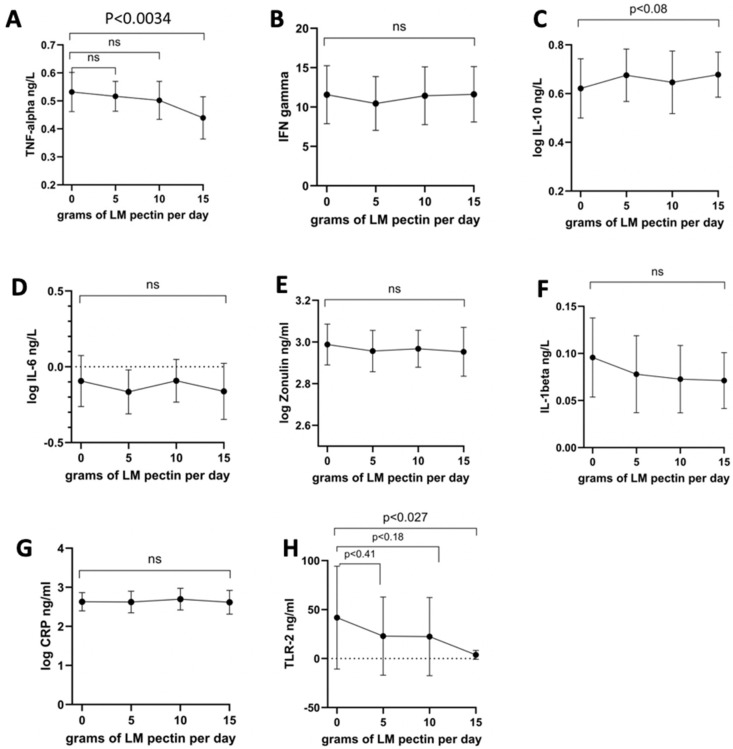
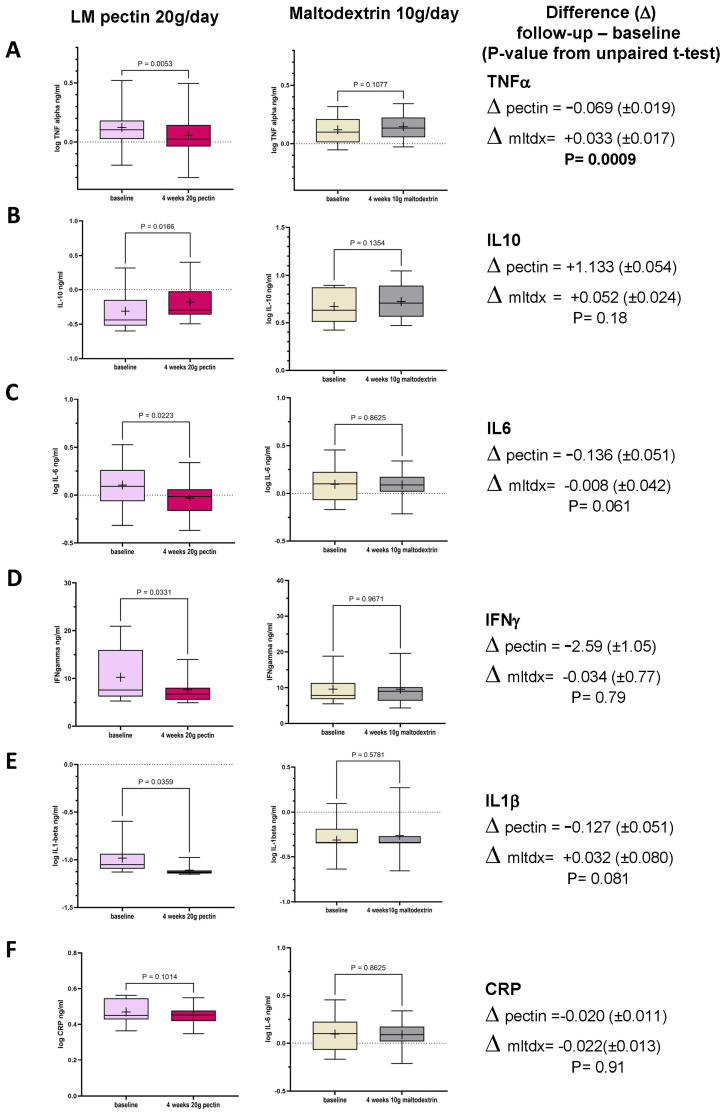
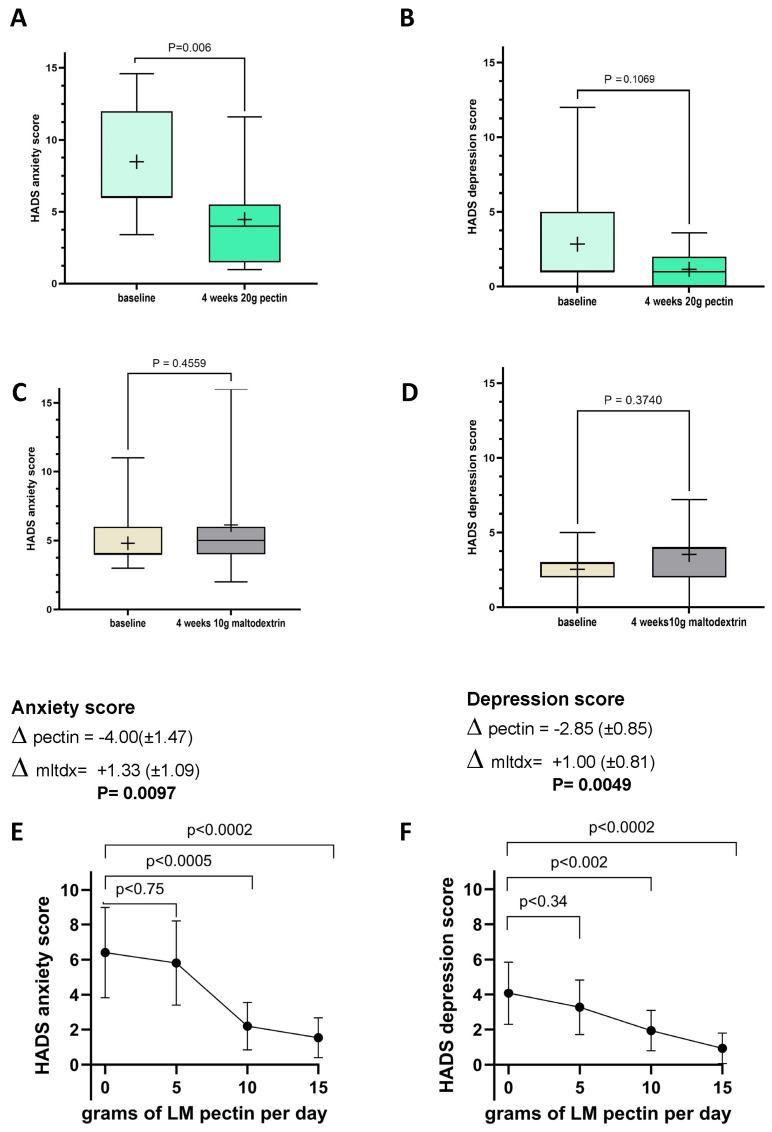
Although low-methoxy (LM) pectin (polysaccharides extracted from citrus peels) can reduce inflammation by binding to and inhibiting the TLR-2 pathway in animal models and in vitro studies, the anti-inflammatory effects of LM pectin in humans and mood have not been explored to date. The purpose of this study is to assess the role of dietary supplementation with LM pectin in healthy volunteers on inflammatory markers and on mood, specifically anxiety and depression. We carried out a 4-week dietary intervention with LM citrus pectin on healthy volunteers (N = 14, age 40 ± 16 y, BMI 24.7 ± 3.0 kg/m, sex F 57%) comparing the effects of daily supplementation with 20 g of LM citrus pectin versus 10 g of maltodextrin as the control (N = 15 age 43.2 ± 11 y, BMI 25.18 ± 2.0 kg/m, sex F 66%). The effects on mood and inflammation were also tested with LM pectin at 5 g, 10 g and 15 g (2 weeks each) in an independent cohort of n = 15 healthy volunteers (age 36 ± 21 y, BMI 23.5 ± 2.4 kg/m, sex F 80%). We assessed serum levels of TNF-alpha (downstream from TLR-2 activation), IL-1 beta, IL-6, IL-10, INF-gamma, CRP, zonulin and TLR-2 concentration which were measured using ELISA in blood samples collected at both the baseline and follow-up visits. Validated measures of anxiety and depression were collected at baseline and follow-up. Supplementation with 20 g of LM pectin resulted in decreases in the pro-inflammatory markers TNF-alpha, IL-1 beta, IL-6 and INF-gamma (all < 0.05) and an increase in anti-inflammatory marker IL-10 ( = 0.01) at the end of the 4 weeks. No such effects were observed in the control group. In addition, a significant drop in anxiety scores (from 8.38 to 4.46, < 0.006) was found with the 20 g/day intervention but not in the control arm. In the dose-response study, anti-inflammatory effects were seen only at 15 g for TNFα ( < 0.003) and a suggestive increase in IL-10 ( = 0.08), alongside a drop in TLR-2 ( < 0.027). No significant anti-inflammatory effects were observed at 5 g and 10 g doses of LM pectin supplementation. Significant dose-dependent drops in both anxiety and depression scores were found with 10 g ( < 0.001) and 15 g per day ( < 0.0002). The current study identifies anxiety-reducing and anti-inflammatory effects of supplementation with 15 g/day LM pectin in healthy humans. Further research is needed to elucidate the precise mechanism and to validate the efficient dose and minimum duration of supplementation.
虽然低甲氧基(LM)果胶(从柑橘皮中提取的多糖)可以通过与 TLR-2 途径结合并抑制其在动物模型和体外研究中减轻炎症,但迄今为止,LM 果胶在人体中的抗炎作用以及对情绪的影响尚未得到探索。本研究旨在评估在健康志愿者中补充 LM 果胶对炎症标志物和情绪(特别是焦虑和抑郁)的作用。我们进行了为期 4 周的 LM 柑橘果胶饮食干预,比较了每日补充 20 克 LM 柑橘果胶与 10 克麦芽糊精作为对照(N=15,年龄 43.2±11 岁,BMI25.18±2.0kg/m,性别 F66%)对健康志愿者的影响。我们还使用来自独立队列的 15 名健康志愿者(年龄 36±21 岁,BMI23.5±2.4kg/m,性别 F80%)的 LM 果胶(5g、10g 和 15g,各持续 2 周),分别测试了对情绪和炎症的影响。在基线和随访时采集血样,使用 ELISA 测量 TNF-α(TLR-2 激活下游)、IL-1β、IL-6、IL-10、INF-γ、CRP、 zonulin 和 TLR-2 浓度。在基线和随访时收集焦虑和抑郁的有效测量值。补充 20 克 LM 果胶可降低促炎标志物 TNF-α、IL-1β、IL-6 和 INF-γ(均<0.05),并在 4 周结束时增加抗炎标志物 IL-10(=0.01)。在对照组中未观察到这种影响。此外,在 20g/天的干预下,焦虑评分(从 8.38 降至 4.46,<0.006)显著下降,但在对照组中没有下降。在剂量反应研究中,仅在 15g 时观察到 TNFα 的抗炎作用(<0.003),以及 IL-10 的提示性增加(=0.08),同时 TLR-2 下降(<0.027)。在 5g 和 10g 的 LM 果胶补充剂量下,未观察到明显的抗炎作用。在每天 10g(<0.001)和 15g(<0.0002)时,焦虑和抑郁评分均出现显著的剂量依赖性下降。本研究在健康人群中确定了每天补充 15g LM 果胶的减轻焦虑和抗炎作用。需要进一步研究以阐明确切的机制,并验证有效剂量和最低补充持续时间。