National Engineering Laboratory for AIDS Vaccine, School of Life Sciences, Jilin University, Changchun 130012, China.
Key Laboratory for Molecular Enzymology and Engineering, The Ministry of Education, School of Life Sciences, Jilin University, Changchun 130012, China.
Int J Mol Sci. 2024 Oct 4;25(19):10699. doi: 10.3390/ijms251910699.
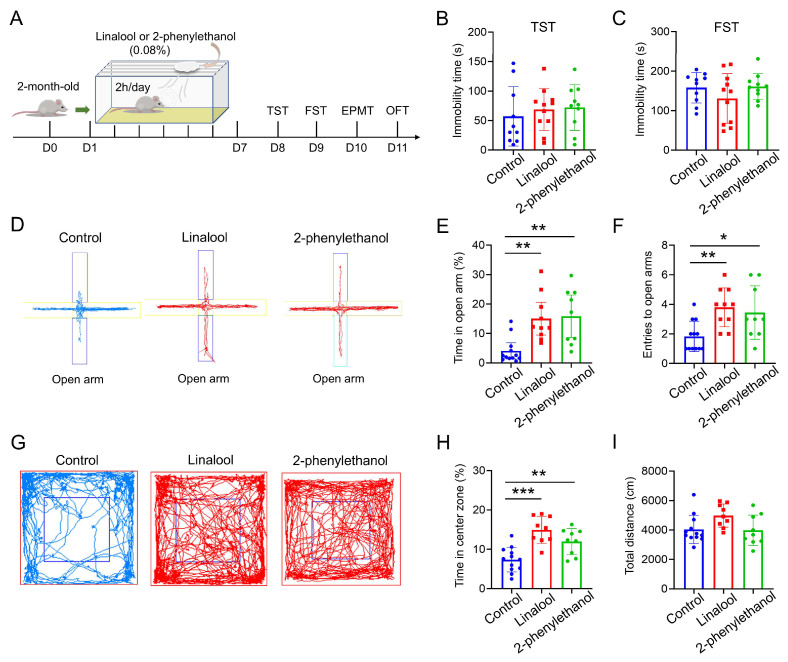
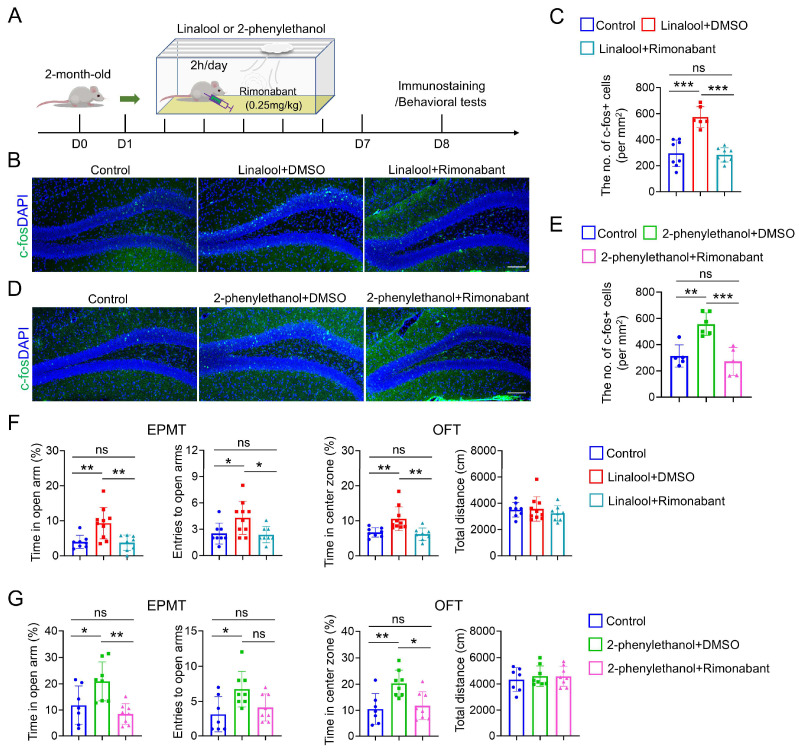
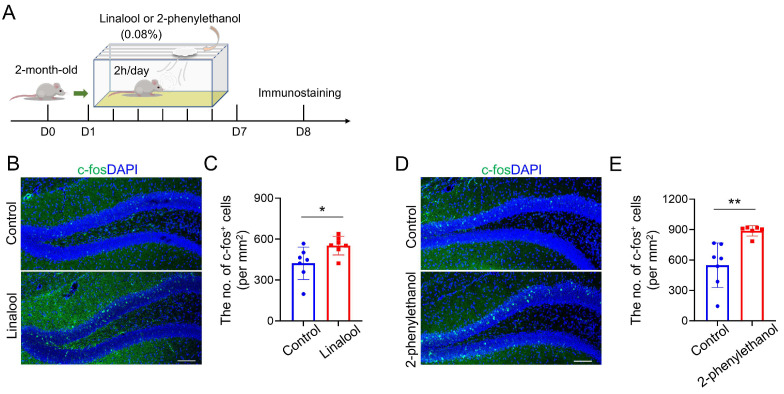
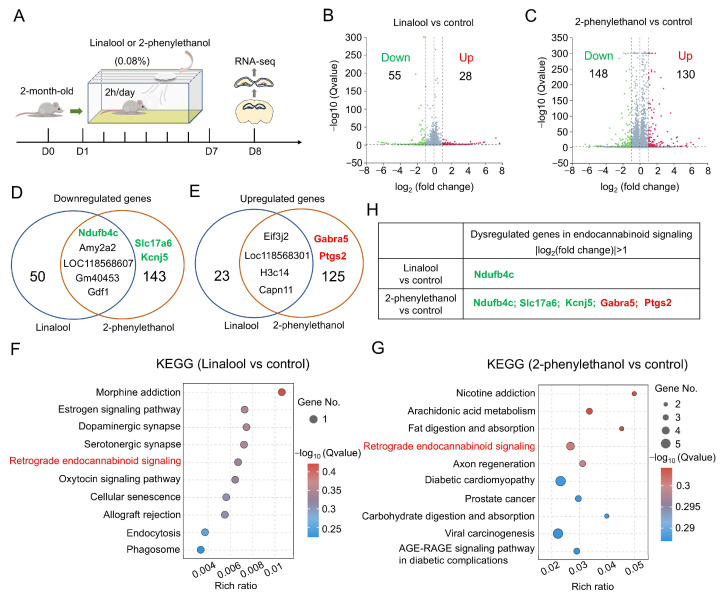
Anxiety disorder is one of the most common neuropsychiatric disorders, and affects many people's daily activities. Although the pathogenesis and treatments of anxiety disorder have been studied for several decades, the underlying mechanisms remain elusive. Here, we provide evidence that olfactory stimuli with inhaled linalool or 2-phenylethanol decreased mouse anxiety-like behaviors and increased the activities of hippocampal dentate granule cells (DGCs). RNA-sequencing analysis identified retrograde endocannabinoid signaling, which is a critical pathway for mood regulation and neuron activation, is altered in the hippocampus of both linalool- and 2-phenylethanol-exposed mice. Further studies found that selective inhibition of endocannabinoid signaling by injecting rimonabant abolished the activation of DGCs and the anxiolytic effect induced by linalool or 2-phenylethanol. Together, these results uncovered a novel mechanism by which linalool or 2-phenylethanol decreases mouse anxiety-like behaviors and increases DG activity likely through activating hippocampal retrograde endocannabinoid signaling.
焦虑症是最常见的神经精神疾病之一,影响着许多人的日常活动。尽管焦虑症的发病机制和治疗方法已经研究了几十年,但潜在的机制仍不清楚。在这里,我们提供的证据表明,吸入芳樟醇或 2-苯乙醇的嗅觉刺激可减少小鼠的焦虑样行为,并增加海马齿状回颗粒细胞(DGC)的活性。RNA 测序分析表明,逆行内源性大麻素信号转导,这是调节情绪和神经元激活的关键途径,在芳樟醇和 2-苯乙醇暴露的小鼠海马体中发生改变。进一步的研究发现,通过注射利莫那班选择性抑制内源性大麻素信号转导,可消除 DGC 的激活和芳樟醇或 2-苯乙醇诱导的抗焦虑作用。综上所述,这些结果揭示了芳樟醇或 2-苯乙醇通过激活海马体逆行内源性大麻素信号转导来降低小鼠焦虑样行为和增加 DG 活性的新机制。