Liu Jiayi, Liu Chao, Zheng Jiaxin, Zhang Xiaoxia, Zheng Kang, Zhuang Jiayao
Collaborative Innovation Center of Sustainable Forestry in Southern China of Jiangsu Province, Nanjing Forestry University, Nanjing 210037, China.
China Construction First Group Co., Ltd., Beijing 100000, China.
Plants (Basel). 2024 Sep 30;13(19):2755. doi: 10.3390/plants13192755.
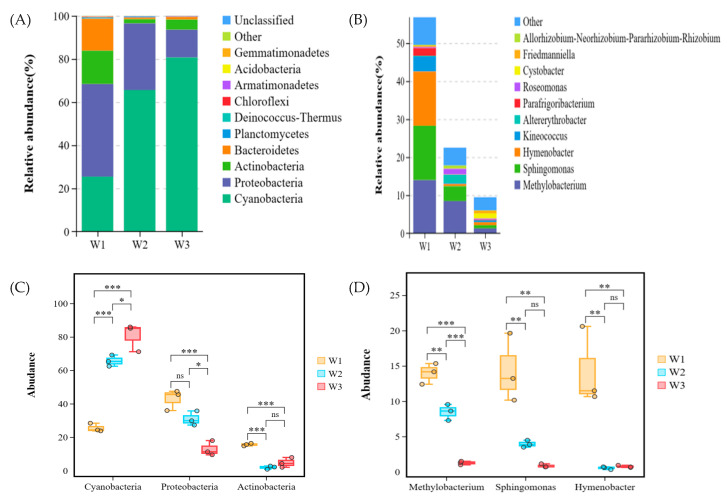
Effects of heavy metals on soil microbial communities have been extensively studied due to their persistence in the environment and imposed threats to living organisms; however, there is a lack of in-depth studies of the impacts of heavy metals on plant endophyte communities. Therefore, the responses of plant endophyte communities to different concentrations of heavy metals were investigated in this study. The endophyte communities of plants existing in severely (W1, Pb, 110.49 mg/kg, Cd, 1.11 mg/kg), moderately (W2, Pb, 55.06 mg/kg, Cd, 0.48 mg/kg), and mildly (W3, Pb, 39.06 mg/kg, Cd, 0.20 mg/kg) contaminated soils were analyzed by 16s rRNA high-throughput Illumina sequencing. Furthermore, networks were constructed to illustrate the relationships between microorganisms and environmental factors. High-quality sequences were clustered at a 97% similarity level. Results revealed that the diversity of the community and relative abundance of Cyanobacteria phylum increased with decreasing levels of pollution. Cyanobacteria and Proteobacteria were found to be the dominant phylum, while and were observed as the dominant genus. Tukey's HSD test showed that the relative abundances of Cyanobacteria and Proteobacteria phyla and and genera differed significantly ( < 0.01) among the plants of the three sample sites. Environmental factor analysis revealed a significant negative correlation ( < 0.01) of Cyanobacteria and a significant positive correlation ( < 0.01) of with the heavy metal content in the environment. These findings suggest that Cyanobacteria and may be phylum and genus indicators, respectively, of heavy metal toxicity. Tax4Fun analysis showed the effect of heavy metal toxicity on the abundance of genes involved in plant metabolism. In addition, culturable endophytic strains were isolated to study their resistance to heavy metal stress and their ability to promote plant growth. The potting tests showed that the JG1 strain was tolerant to heavy metals, and it could significantly promote the growth of the host plant under stress caused by multiple heavy metals. Compared to the control, the JG1-treated plants showed a 23.14% increase in height and a 12.84% increase in biomass. Moreover, AP, AK, and HN contents in JG1-treated plants were 20.87%, 12.55%, and 9.03% higher, respectively, under heavy metal stress. The results of this study provide a scientific basis for the construction of an efficient plant endophyte restoration system.
由于重金属在环境中的持久性及其对生物有机体构成的威胁,重金属对土壤微生物群落的影响已得到广泛研究;然而,关于重金属对植物内生菌群落影响的深入研究却很缺乏。因此,本研究调查了植物内生菌群落对不同浓度重金属的响应。通过16s rRNA高通量Illumina测序分析了生长在重度(W1,铅,110.49毫克/千克,镉,1.11毫克/千克)、中度(W2,铅,55.06毫克/千克,镉,0.48毫克/千克)和轻度(W3,铅,39.06毫克/千克,镉,0.20毫克/千克)污染土壤中的植物的内生菌群落。此外,构建网络以阐明微生物与环境因素之间的关系。高质量序列在97%的相似性水平上进行聚类。结果表明,随着污染程度的降低,群落多样性和蓝藻门的相对丰度增加。发现蓝藻门和变形菌门是优势门,而[此处原文缺失两个属名]被观察为优势属。Tukey's HSD检验表明,三个采样点的植物中,蓝藻门和变形菌门以及[此处原文缺失两个属名]属的相对丰度存在显著差异(P < 0.01)。环境因子分析显示,蓝藻门与环境中重金属含量呈显著负相关(P < 0.01),而[此处原文缺失一个属名]与环境中重金属含量呈显著正相关(P < 0.01)。这些发现表明,蓝藻门和[此处原文缺失一个属名]可能分别是重金属毒性的门和属指标。Tax4Fun分析显示了重金属毒性对参与植物代谢的基因丰度的影响。此外,分离出可培养的内生菌株,以研究它们对重金属胁迫的抗性及其促进植物生长的能力。盆栽试验表明,JG1菌株对重金属具有耐受性,并且在多种重金属胁迫下能够显著促进宿主植物的生长。与对照相比,经JG1处理的植物高度增加了23.14%,生物量增加了12.84%。此外,在重金属胁迫下,经JG1处理的植物中的有效磷、速效钾和全氮含量分别高出20.87%、12.55%和9.03%。本研究结果为构建高效的植物内生菌修复系统提供了科学依据。