Elghawy Omar, Cao Miao, Xu Jason, Landsburg Daniel J, Svoboda Jakub, Nasta Sunita D, Chong Elise A, Schuster Stephen J, Thomas Colin J, Carter Jordan S, Tavakkoli Montreh, Ruella Marco, Barta Stefan K
Department of Medicine, University of Pennsylvania, Philadelphia, PA 19104, USA.
Thomas Jefferson University Department of Pharmacology, Physiology and Cancer Biology, Philadelphia, PA 19107, USA.
Cancers (Basel). 2024 Oct 9;16(19):3430. doi: 10.3390/cancers16193430.
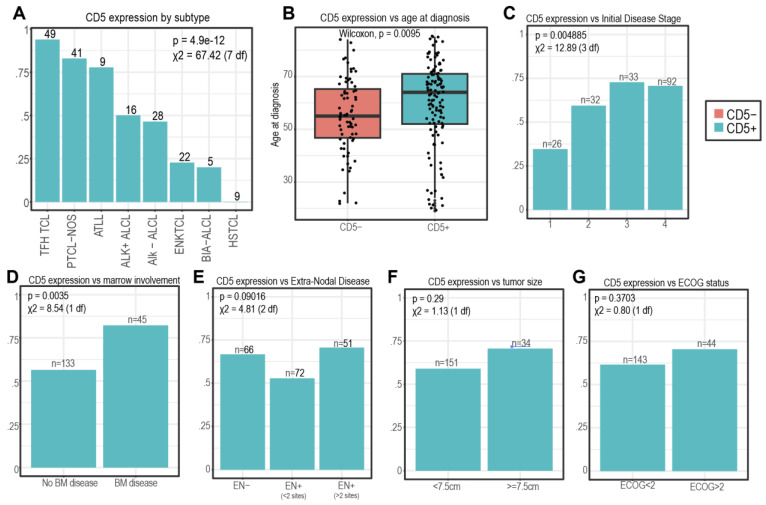
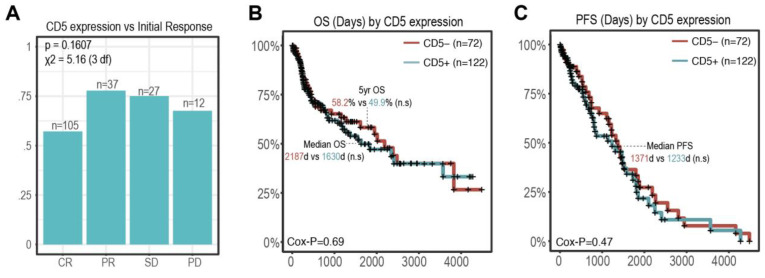
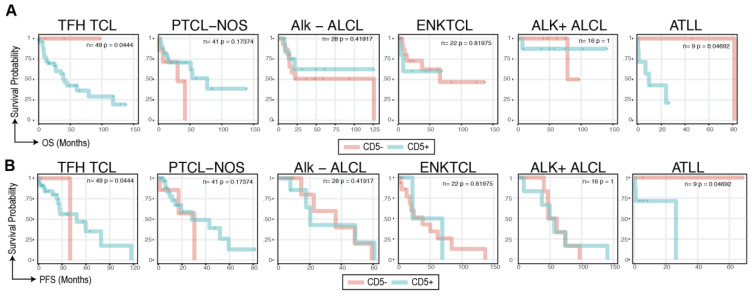
T-cell lymphomas (TCLs) are a group of heterogenous cancers with poor rates and duration of response. There remains a great challenge in risk stratification of these cancers. Cluster of differentiation (CD) 5 has shown prognostic implication in many subtypes of B-cell lymphoma; however, its role in TCLs is not known. We performed a single-institution retrospective analysis of newly diagnosed patients with TCL. CD5 positivity was determined based on positive results via immunohistochemistry and/or flow cytometry. We used univariate and multivariable analysis of biological factors to assess their association with survival outcomes. A total of 194 patients with TCL spanning 14 subtypes were identified. CD5 positivity was noted in 63% of patients, with the highest proportion of CD5 expression in TFH TCL (93.9%), PTCL-NOS (82.9%), and ATLL (77.8%) ( = 0.00004). Older age at diagnosis ( = 0.001), stage III or IV disease ( = 0.05), and bone marrow involvement ( = 0.003) were also associated with CD5 expression. Complete response rates were numerically lower in patients with CD5+ TCL across all subtypes. OS/PFS was not statistically associated with CD5 status in the overall cohort; however there was significantly decreased OS in CD5+ TFH TCL ( = 0.04) and CD5+ ATLL ( = 0.04) patients. This study represents the first to examine CD5 expression as a prognostic biomarker for outcomes in TCL. The frequent expression of CD5 in the most common nodal TCL in the Western world underpins its potential as an attractive target for cellular therapies. Confirmation of these findings in a larger cohort and investigation of potential pathophysiological mechanisms explaining our observations are planned.
T细胞淋巴瘤(TCLs)是一组异质性癌症,缓解率和缓解持续时间较差。对这些癌症进行风险分层仍然面临巨大挑战。分化簇(CD)5在许多B细胞淋巴瘤亚型中已显示出预后意义;然而,其在TCLs中的作用尚不清楚。我们对新诊断的TCL患者进行了单机构回顾性分析。通过免疫组织化学和/或流式细胞术的阳性结果确定CD5阳性。我们使用生物因素的单变量和多变量分析来评估它们与生存结果的关联。共确定了194例跨越14个亚型的TCL患者。63%的患者CD5呈阳性,其中TFH TCL(93.9%)、PTCL-NOS(82.9%)和ATLL(77.8%)中CD5表达比例最高(P = 0.00004)。诊断时年龄较大(P = 0.001)、III期或IV期疾病(P = 0.05)以及骨髓受累(P = 0.003)也与CD5表达相关。所有亚型中CD5+ TCL患者的完全缓解率在数值上较低。在整个队列中,总生存期/无进展生存期与CD5状态无统计学关联;然而,CD5+ TFH TCL患者(P = 0.04)和CD5+ ATLL患者(P = 0.04)的总生存期显著降低。本研究是首次将CD5表达作为TCL预后生物标志物进行研究。CD5在西方世界最常见的结内TCL中频繁表达,这支持了其作为细胞治疗有吸引力靶点的潜力。计划在更大队列中证实这些发现,并研究解释我们观察结果的潜在病理生理机制。