Department of Biochemistry, Asahikawa Medical University, Asahikawa, Japan.
Department of Obstetrics and Gynecology, Asahikawa Medical University, Asahikawa, Japan.
Front Endocrinol (Lausanne). 2024 Oct 2;15:1480722. doi: 10.3389/fendo.2024.1480722. eCollection 2024.
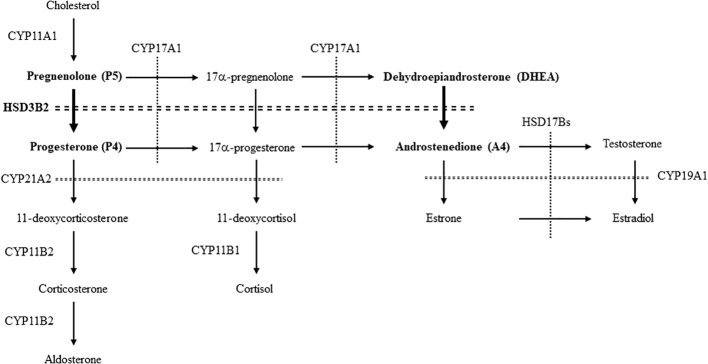
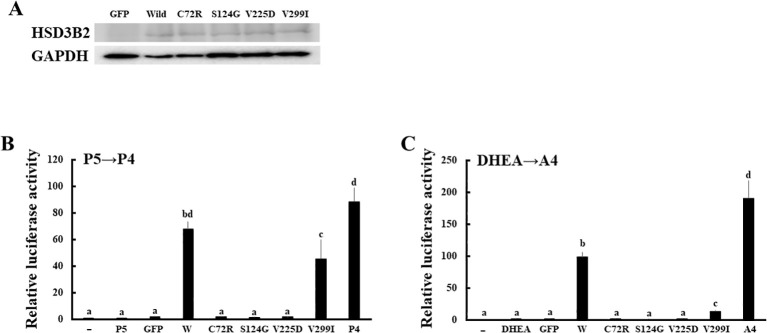
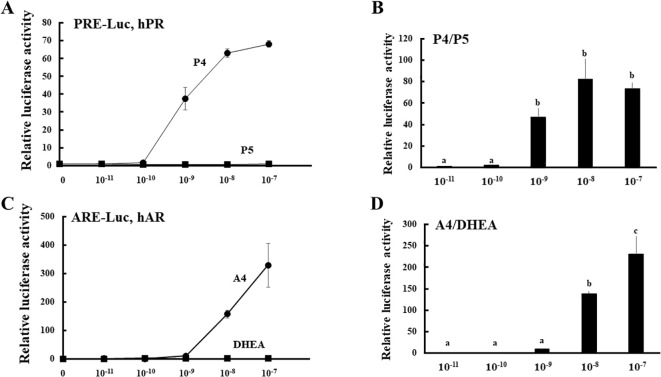
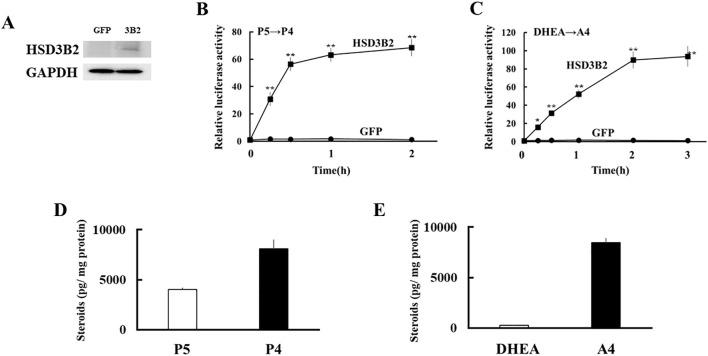
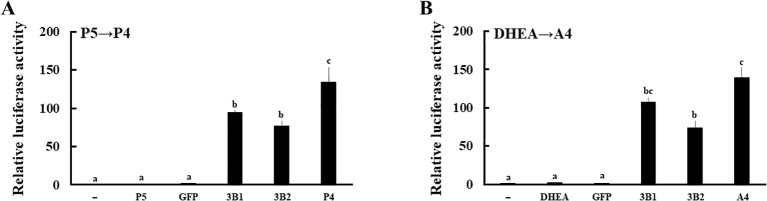
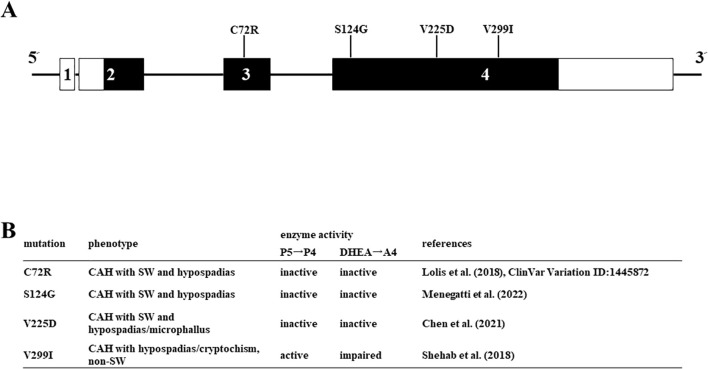
3β-Hydroxysteroid dehydrogenases (3β-HSDs) catalyze the oxidative conversion of delta (5)-ene-3-beta-hydroxy steroids and ketosteroids. Human 3β-HSD type 2 (HSD3B2) is predominantly expressed in gonadal and adrenal steroidogenic cells for producing all classes of active steroid hormones. Mutations in HSD3B2 gene cause a rare form of congenital adrenal hyperplasia with varying degree of salt wasting and incomplete masculinization, resulting from reduced production of corticoids and androgens. Therefore, evaluation of the HSD3B2 enzymatic activity in both pathways for each steroid hormone production is important for accurately understanding and diagnosing this disorder. Using progesterone receptor (PR)- and androgen receptor (AR)-mediated transactivation, we adapted a method that easily evaluates enzymatic activity of HSD3B2 by quantifying the conversion from substrates [pregnenolone (P5) and dehydroepiandrosterone (DHEA)] to (progesterone and androstenedione). HEK293 cells were transduced to express human HSD3B2, and incubated medium containing P5 or DHEA. Depending on the incubation time with HSD3B2-expressing cells, the culture media progressively increased luciferase activities in CV-1 cells, transfected with the PR/AR expression vector and progesterone-/androgen-responsive reporter. Culture media from human and other mammalian HSD3B1-expressing cells also increased the luciferase activities. HEK293 cells expressing various missense mutations in the HSD3B2 gene revealed the potential of this system to evaluate the relationship between the enzymatic activities of mutant proteins and patient phenotype.
3β-羟甾脱氢酶(3β-HSDs)催化 δ(5)-烯-3β-羟甾类和酮甾类的氧化转化。人 3β-HSD 型 2(HSD3B2)主要在性腺和肾上腺类固醇生成细胞中表达,用于产生所有类别的活性类固醇激素。HSD3B2 基因突变导致一种罕见的先天性肾上腺增生形式,具有不同程度的盐耗竭和不完全男性化,这是由于皮质激素和雄激素生成减少所致。因此,评估每个类固醇激素产生的两条途径中的 HSD3B2 酶活性对于准确理解和诊断这种疾病非常重要。我们使用孕激素受体(PR)和雄激素受体(AR)介导的反式激活,适应了一种方法,通过定量从底物(孕烯醇酮(P5)和脱氢表雄酮(DHEA))转化为(孕酮和雄烯二酮),轻松评估 HSD3B2 的酶活性。HEK293 细胞被转导以表达人 HSD3B2,并孵育含有 P5 或 DHEA 的培养基。根据与表达 HSD3B2 的细胞孵育的时间,CV-1 细胞中的荧光素酶活性逐渐增加,该细胞转染了 PR/AR 表达载体和孕酮/雄激素反应性报告基因。来自人源和其他哺乳动物 HSD3B1 表达细胞的培养基也增加了荧光素酶活性。表达 HSD3B2 基因突变的各种错义突变的 HEK293 细胞揭示了该系统评估突变蛋白的酶活性与患者表型之间关系的潜力。