• 文献检索
  • 文档翻译
  • 深度研究
  • 学术资讯
  • Suppr Zotero 插件Zotero 插件
  • 邀请有礼
  • 套餐&价格
  • 历史记录
应用&插件
Suppr Zotero 插件Zotero 插件浏览器插件Mac 客户端Windows 客户端微信小程序
定价
高级版会员购买积分包购买API积分包
服务
文献检索文档翻译深度研究API 文档MCP 服务
关于我们
关于 Suppr公司介绍联系我们用户协议隐私条款
关注我们

Suppr 超能文献

核心技术专利:CN118964589B侵权必究
粤ICP备2023148730 号-1Suppr @ 2026

文献检索

告别复杂PubMed语法,用中文像聊天一样搜索,搜遍4000万医学文献。AI智能推荐,让科研检索更轻松。

立即免费搜索

文件翻译

保留排版,准确专业,支持PDF/Word/PPT等文件格式,支持 12+语言互译。

免费翻译文档

深度研究

AI帮你快速写综述,25分钟生成高质量综述,智能提取关键信息,辅助科研写作。

立即免费体验

墨西哥恰帕斯州中央山谷基孔肯雅热疫情

Outbreak of Chikungunya Fever in the Central Valley of Chiapas, Mexico.

作者信息

Gonzalez-Perez Ana Luz, Vazquez Ana, de Ory Fernando, Negredo Anabel, Plante Kenneth S, Plante Jessica A, Palermo Pedro M, Watts Douglas, Sanchez-Seco Maria Paz, Weaver Scott C, Estrada-Franco Jose Guillermo

机构信息

Centro de Investigación y Estudios Avanzados en Salud Animal (CIESA), Universidad Autónoma del Estado de México, Toluca, México.

Laboratory of Arboviruses and Imported Viral Diseases, Centro Nacional de Microbiología, Instituto de Salud Carlos III, Majadahonda, Spain.

出版信息

medRxiv. 2024 Oct 11:2024.10.09.24314897. doi: 10.1101/2024.10.09.24314897.

DOI:10.1101/2024.10.09.24314897
PMID:39417119
原文链接:https://pmc.ncbi.nlm.nih.gov/articles/PMC11483022/
Abstract

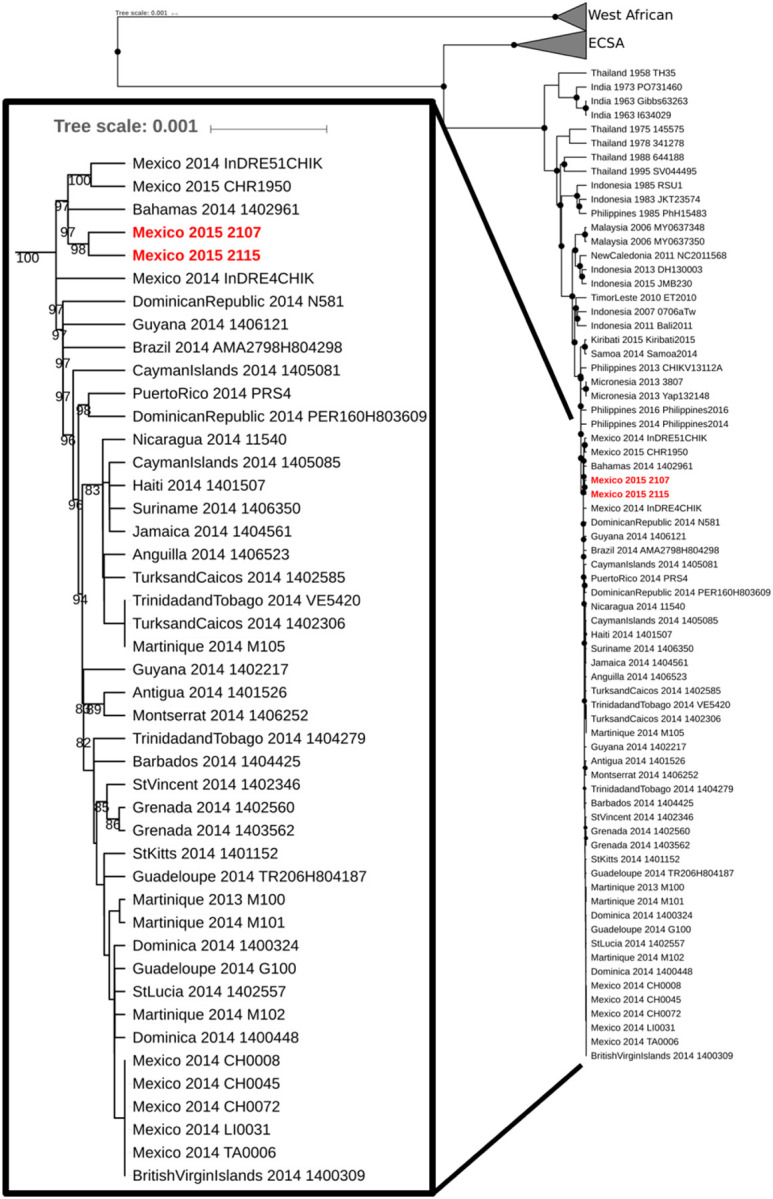
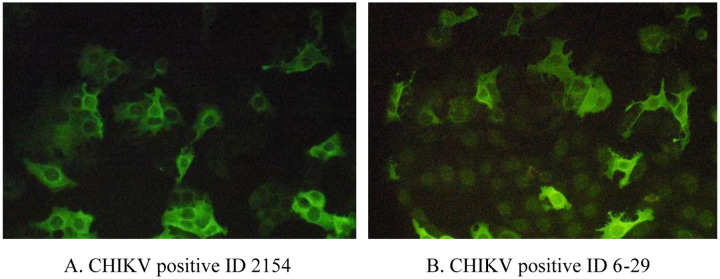
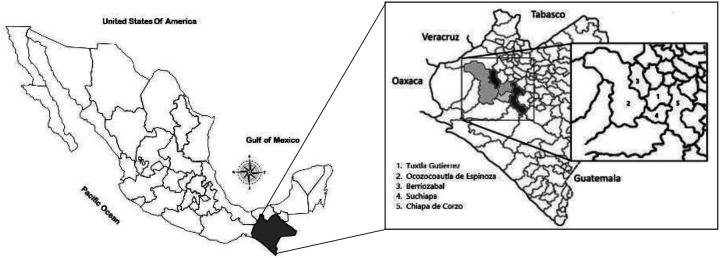
Chikungunya virus (CHIKV) was isolated from humans in an outbreak of a febrile illness during July and August 2015 in the central valleys of Chiapas, Mexico. Sera obtained from 80 patients were tested for CHIKV RNA by reverse transcriptase polymerase chain reaction (RT-PCR) and for IgM and IgG antibodies by an enzyme linked immunoassay and a commercial indirect immunofluorescence test for CHIKV and dengue virus (DENV). Of the 80 patients, 67 were positive, including 50 for RNA and 17 for IgM. In addition, one patient was coinfected with CHIKV-DENV and 40 patients were positive for IgG antibody to DENV. The clinical manifestations included a high fever, polyarthralgia, headache, myalgia, rash, digestive disorders, conjunctivitis, and adenopathy associated with cervical and axillary inguinal regions. Complete nucleotide sequences of two of the CHIKV isolates showed that they belonged to the Asian lineage but did not group with other Mexican CHIKV isolates from the Chiapas coast. Our findings documented that different Asian lineage strains of CHIKV were circulating simultaneously during the 2015 outbreak in the Central Valley of Chiapas, Mexico. The 2024 cases suggest an explosive scenario of re-emergence of thousands of new Chikungunya and dengue fever (DENF) cases associated with deaths, and a dangerous increase of the four DENV serotypes throughout the Americas, especially in South American countries that have shown a high influx of human migration to southern Mexico. In Mexico, the state of Chiapas and other southern regions are the most vulnerable.

摘要

2015年7月和8月,在墨西哥恰帕斯州中部山谷的一次发热性疾病暴发中,从人类身上分离出了基孔肯雅病毒(CHIKV)。通过逆转录聚合酶链反应(RT-PCR)对从80名患者身上采集的血清进行CHIKV RNA检测,并通过酶联免疫吸附测定以及针对CHIKV和登革热病毒(DENV)的商业间接免疫荧光试验检测IgM和IgG抗体。80名患者中,67名呈阳性,其中50名RNA阳性,17名IgM阳性。此外,1名患者同时感染了CHIKV-DENV,40名患者DENV IgG抗体呈阳性。临床表现包括高烧、多关节痛、头痛、肌痛、皮疹、消化系统紊乱、结膜炎以及与颈部和腋窝腹股沟区域相关的腺病。两份CHIKV分离株的完整核苷酸序列显示,它们属于亚洲谱系,但未与来自恰帕斯海岸的其他墨西哥CHIKV分离株归为一组。我们的研究结果表明,在2015年墨西哥恰帕斯州中部山谷的疫情暴发期间,不同的亚洲谱系CHIKV毒株同时在传播。2024例病例表明,出现了数千例与死亡相关的新基孔肯雅热和登革热病例再次暴发的爆炸性情况,并且在整个美洲,尤其是在显示有大量人口向墨西哥南部迁移的南美洲国家,四种DENV血清型出现了危险的增加。在墨西哥,恰帕斯州和其他南部地区最为脆弱。
https://cdn.ncbi.nlm.nih.gov/pmc/blobs/aa11/11483022/33ab608196c8/nihpp-2024.10.09.24314897v1-f0003.jpg
https://cdn.ncbi.nlm.nih.gov/pmc/blobs/aa11/11483022/b95d17b02963/nihpp-2024.10.09.24314897v1-f0001.jpg
https://cdn.ncbi.nlm.nih.gov/pmc/blobs/aa11/11483022/d228d4ca7e06/nihpp-2024.10.09.24314897v1-f0002.jpg
https://cdn.ncbi.nlm.nih.gov/pmc/blobs/aa11/11483022/33ab608196c8/nihpp-2024.10.09.24314897v1-f0003.jpg
https://cdn.ncbi.nlm.nih.gov/pmc/blobs/aa11/11483022/b95d17b02963/nihpp-2024.10.09.24314897v1-f0001.jpg
https://cdn.ncbi.nlm.nih.gov/pmc/blobs/aa11/11483022/d228d4ca7e06/nihpp-2024.10.09.24314897v1-f0002.jpg
https://cdn.ncbi.nlm.nih.gov/pmc/blobs/aa11/11483022/33ab608196c8/nihpp-2024.10.09.24314897v1-f0003.jpg

相似文献

1
Outbreak of Chikungunya Fever in the Central Valley of Chiapas, Mexico.墨西哥恰帕斯州中央山谷基孔肯雅热疫情
medRxiv. 2024 Oct 11:2024.10.09.24314897. doi: 10.1101/2024.10.09.24314897.
2
Competitive suppression of dengue virus replication occurs in chikungunya and dengue co-infected Mexican infants.在基孔肯雅热和登革热合并感染的墨西哥婴儿中,存在对登革病毒复制的竞争抑制作用。
Parasit Vectors. 2018 Jul 3;11(1):378. doi: 10.1186/s13071-018-2942-1.
3
Clinical characterization of acute and convalescent illness of confirmed chikungunya cases from Chiapas, S. Mexico: A cross sectional study.墨西哥恰帕斯州确诊基孔肯雅热病例急性和恢复期疾病的临床特征:一项横断面研究
PLoS One. 2017 Oct 24;12(10):e0186923. doi: 10.1371/journal.pone.0186923. eCollection 2017.
4
Co-circulation of the dengue with chikungunya virus during the 2013 outbreak in the southern part of Lao PDR.2013年老挝人民民主共和国南部疫情期间登革热与基孔肯雅病毒的共同传播。
Trop Med Health. 2016 Aug 4;44:24. doi: 10.1186/s41182-016-0020-y. eCollection 2016.
5
Genetic Variability of Chikungunya Virus in Southern Mexico.墨西哥南部地区的基孔肯雅热病毒遗传变异性。
Viruses. 2019 Aug 5;11(8):714. doi: 10.3390/v11080714.
6
Cross-Neutralizing Anti-Chikungunya and Anti-Dengue 2 IgG Antibodies from Patients and BALB/c Mice against Dengue and Chikungunya Viruses.抗基孔肯雅热和抗登革热 2 型 IgG 抗体的交叉中和作用,来自患者和 BALB/c 小鼠对登革热和基孔肯雅热病毒的反应。
Viruses. 2024 Jul 8;16(7):1098. doi: 10.3390/v16071098.
7
Evaluation of chikungunya virus infection in children from India during 2009-2010: A cross sectional observational study.评估 2009-2010 年印度儿童的基孔肯雅病毒感染:一项横断面观察性研究。
J Med Virol. 2016 Jun;88(6):923-30. doi: 10.1002/jmv.24433. Epub 2015 Dec 15.
8
Dengue and Chikungunya Virus Co-infections: The Inside Story.登革热与基孔肯雅病毒合并感染:内幕
J Assoc Physicians India. 2016 Mar;64(3):36-40.
9
Molecular Characterisation of Chikungunya Virus Infections in Trinidad and Comparison of Clinical and Laboratory Features with Dengue and Other Acute Febrile Cases.特立尼达基孔肯雅病毒感染的分子特征以及与登革热和其他急性发热病例的临床和实验室特征比较
PLoS Negl Trop Dis. 2015 Nov 18;9(11):e0004199. doi: 10.1371/journal.pntd.0004199. eCollection 2015 Nov.
10
Chikungunya Virus as Cause of Febrile Illness Outbreak, Chiapas, Mexico, 2014.2014年,基孔肯雅病毒引发墨西哥恰帕斯州发热疾病疫情
Emerg Infect Dis. 2015 Nov;21(11):2070-3. doi: 10.3201/eid2111.150546.