University of Leipzig Medical Center, Institute of Hygiene, Hospital Epidemiology and Environmental Health, Leipzig, Germany.
Leipzig University, Faculty of Medicine, Clinical Trial Centre (ZKS Leipzig), Leipzig, Germany.
Intensive Care Med. 2024 Dec;50(12):2073-2082. doi: 10.1007/s00134-024-07667-2. Epub 2024 Oct 17.
Antiseptic bathing has garnered attention in an effort to reduce hospital-acquired infections. Previous studies have shown the efficacy of antiseptic bathing in high-risk environments, such as intensive care units (ICUs), using chlorhexidine. In this study we aimed to evaluate the effectiveness of octenidine as a potential alternative due to its established popularity and widespread use in Europe.
We compared the rates of ICU-acquired primary bacteremia and ICU-acquired multidrug-resistant organisms (MDROs) in a multicenter, cluster-randomized, double-blind, placebo-controlled, cross-over study using octenidine-impregnated and placebo washcloths. On 44 ICUs in 23 hospitals throughout Germany, we compared individual ICUs with themselves over two 12-month time periods. All data were obtained digitally via hospital information systems as individual ward-movement data and microbiological test results; both endpoints were algorithmically derived.
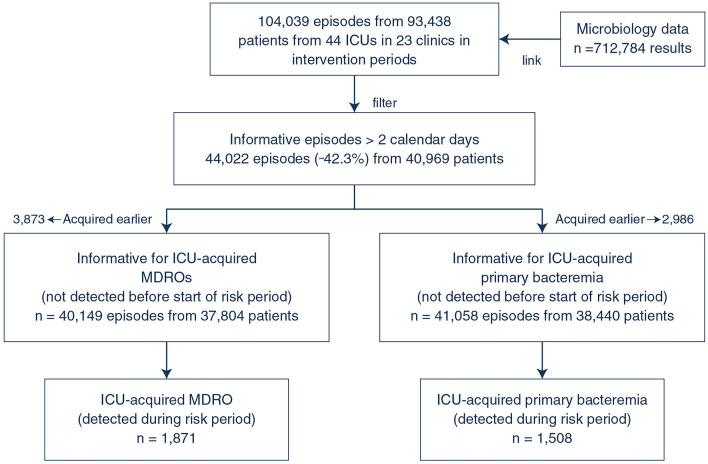
104,039 ICU episodes from 93,438 patients with 712,784 microbiological test results were analyzed, thereby detecting 1508 cases of ICU-acquired primary bacteremia and 1871 cases of ICU-acquired MDRO. Bathing with octenidine-impregnated washcloths prevented ICU-acquired primary bacteremia; a risk reduction of 17% was seen homogeneously across all participating ICUs (adjusted hazard ratio (HR) 0.83, 95% confidence interval (CI) [0.75; 0.92], p = 0.0003). This reduction affected predominantly coagulase-negative staphylococci (53%) and enterococci (17%). However, no intervention effect was seen for ICU-acquired MDROs (adjusted HR 0.98, 95% CI [0.83; 1.15]). Heterogeneity among intra-ICU intervention effects on MDRO acquisition was substantial.
Antiseptic bathing with octenidine may be effective in preventing ICU-acquired primary bacteremia, particularly due to Gram-positive bacteria and common skin commensals.
抗菌沐浴在降低医院获得性感染方面受到关注。先前的研究表明,在重症监护病房(ICU)等高风险环境中,使用洗必泰进行抗菌沐浴是有效的。在这项研究中,我们旨在评估奥替尼啶作为一种潜在替代品的有效性,因为它在欧洲已被广泛使用且广受欢迎。
我们在一项多中心、集群随机、双盲、安慰剂对照、交叉研究中比较了使用奥替尼啶浸渍和安慰剂毛巾擦拭的 ICU 获得性原发性菌血症和 ICU 获得性多药耐药菌(MDRO)的发生率。在德国 23 家医院的 44 个 ICU 中,我们比较了每个 ICU 在两个 12 个月时间段内自身的情况。所有数据均通过医院信息系统以单个病房移动数据和微生物学检测结果的形式获得;两个终点均通过算法得出。
分析了来自 93438 名患者的 104039 例 ICU 病例,共进行了 712784 次微生物学检测,从而检测到 1508 例 ICU 获得性原发性菌血症和 1871 例 ICU 获得性 MDRO。用奥替尼啶浸渍的毛巾擦拭可预防 ICU 获得性原发性菌血症;所有参与的 ICU 均观察到 17%的风险降低(调整后的危险比(HR)0.83,95%置信区间(CI)[0.75;0.92],p=0.0003)。这种降低主要影响凝固酶阴性葡萄球菌(53%)和肠球菌(17%)。然而,对于 ICU 获得性 MDRO 未观察到干预效果(调整后的 HR 0.98,95%CI[0.83;1.15])。MDRO 获得的 ICU 内干预效果的异质性很大。
奥替尼啶抗菌沐浴可能有效预防 ICU 获得性原发性菌血症,特别是由于革兰氏阳性菌和常见皮肤共生菌。