University of Michigan, Ann Arbor, MI, USA.
VA Ann Arbor Healthcare System, Ann Arbor, MI, USA.
BMC Health Serv Res. 2024 Oct 17;24(1):1254. doi: 10.1186/s12913-024-11520-z.
Type 2 diabetes (T2D) is one of the most prevalent chronic diseases worldwide and a leading cause of cardiorenal disease and mortality. Only one-third of individuals with T2D receive care as recommended by the American Diabetes Association's clinical practice guidelines. Effective strategies are needed to accelerate the implementation of guideline concordant T2D care.
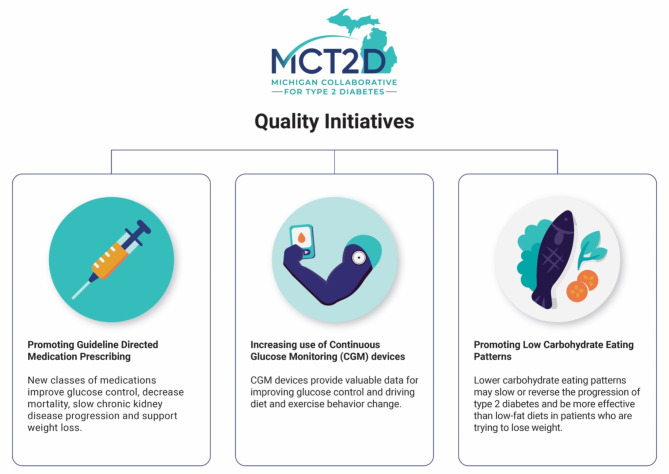
The Michigan Collaborative for Type 2 Diabetes (MCT2D) is a statewide population health collaborative quality initiative (CQI) developed to improve the care of all people with T2D in Michigan. MCT2D has developed a learning health system with physician organizations and their constituent practices to support quality improvement initiatives focused on (1) improving use of guideline-directed pharmacotherapy to improve cardiorenal outcomes, (2) increasing evidence-based use of continuous glucose monitoring, and (3) supporting use of lower carbohydrate eating patterns.
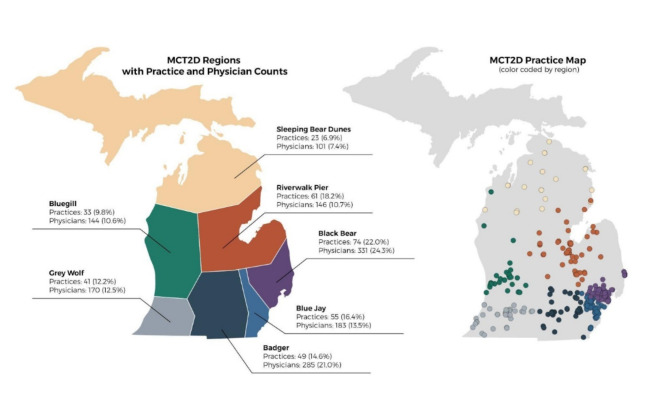
Between 2021 and 2022, MCT2D recruited 28 of the 40 Michigan-based physician organizations participating in Blue Cross' Physician Group Incentive Program with 336 constituent practices and 1357 physicians in primary care (304), endocrinology (21) and nephrology (11). In January 2022, baseline data included a sample of 96,140 unique individuals with T2D. The baseline HbA1c was ≤ 7.0% for 66.3% of patients (n = 32,787), while 14.9% of patients had a most recent HbA1c ≥ 8.0% (n = 7,393). The most recent body mass index (BMI) was ≥ 30.0 for 64.8% of patients (n = 38,516).
MCT2D has organized a statewide collaborative to recruit and engage a diverse and large set of physician organizations and their constituent practices. This is a promising opportunity to accelerate adoption of guideline-concordant care for people with T2D and may be a model for other state or regional collaboratives. Future directions include specific evidence-based interventions targeted at reducing diabetes-linked comorbidities and associated healthcare costs as well as strategies focused on T2D prevention among at-risk populations.
2 型糖尿病(T2D)是全球最常见的慢性病之一,也是导致心肾疾病和死亡的主要原因。只有三分之一的 T2D 患者接受了美国糖尿病协会临床实践指南推荐的治疗。需要采取有效的策略来加速实施符合指南的 T2D 治疗。
密歇根州 2 型糖尿病合作组织(MCT2D)是一个全州范围的人群健康合作质量倡议(CQI),旨在改善密歇根州所有 T2D 患者的治疗效果。MCT2D 已经建立了一个学习型健康系统,与医生组织及其下属医疗机构合作,支持以改善(1)指南指导药物治疗的使用以改善心肾结局,(2)增加基于证据的连续血糖监测的使用,(3)支持低碳水化合物饮食模式的使用为重点的质量改进计划。
在 2021 年至 2022 年期间,MCT2D 招募了参与 Blue Cross 医生团体激励计划的 40 个密歇根州医生组织中的 28 个,其中包括 336 个下属医疗机构和 1357 名初级保健医生(304 名)、内分泌医生(21 名)和肾病医生(11 名)。2022 年 1 月,基线数据包括一个有 96140 名 T2D 独特个体的样本。基线时,HbA1c <7.0%的患者占 66.3%(n=32787),而最近一次 HbA1c≥8.0%的患者占 14.9%(n=7393)。最近的体重指数(BMI)≥30.0 的患者占 64.8%(n=38516)。
MCT2D 已组织全州范围内的合作,招募并吸引了各种不同的医生组织及其下属医疗机构。这是一个加速采用符合指南的 T2D 治疗方法的有希望的机会,也可能成为其他州或地区合作的典范。未来的方向包括针对降低糖尿病相关并发症和相关医疗保健成本的具体循证干预措施,以及针对高危人群的 T2D 预防策略。