García-Salirrosas Elizabeth Emperatriz, Escobar-Farfán Manuel, Esponda-Perez Jorge Alberto, Millones-Liza Dany Yudet, Villar-Guevara Miluska, Haro-Zea Karla Liliana, Gallardo-Canales Rodrigo
Grupo de Investigación e Innovación para el Emprendimiento y Sostenibilidad, Universidad Nacional Tecnológica de Lima Sur, Lima, Peru.
Department of Administration, Faculty of Administration and Economics, University of Santiago of Chile, Santiago, Chile.
Front Nutr. 2024 Oct 3;11:1482009. doi: 10.3389/fnut.2024.1482009. eCollection 2024.
Food brands that promote a healthy lifestyle are gaining more followers. Healthy food consumers are a conscious and demanding segment that values the quality and benefits they receive from a product and the ethical, environmental, and social impact of their purchasing decisions. The objective of the research is to evaluate the influence of perceived value components on health food brand image and brand loyalty in an emerging market.
A cross-sectional and explanatory study was conducted considering 612 consumers of a healthy brand in Peru. The participants included women (65.2%) and men (34.8%), with ages between 18 and 56 (M = 22.56; SD = 5.95). Data were collected using a self-report form and statistically analyzed using PLS-SEM.
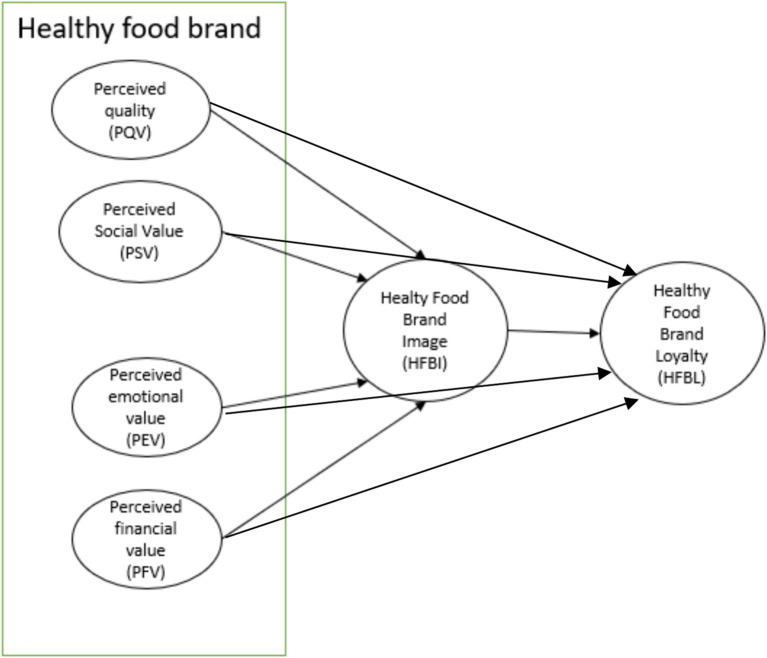
The study hypotheses confirmed the impact of perceived emotional value, perceived social value, perceived financial value, and perceived quality on brand image and loyalty. However, the proposed model observes that perceived social value has no impact on brand loyalty.
Implementing strategies that help build stronger, healthy brands is part of effective management for business leaders. In this context, the findings indicate that brands should effectively communicate their attributes and offer them that meet and exceed consumer expectations to achieve consumer loyalty. This is a mechanism to consolidate a strong and positive image that facilitates customer loyalty based on perceived value. The results obtained can help marketers and decision-makers in the healthy food industry to design more effective brand strategies, which could increase demand for their healthy products.
推广健康生活方式的食品品牌正赢得越来越多的追随者。健康食品消费者是一个有觉悟且要求苛刻的群体,他们重视从产品中获得的质量和益处,以及购买决策对道德、环境和社会的影响。本研究的目的是评估新兴市场中感知价值成分对健康食品品牌形象和品牌忠诚度的影响。
对秘鲁一个健康品牌的612名消费者进行了横断面解释性研究。参与者包括女性(65.2%)和男性(34.8%),年龄在18至56岁之间(M = 22.56;SD = 5.95)。数据通过自我报告表格收集,并使用PLS-SEM进行统计分析。
研究假设证实了感知情感价值、感知社会价值、感知财务价值和感知质量对品牌形象和忠诚度的影响。然而,所提出的模型观察到感知社会价值对品牌忠诚度没有影响。
实施有助于打造更强大、健康品牌的策略是企业领导者有效管理的一部分。在此背景下,研究结果表明,品牌应有效传达其属性,并提供符合且超越消费者期望的产品,以实现消费者忠诚度。这是巩固基于感知价值的强大且积极形象、促进客户忠诚度的一种机制。所获得的结果可帮助健康食品行业的营销人员和决策者设计更有效的品牌策略,从而可能增加对其健康产品的需求。