Yi Lin, Khan Muhammad Saqib, Safeer Asif Ali
School of Physical Education, Huazhong University of Science and Technology, Wuhan, China.
School of Management, Huazhong University of Science and Technology, Wuhan, China.
Front Psychol. 2022 Jul 25;13:942048. doi: 10.3389/fpsyg.2022.942048. eCollection 2022.
In recent years, technological advancements have increased the importance of innovation activities. Therefore, firms invest millions of dollars in innovation activities to ensure long-term business sustainability. Similarly, consumer concerns have increased dramatically over the past years. Thus, brand loyalty has become a top priority for firms and consumers. In this background, this research examines how firms' innovation activities translate into consumer brand loyalty to assure business sustainability in Asian markets, particularly China, Pakistan, and Indonesia.
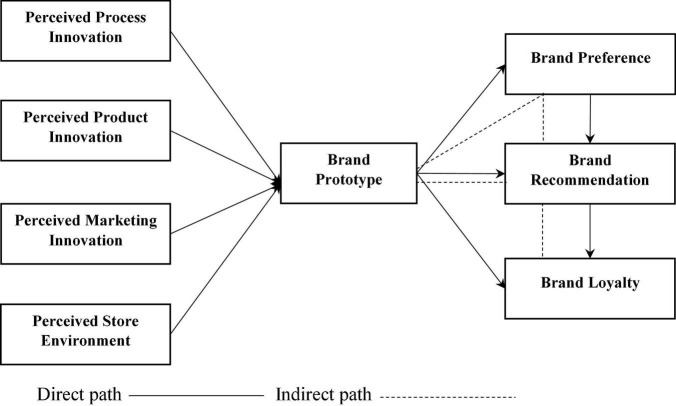
This study's specific objectives are to comprehend the concept of firms' innovation activities and their effect on the brand prototype. Examine the effect of the brand prototype on global brand preference, recommendation, and loyalty among Asian consumers. Find out the impact of brand preference on brand recommendations and the influence of brand recommendations on brand loyalty among Asian consumers.
A total of 814 consumers from Asian countries (China, Pakistan, and Indonesia) participated in this study, and structural equation modeling was used to analyze the data.
The findings indicate that firms' innovation activities, such as processes, products, and store environment, positively influenced the brand prototype, thereby increasing consumer brand knowledge. Likewise, brand prototype contributes to developing brand preference, brand recommendation, and brand loyalty among Asian consumers. Lastly, consumer brand preference significantly influenced brand recommendation, which positively improves consumer brand loyalty in Asia.
This study concluded that Asian (Chinese, Pakistani, and Indonesian) consumers have favorable perceptions of firms' innovation activities (i.e., process, product, and store environment innovation), which influences their ability to develop brand prototypes to increase consumer brand knowledge. Similarly, brand prototype fosters brand preference, recommendation, and loyalty. Likewise, favorable brand preference encourages consumers to recommend the brand to others, strengthening brand loyalty. Thus, firms should invest in innovation activities to strengthen consumer brand loyalty in Asian markets. Consequently, this study may assist multinational corporations in increasing their business volumes and market shares in Asia.
This study provides important managerial recommendations. The findings revealed that global managers can develop and implement several branding strategies for sustaining their businesses in the Asian environment.
近年来,技术进步提升了创新活动的重要性。因此,企业投入数百万美元开展创新活动,以确保长期的业务可持续性。同样,在过去几年里,消费者的关注度急剧上升。因此,品牌忠诚度已成为企业和消费者的首要任务。在此背景下,本研究考察企业的创新活动如何转化为消费者的品牌忠诚度,以确保亚洲市场,特别是中国、巴基斯坦和印度尼西亚的业务可持续性。
本研究的具体目标是理解企业创新活动的概念及其对品牌原型的影响。考察品牌原型对亚洲消费者全球品牌偏好、推荐和忠诚度的影响。找出品牌偏好对品牌推荐的影响以及品牌推荐对亚洲消费者品牌忠诚度的影响。
共有来自亚洲国家(中国、巴基斯坦和印度尼西亚)的814名消费者参与了本研究,并采用结构方程模型对数据进行分析。
研究结果表明,企业的创新活动,如流程、产品和店铺环境,对品牌原型有积极影响,从而增加了消费者的品牌知识。同样,品牌原型有助于在亚洲消费者中培养品牌偏好、品牌推荐和品牌忠诚度。最后,消费者的品牌偏好对品牌推荐有显著影响,这对提升亚洲消费者的品牌忠诚度有积极作用。
本研究得出结论,亚洲(中国、巴基斯坦和印度尼西亚)消费者对企业的创新活动(即流程、产品和店铺环境创新)有良好的认知,这影响了他们开发品牌原型以增加消费者品牌知识的能力。同样,品牌原型促进了品牌偏好、推荐和忠诚度。同样,良好的品牌偏好会鼓励消费者向他人推荐该品牌,从而加强品牌忠诚度。因此,企业应投资于创新活动,以增强亚洲市场消费者的品牌忠诚度。因此,本研究可能有助于跨国公司在亚洲增加业务量和市场份额。
本研究提供了重要的管理建议。研究结果表明,全球管理者可以制定和实施多种品牌战略,以在亚洲环境中维持其业务。