Wang Lili, Wang Shan, Dai Xuan, Yue Gaiyue, Yin Jiyuan, Xu Tianshu, Shi Hanfen, Liu Tianyuan, Jia Zhanhong, Brömme Dieter, Zhang Shuofeng, Zhang Dongwei
Department of TCM Pharmacology, Chinese Material Medica School, Beijing University of Chinese Medicine, Beijing, China.
Diabetes Research Center, School of Traditional Chinese Medicine, Beijing University of Chinese Medicine, Beijing, China.
Front Pharmacol. 2024 Oct 3;15:1483431. doi: 10.3389/fphar.2024.1483431. eCollection 2024.
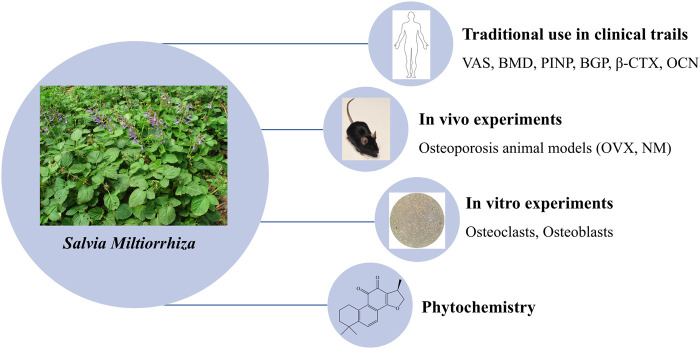
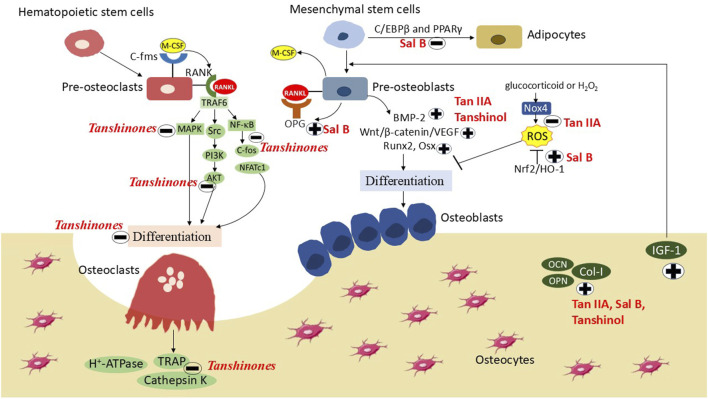
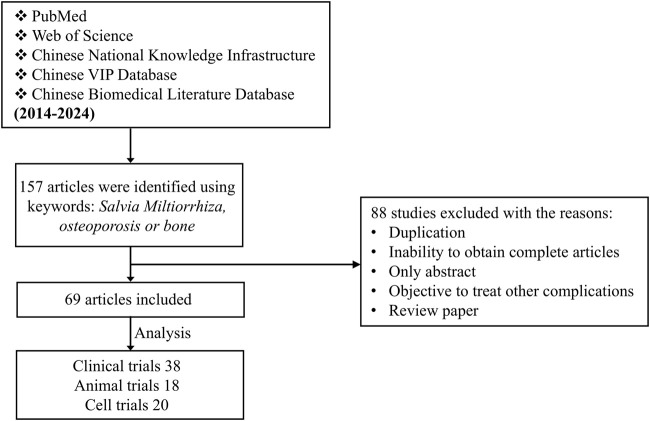
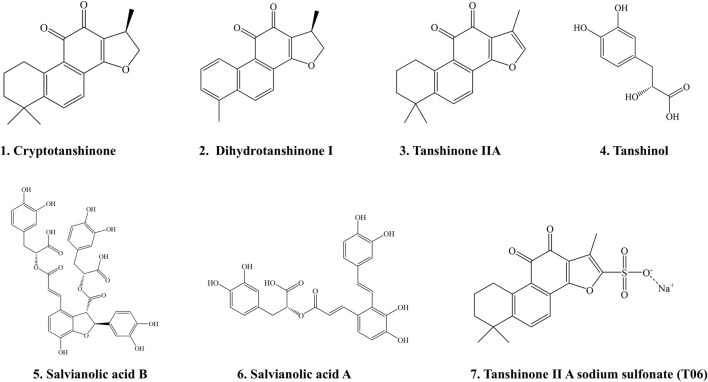
Osteoporosis becomes a global public health concern due to its rising prevalence and substantial impact on life quality. Salvia miltiorrhiza Bunge (Salviae Miltiorrhizae Radix et Rhizoma, SM) has been firstly recorded in Shen Nong's Herbal Classic, and is frequently prescribed in conjunction with other herbs for the management of osteoporosis. This systematic review aims to comprehensively analyze the recent advances of SM on osteoporosis in traditional Chinese clinical uses and preclinical investigations. Literature encompassing pertinent studies were systematically retrieved across multiple databases, including the PubMed, Web of Science, Chinese National Knowledge Infrastructure, Chinese VIP Database, and Chinese Biomedical Literature Database. Original investigations spanning from February 2014 to March 2024, including traditional Chinese medicine (TCM) clinical trials and preclinical studies, were employed to analyze the effects and actions of SM on osteoporosis. Thirty-eight TCM clinical trials were identified to employ SM in combination with other herbs for the management of primary and secondary osteoporosis. The overall efficacy was between 77% and 96.67%. Forty preclinical studies were identified to investigate the effects and actions of SM and/or its ingredients on osteoporosis. The anti-osteoporosis actions of this herb may be attributed to inhibit osteoclastogenesis/bone resorption and promote osteoblastogenesis/osteogenesis. The ethanol extracts and its ingredients (tanshinones) inhibit osteoclastogenesis/bone resorption by inhibiting the MAPK/NF-κB/NFATc1 signaling pathway and cathepsin K-induced collagen degradation. Both ethanol extracts (tanshinones) and water extracts (Sal B and tanshinol) contribute to osteoblastogenesis by promoting osteogenesis and angiogenesis via activation of the Wnt/β-catenin/VEGF and ERK/TAZ pathways, and eliminating ROS production targeting Nrf2/ARE/HO-1 pathway. In conclusions, SM may offer a novel strategy for osteoporosis management. Well-designed clinical trials are still needed to evaluate the actions of this herb and its ingredients on bone remodeling.
由于骨质疏松症患病率不断上升且对生活质量有重大影响,它已成为全球公共卫生问题。丹参最早记载于《神农本草经》,常与其他草药联合用于治疗骨质疏松症。本系统评价旨在全面分析丹参在中医临床应用和临床前研究中治疗骨质疏松症的最新进展。通过多个数据库系统检索相关文献,包括PubMed、Web of Science、中国知网、维普数据库和中国生物医学文献数据库。采用2014年2月至2024年3月期间的原始研究,包括中医临床试验和临床前研究,分析丹参对骨质疏松症的作用和效果。共纳入38项中医临床试验,这些试验使用丹参联合其他草药治疗原发性和继发性骨质疏松症。总有效率在77%至96.67%之间。共纳入40项临床前研究,研究丹参及其成分对骨质疏松症的作用和效果。该草药的抗骨质疏松作用可能归因于抑制破骨细胞生成/骨吸收以及促进成骨细胞生成/骨形成。乙醇提取物及其成分(丹参酮)通过抑制MAPK/NF-κB/NFATc1信号通路和组织蛋白酶K诱导的胶原蛋白降解来抑制破骨细胞生成/骨吸收。乙醇提取物(丹参酮)和水提取物(丹酚酸B和丹参素)均通过激活Wnt/β-连环蛋白/VEGF和ERK/TAZ通路促进骨生成和血管生成,并通过靶向Nrf2/ARE/HO-1通路消除活性氧生成,从而促进成骨细胞生成。总之,丹参可能为骨质疏松症的治疗提供一种新策略。仍需要设计良好的临床试验来评估该草药及其成分对骨重塑的作用。