Division of Pulmonary and Critical Care Medicine, David Geffen School of Medicine at the University of California, Los Angeles.
Center for the Study of Healthcare Innovation, Implementation, and Policy, Health Services Research, Greater Los Angeles Veterans Affairs Healthcare System, Los Angeles, California.
JAMA Health Forum. 2024 Oct 4;5(10):e243509. doi: 10.1001/jamahealthforum.2024.3509.
The COVID-19 pandemic prompted rapid development of scarce resource allocation policies (SRAPs) in case demand for critical health services eclipsed capacity.
To test whether a brief educational video could improve knowledge of how the University of California Health's SRAP would be implemented and trust in health systems to implement such policies in accordance with ethical principles during the pandemic.
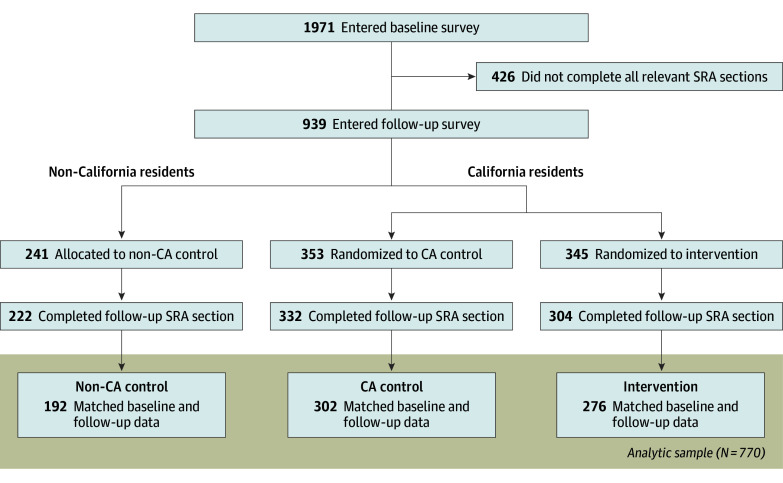
DESIGN, SETTING, AND PARTICIPANTS: This randomized clinical trial used an educational video intervention embedded in a longitudinal web-based survey and was conducted between May and December 2020 and analyzed during March 2024. A total of 1971 adult participants were enrolled, of whom 939 completed follow-up; participants with matched baseline and follow-up responses were analyzed. California residents were randomized to view the intervention (n = 345) or not (n = 353) and stratified by age, sex, education, racial identity, and self-reported health care worker status. Non-California residents were allocated to the control group (n = 241).
A brief (6-minute) "explainer" video that provided an overview of mechanics and ethical principles underpinning the University of California Health SRAP, subtitled in 6 languages.
Self-reported survey assessment of knowledge of components of SRAP, graded as correct vs incorrect, and trust graded on a 10-point Likert scale. Anxiety about such policies was graded on a 10-point Likert scale with an a priori noninferiority margin of half of a standard deviation. Participants answered items at baseline and follow-up (approximately 10 weeks after baseline), with randomization occurring between administrations.
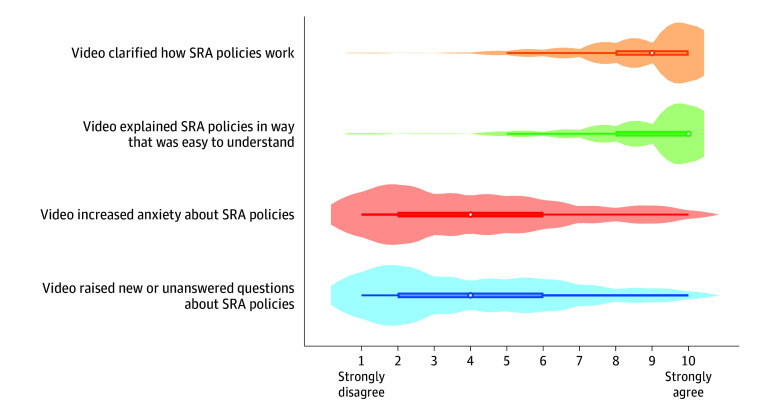
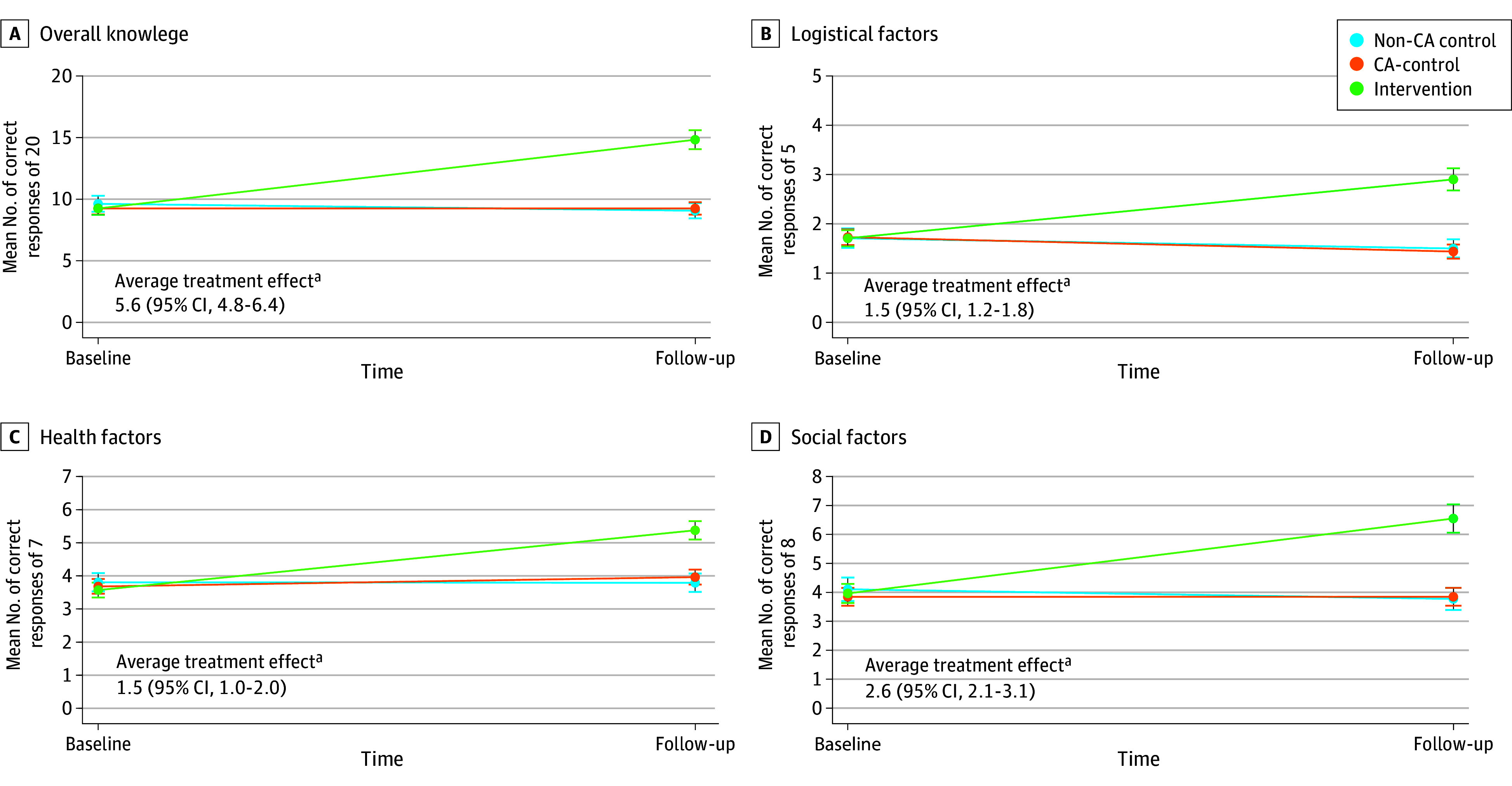
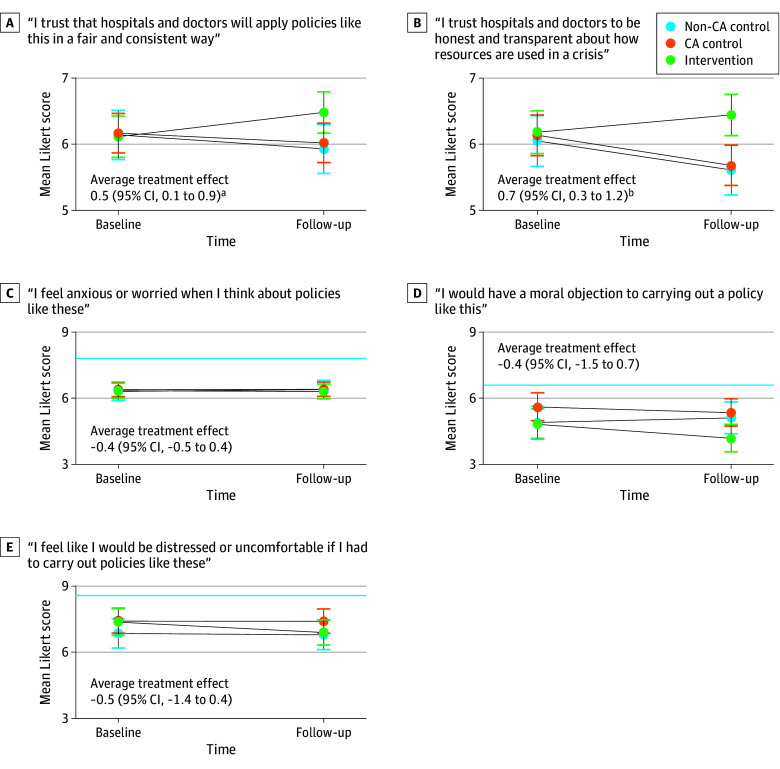
Of 770 randomized participants with responses at both points, 566 (73.5%) were female, and the median (IQR) age was 43.5 (36-57) years. Intervention participants demonstrated improvement of 5.6 (95% CI, 4.8-6.4; P < .001) more correct knowledge items of 20 vs controls, as well as significant improvements in reported trust in fairness/consistency and honesty/transparency about SRAP implementation. There was no significant change in reported anxiety surrounding SRAP in either treatment or control groups.
The trial found that a brief educational video is sufficient to explain complex ethical tenets and mechanics of SRAP and improved knowledge of such policies and trust in health systems to implement them equitably while not exacerbating anxiety about potential policy implications. This informs practice by providing a framework for educating people about the use of these policies during future situations necessitating crisis standards of care.
ClinicalTrials.gov Identifier: NCT04373135.
新冠疫情促使快速制定稀缺资源分配政策(SRAP),以防关键卫生服务的需求超过能力。
测试一段简短的教育视频是否可以提高对加州大学卫生系统的 SRAP 将如何实施的了解,并在大流行期间信任卫生系统能够按照伦理原则实施此类政策。
设计、设置和参与者:这是一项随机临床试验,采用嵌入纵向网络调查的教育视频干预措施,于 2020 年 5 月至 12 月进行,并于 2024 年 3 月进行分析。共有 1971 名成年参与者入组,其中 939 名完成了随访;对具有匹配基线和随访反应的参与者进行了分析。加利福尼亚州的居民被随机分配观看干预组(n=345)或不观看(n=353),并按年龄、性别、教育程度、种族身份和自我报告的医疗保健工作者身份进行分层。非加利福尼亚州的居民被分配到对照组(n=241)。
一段简短的(6 分钟)“解释”视频,提供了对加州大学卫生 SRAP 的机制和伦理原则的概述,配有 6 种语言的字幕。
自我报告的调查评估对 SRAP 组成部分的知识,评分正确与错误,以及信任程度在 10 点李克特量表上评分。对这些政策的焦虑程度在 10 点李克特量表上评分,预先设定的非劣效性边界为半标准差。参与者在基线和随访时(大约在基线后 10 周)回答问题,随机分配在两次管理之间进行。
在 770 名具有两个时间点反应的随机参与者中,566 名(73.5%)为女性,中位数(IQR)年龄为 43.5(36-57)岁。干预组在 20 项正确知识项目中比对照组多答对 5.6 项(95%CI,4.8-6.4;P<.001),并且在公平/一致性和实施 SRAP 的诚实/透明度方面的信任报告也有显著改善。在治疗组或对照组中,对 SRAP 周围焦虑的报告均未发生显著变化。
该试验发现,一段简短的教育视频足以解释复杂的伦理原则和 SRAP 的机制,并提高对这些政策的了解和对卫生系统公平实施这些政策的信任,同时不会加剧对潜在政策影响的担忧。这为在未来需要危机护理标准的情况下,为人们提供了一个关于使用这些政策的教育框架,从而为实践提供了信息。
ClinicalTrials.gov 标识符:NCT04373135。