Buhr Russell G, Huynh Ashley, Lee Connie, Nair Vishnu P, Romero Ruby, Wisk Lauren E
Division of Pulmonary and Critical Care Medicine, David Geffen School of Medicine at the University of California, Los Angeles.
Center for the Study of Healthcare Innovation, Implementation, and Policy, Health Services Research and Development, Greater Los Angeles Veterans Affairs Healthcare System, Los Angeles, California.
JAMA Netw Open. 2024 Mar 4;7(3):e241958. doi: 10.1001/jamanetworkopen.2024.1958.
COVID-19 prompted rapid development of scarce resource allocation (SRA) policies to be implemented if demand eclipsed health systems' ability to provide critical care. While SRA policies follow general ethical frameworks, understanding priorities of those affected by policies and/or tasked with implementing them is critical.
To evaluate whether community members and health care profesionals (HCP) agree with SRA protocols at the University of California (UC).
DESIGN, SETTING, AND PARTICIPANTS: This survey study used social media and community-partnered engagement to recruit participants to a web-based survey open to all participants aged older than 18 years who wished to enroll. This study was fielded between May and September 2020 and queried participants' values and preferences on draft SRA policy tenets. Participants were also encouraged to forward the survey to their networks for snowball sampling. Data were analyzed from July 2020 to January 2024.
Survey items assessed values and preferences, graded on Likert scales. Agreement was tabulated as difference in Likert points between expressed opinion and policy tenets. Descriptive statistics were tested for significance by HCP status. Free text responses were analyzed using applied rapid qualitative analysis.
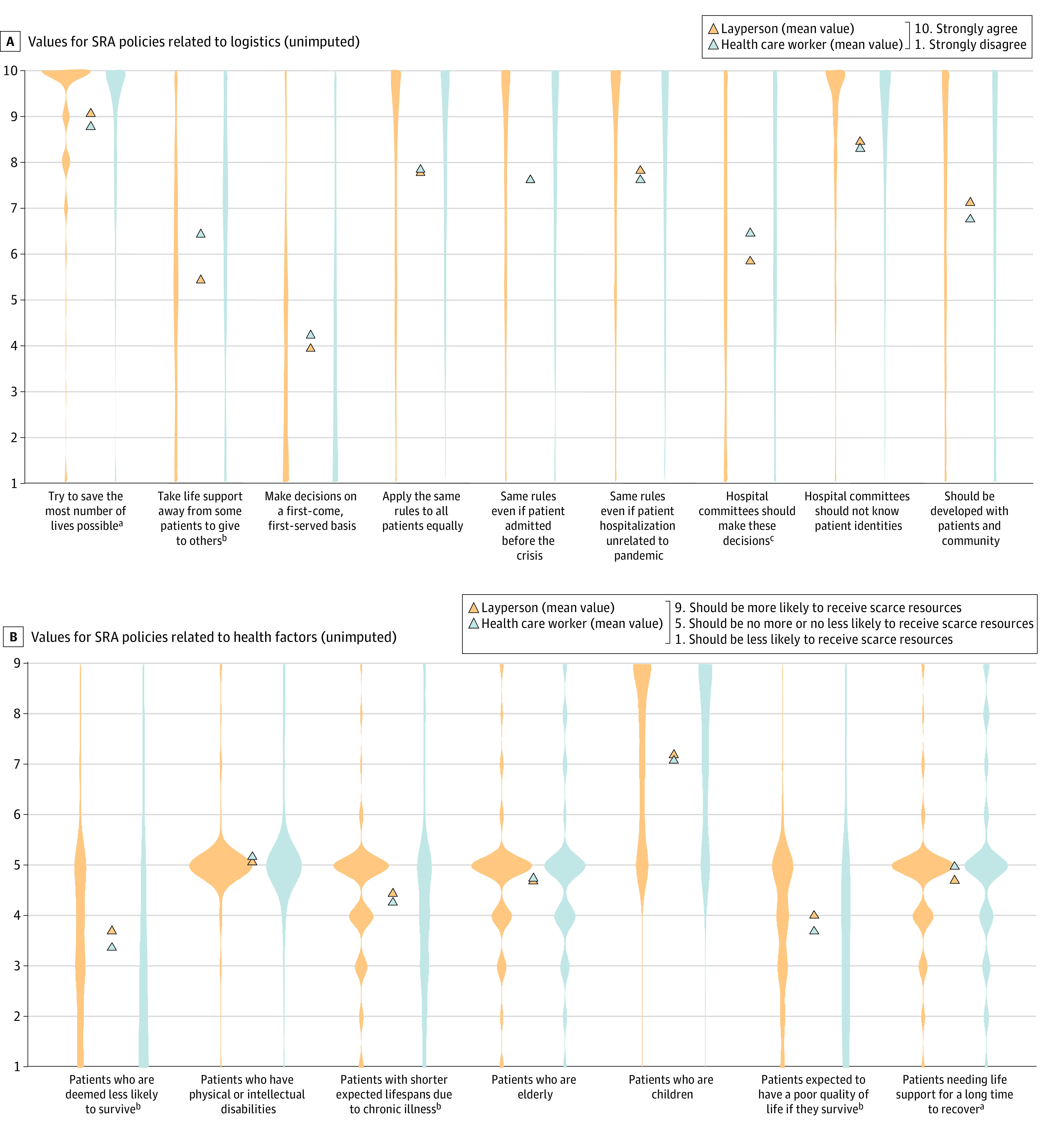
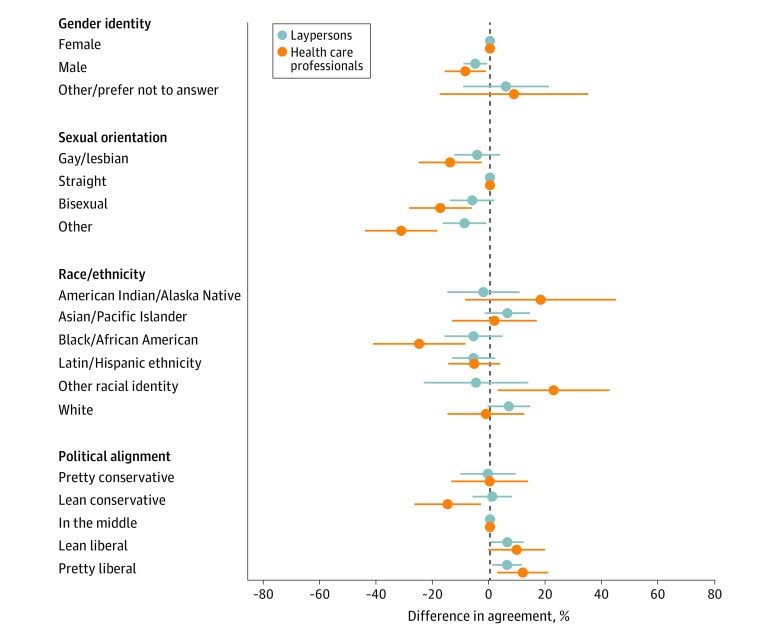
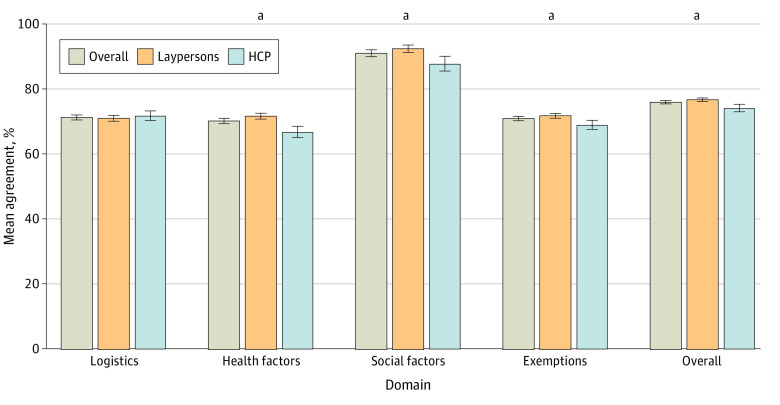
A total of 1545 participants aged older than 18 years (mean [SD] age 49 [16] years; 1149 female participants [74%], 478 health care practitioners [30%]) provided data on SRA values and preferences. Agreement with UC SRA policy as drafted was moderately high among respondents, ranging from 67% to 83% across domains. Higher agreement with the interim policy was observed for laypersons across all domains except health-related factors. HCPs agreed more strongly on average that resources should not be allocated to those less likely to survive (HCP mean, 3.70; 95% CI, 3.16-3.59; vs layperson mean, 3.38; 95% CI, 3.17-3.59; P = .002), and were more in favor of reallocating life support from patients less likely to those more likely to survive (HCP mean, 6.41; 95% CI, 6.15-6.67; vs layperson mean, 5.40; 95% CI, 5.23-5.58; P < .001). Transparency and trust building themes were common in free text responses and highly rated on scaled items.
This survey of SRA policy values found moderate agreement with fundamental principles of such policies. Engagement with communities affected by SRA policy should continue in iterative refinement in preparation for future crises.
如果需求超过卫生系统提供重症护理的能力,新冠疫情促使稀缺资源分配(SRA)政策迅速制定并实施。虽然SRA政策遵循一般的伦理框架,但了解受政策影响者和/或负责实施政策者的优先事项至关重要。
评估社区成员和医疗保健专业人员(HCP)是否同意加利福尼亚大学(UC)的SRA方案。
设计、背景和参与者:这项调查研究利用社交媒体和社区合作参与,招募18岁以上希望参与的所有参与者进行基于网络的调查。本研究于2020年5月至9月进行,询问参与者对SRA政策原则草案的价值观和偏好。还鼓励参与者将调查转发给他们的社交网络以进行滚雪球抽样。数据于2020年7月至2024年1月进行分析。
调查项目评估价值观和偏好,采用李克特量表评分。将同意程度列为表达意见与政策原则之间李克特分数的差异。描述性统计通过HCP状态检验显著性。使用应用快速定性分析对自由文本回复进行分析。
共有1545名18岁以上的参与者(平均[标准差]年龄49[16]岁;1149名女性参与者[74%],478名医疗保健从业者[30%])提供了有关SRA价值观和偏好的数据。受访者对UC起草的SRA政策的同意程度中等偏高,各领域的同意率在67%至83%之间。除健康相关因素外,所有领域的外行人对临时政策的同意率更高。HCP平均更强烈地同意资源不应分配给生存可能性较小的人(HCP平均值,3.70;95%置信区间,3.16 - 3.59;外行人平均值,3.38;95%置信区间,3.17 - 3.59;P = 0.002),并且更倾向于将生命支持从生存可能性较小的患者重新分配给生存可能性较大的患者(HCP平均值,6.41;95%置信区间,6.15 - 6.67;外行人平均值,5.40;95%置信区间,5.23 - 5.58;P < 0.001)。透明度和建立信任的主题在自由文本回复中很常见,并且在量表项目上得分很高。
这项对SRA政策价值观的调查发现,对这些政策的基本原则有中等程度的认同。应继续与受SRA政策影响的社区进行互动,反复完善,为未来的危机做好准备。